
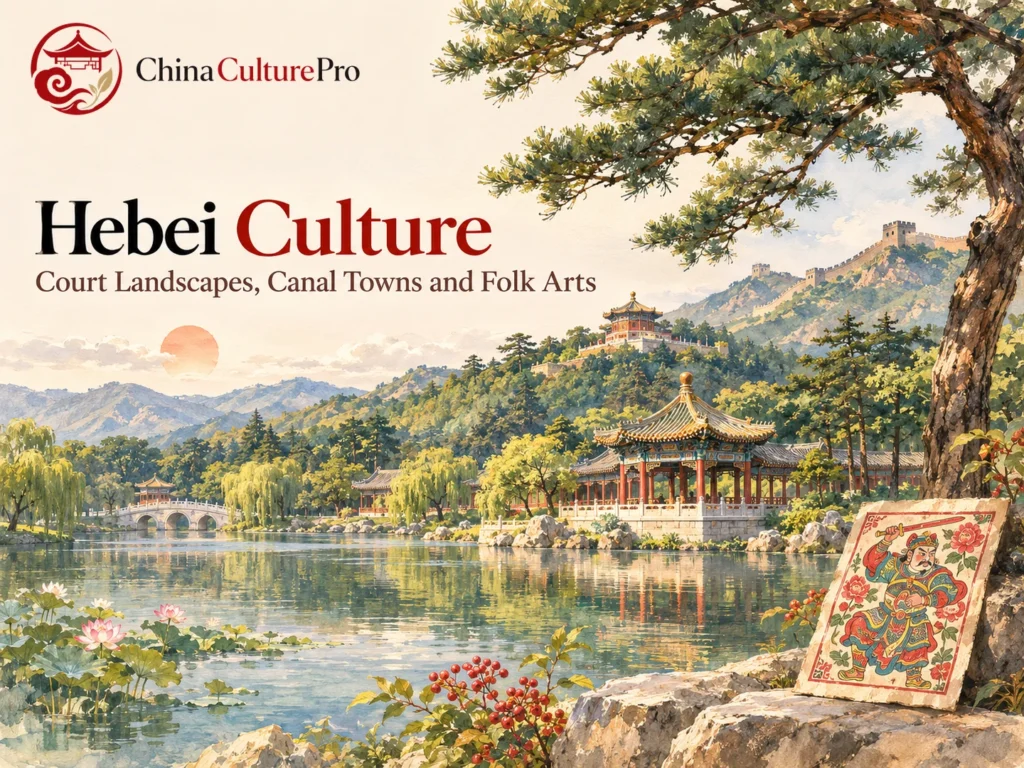

Quick Answer: What Defines Hebei Culture?
Hebei culture encompasses the Qing court landscape at Chengde, Grand Canal communities across the North China Plain, and local traditions of performance and printmaking. The historical name Yanzhao (燕赵, Yān-Zhào) recalls the states of Yan and Zhao. The places where people maintain these traditions give a clearer picture of the province today.[1][2][3][4][5][6]
- Court landscape: Chengde’s Mountain Resort and temples preserve a Qing imperial environment designed around hills and water.[2]
- Canal corridor: Historic water routes cross the plain around Cangzhou, the municipality that includes Wuqiao (吴桥, Wúqiáo), a center for acrobatics.[3][4]
- Local arts: Wuqiang (武强, Wǔqiáng) is known for woodblock New Year prints, while eastern Hebei helped shape Pingju opera (评剧, Píngjù).[5][6]
The old regional name, the imperial complex and the living art forms belong to different periods and settings.
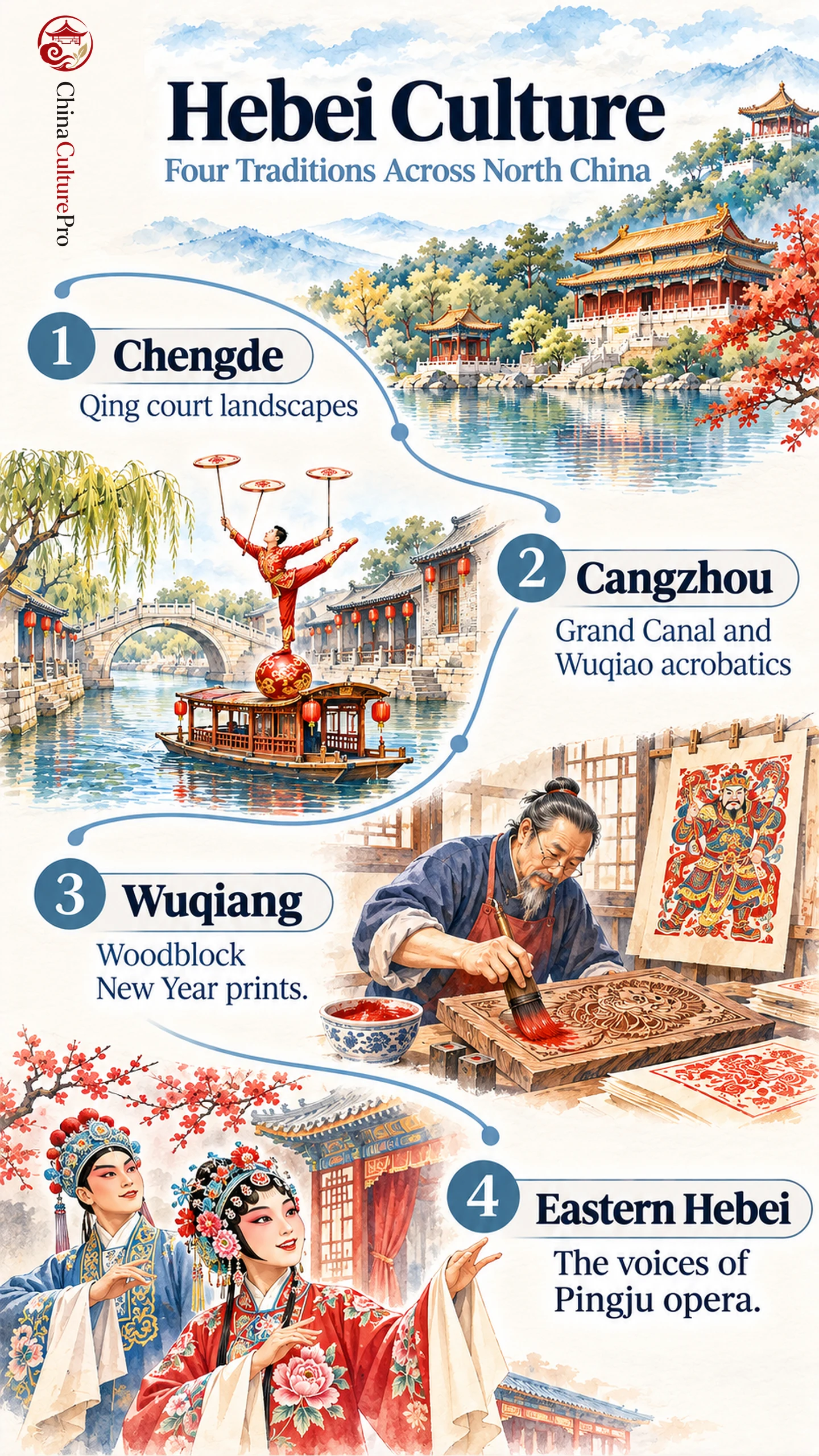
A temple at Chengde, a set of printed door gods and a vernacular opera scene each preserve part of Hebei’s story. Their locations help explain the different audiences they were made for.
A Regional Guide to Hebei Culture
| Место | Tradition or heritage | На что обратить внимание |
|---|---|---|
| Chengde | Qing Mountain Resort and outlying temples | Architecture fitted to lakes and hills.[2] |
| Cangzhou and Wuqiao | Grand Canal and acrobatics | Water transport heritage and a distinct training tradition.[3][4] |
| Wuqiang County | Woodblock New Year prints | Bold designs made to be printed and displayed for the season.[5] |
| Eastern Hebei | Pingju opera | A regional performance tradition with vernacular dialogue and singing.[6] |
From the Name Yanzhao to the Qing Court at Chengde
Yan and Zhao were states of the Eastern Zhou era. Both had territory in parts of today’s Hebei. The name Yanzhao pairs their names and survives as an informal label for the province. Those states had their own political borders, and the modern map came much later.[1]
Chengde presents a different historical layer. Qing emperors established the Mountain Resort as a summer residence. Its gardens and surviving outlying temples bring together landscape design, imperial building and several architectural traditions. Scenes of court life there belong in the wider history of the Qing dynasty.[2]
Canal Communities and Wuqiao Acrobatics
Hebei’s plain connects to the Grand Canal system, which linked settlements by water. UNESCO’s inventory identifies canal segments in Hebei, including the corridor through Cangzhou. The northern waterway reaches Tianjin, where river and port traffic helped form another urban culture.[3]
Wuqiao County, administered by Cangzhou, has a specialized practice of Chinese acrobatics. Its training includes rehearsals with instructors and performance in front of changing audiences. The place is known for the skills people teach and practice there as well as for staged displays.[4]
Woodblock Prints and Opera in Eastern Hebei
In a woodblock workshop, a carved design allows printers to make repeated impressions on paper. Wuqiang New Year prints belong to a family of seasonal images that could be displayed in homes. The national heritage list records Wuqiang’s tradition separately from Tianjin’s Yangliuqing prints and Suzhou’s Taohuawu prints in Цзянсу.[5]
Pingju opera grew from performance practices in eastern Hebei and developed across regional circuits. Its dialogue and lyrics use vernacular speech. It drew on local performance forms and used instruments from Hebei Bangzi, while establishing its own way of singing. Pingju also found audiences in Beijing, Tianjin and northeast China.[6]
FAQs About Hebei Culture
Why is Hebei called Yanzhao?
Yanzhao joins the names of Yan and Zhao, Eastern Zhou states whose territories included parts of today’s Hebei. The name remains a cultural shorthand for Hebei.[1]
What is the difference between Wuqiao and Wuqiang?
Wuqiao is a county in Cangzhou associated with acrobatics. Wuqiang is a separate county known for woodblock New Year prints. The first tradition is performed, and the second produces images printed on paper.[4][5]
Are Beijing and Tianjin part of Hebei?
Beijing and Tianjin are separately administered municipalities. Their arts and waterways still cross paths with Hebei’s. Pingju, for example, has audiences and practitioners across all three jurisdictions.[3][6]
Источники
[1] Palgrave Macmillan. Hebei in The Palgrave Handbook of Chinese Provincial Economics
[2] UNESCO World Heritage Centre. Mountain Resort and Its Outlying Temples Chengde
[3] UNESCO World Heritage Centre. The Grand Canal Component Maps
[4] China Today. Wuqiao Acrobatics
[5] China Heritage Quarterly. First List of Intangible Cultural Heritage
[6] Fengtai District Government. Pingju Opera