
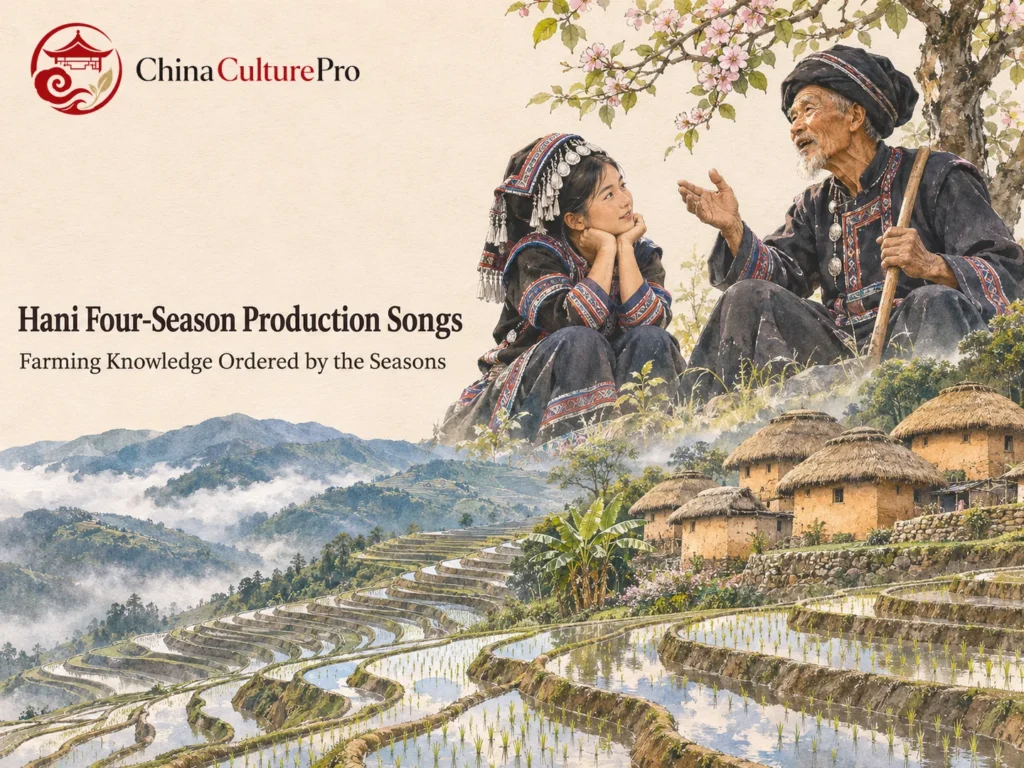

Quick Answer: What Are the Hani Four-Season Production Songs?
The Hani (哈尼族, Hānízú) Four-Season Production Songs (四季生产调, Sìjì Shēngchǎndiào) are an oral work from Honghe (红河, Hónghé) in southern Yunnan. They organize terrace farming knowledge, seasonal observations and customary practices into material that can be sung or recited.[1][2]
- The sequence has an opening followed by winter, spring, summer and autumn.[1]
- The seasons connect farm tasks with changes in the natural world.[1]
- A recorded practitioner learned through family and teachers.[2]
The name describes a body of knowledge ordered around the farming year.
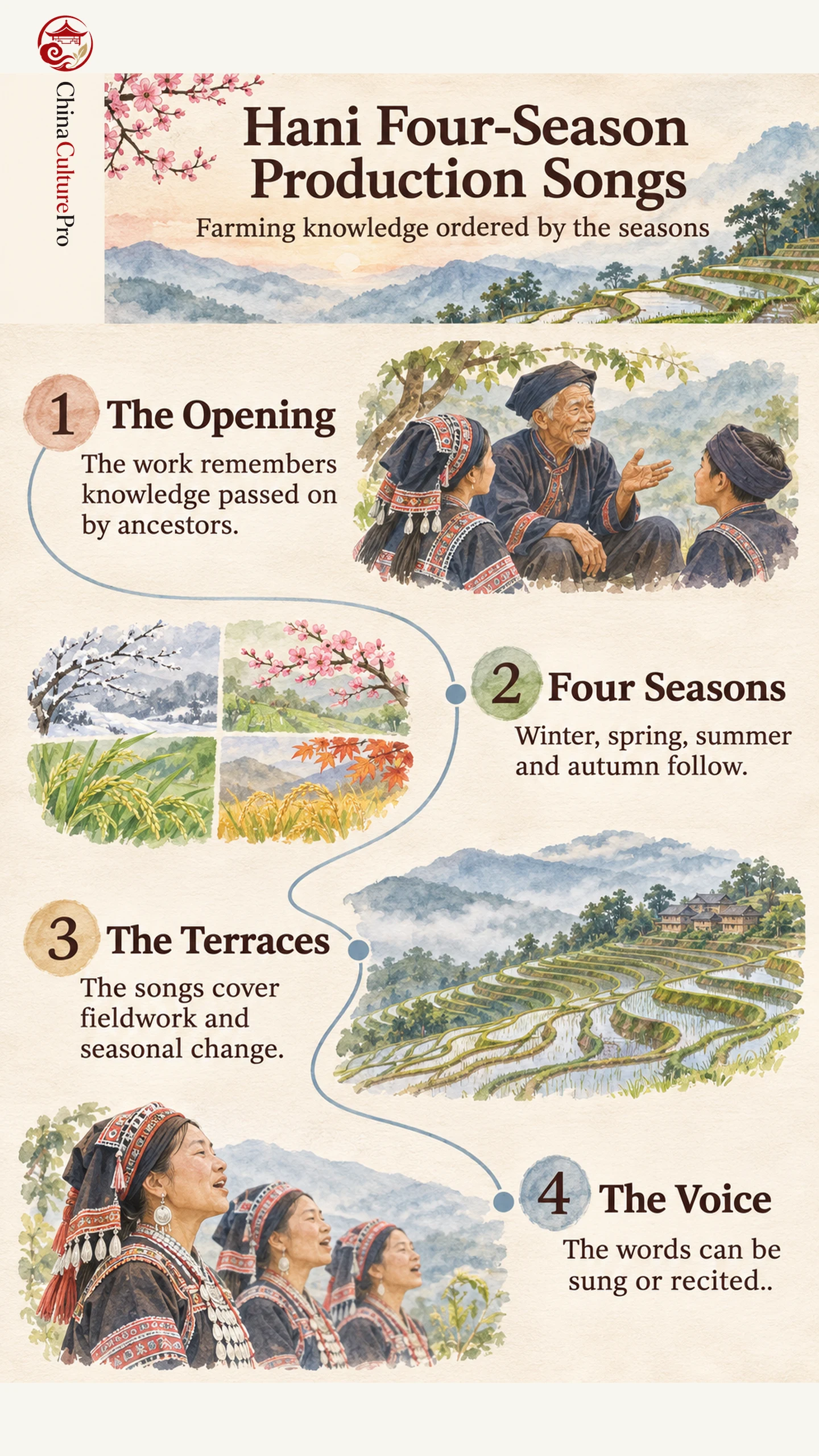
The recitation follows the turning of the agricultural year. Calendar observations, farm work and village customs belong to the same account of what changes with each season.
Why the Songs Begin With Winter
The opening emphasizes the value of knowledge passed on by ancestors. The seasonal sections then start with winter and continue to autumn. They cover the order of work on terraces as well as observations of weather and seasonal change, a calendar, festival rites and social customs.[1] The Hani October New Year offers another way to understand how a farming community can mark the year.
The Terrace Landscape Behind the Songs
In the Honghe landscape, forests above villages help supply water that channels carry toward the terraces. Managing the channels involves community labor. This arrangement gives the seasonal knowledge a physical setting. A terrace field belongs to a wider system of land, water and settlement, and that system is part of Hani community life.[3]
How the Songs Have Been Passed On
Zhu Xiaohe (朱小和, Zhū Xiǎohé), a representative practitioner, learned from family members and teachers. The tradition uses Hani proverbs to give familiar form to advice and observations. Singing or speaking the lines aloud allows knowledge to pass from one person to another.[2] The Hani long-table banquet shows a separate setting in which communities bring households together.
FAQs About the Hani Four-Season Production Songs
Are the songs always sung?
They can be sung or recited.[2]
Which season comes first?
Winter follows the opening section.[1]
Where is the tradition documented?
The national entry names communities in Honghe Prefecture, including Yuanyang, Lüchun and other counties.[1]
Источники
[1] China Intangible Cultural Heritage Digital Museum. Four-Season Production Songs
[2] China Intangible Cultural Heritage Digital Museum. Zhu Xiaohe
[3] UNESCO World Heritage Centre. Cultural Landscape of Honghe Hani Rice Terraces