


Quick Answer: What Were the Four Great Academies?
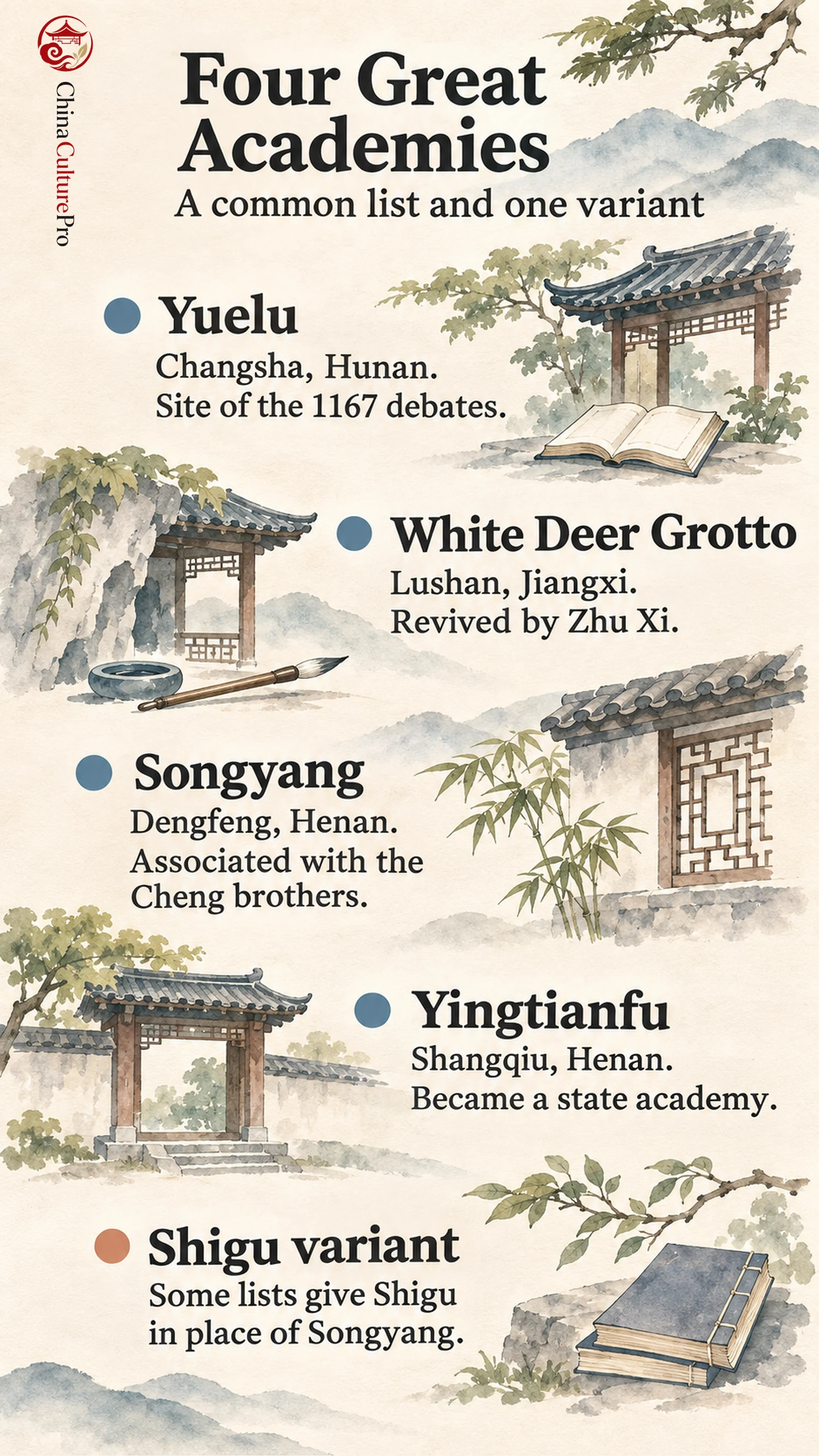
The Four Great Academies (四大書院, sì dà shūyuàn) were prominent centers of classical learning associated with the Song dynasty. A widely used list names Yuelu Academy (嶽麓書院, Yuèlù Shūyuàn), White Deer Grotto Academy (白鹿洞書院, Báilùdòng Shūyuàn), Songyang Academy (嵩陽書院, Sōngyáng Shūyuàn) and Yingtianfu Academy (應天府書院, Yìngtiānfǔ Shūyuàn).[1][2][5]
- Common list: Yuelu, White Deer Grotto, Songyang and Yingtianfu.[1][5]
- Historical variant: Another list includes Shigu Academy (石鼓書院, Shígǔ Shūyuàn) in place of Songyang.[1]
- Institution: Each was a shuyuan (書院, shūyuàn), an academy for study and teaching, with its own history of support and administration.[2][4][5][6]
The grouping reflects historical reputation. It brings together institutions that took different paths and did their best-known work at different times.[1][2][4][5][6]
In a text marking the revival of White Deer Grotto, the writer placed it alongside three other famous academies. A text about Shigu could place that academy in equally distinguished company. The lists took shape in accounts of particular institutions.[1]
Which Four Academies Are Usually Named?
The following list follows the grouping used by the Southern Song scholar Lü Zuqian (呂祖謙, Lǚ Zǔqiān), who identified Yingtianfu by its older place name, Suiyang. The places in the second column are modern reference points.[1][2][4][5][6]
| Academy | Modern location | A distinctive part of its history |
|---|---|---|
| Yuelu | Чанша, Хунань | A center of scholarly exchange and Huxiang learning. |
| White Deer Grotto | Lushan, Jiangxi | Revived in the Southern Song with a program of study and conduct. |
| Songyang | Dengfeng, Henan | A teaching site associated with the Cheng brothers. |
| Yingtianfu | Shangqiu, Henan | Grew from an earlier school into a government institution. |
What Made Each Academy Distinctive?
Yuelu: Lectures and Scholarly Exchange
Hunan University dates Yuelu’s formal establishment to 976. Its reputation also owes much to a later event, the 1167 discussions between Zhu Xi (朱熹, Zhū Xī) and Zhang Shi (張栻, Zhāng Shì). The exchange shows how an academy could become a place for established scholars to test ideas in conversation, as well as a place for students to study.[2][3]
White Deer Grotto: A Revival With Rules for Study
White Deer Grotto at Lushan had a history before Zhu Xi helped revive it in the Southern Song. The rules associated with him asked students to read widely, examine what they learned and put it into practice. They also addressed obligations in relationships. The written rules made the academy a model other institutions could draw on even when their daily arrangements differed.[4][7]
Songyang: A Site With More Than One Institutional History
The site at Dengfeng goes back to a Northern Wei Buddhist temple. The name Songyang Academy dates to 1035, after the grounds had already served different institutions. The Northern Song scholars Cheng Hao (程顥, Chéng Hào) and Cheng Yi (程頤, Chéng Yí) are associated with the academy’s teaching tradition. The temple date describes the history of the site. The Song date identifies the academy under the name used in the list.[5]
Yingtianfu: An Academy Incorporated Into the State
Yingtianfu grew out of a teaching institution at Suiyang and received recognition in 1009. Its history eventually intersected with that of the Guozijian (國子監, Guózǐjiàn), the state’s directorate of education. In 1043 the institution became the Guozijian of the Song Southern Capital. The change illustrates how a school could gain official standing and take on a new administrative role while keeping its earlier reputation as an academy.[6]
Why Does Shigu Appear on Another List?
Accounts preserved and discussed in Hengyang name Shigu among the four. The variation appears even within the institutional encyclopedia of Ma Duanlin (馬端臨, Mǎ Duānlín). One section lists Shigu, Yuelu, White Deer Grotto and Yingtianfu. A different section gives Songyang in Shigu’s place. Both lists include the same other three institutions.[1]
Shigu at Hengyang had Song recognition of its own, including an official name and land. Its appearance on a list reflects that history of patronage and study. The broader history of shuyuan academies includes many such places beyond these familiar groupings.[1]
FAQs About the Four Great Academies
Were the Four Great Academies an official ranking?
The group is a historical convention. The survival of differing lists makes it more useful as an account of reputation than as a rank awarded to a fixed group.[1]
Was Yingtianfu Academy in today’s Nanjing?
The Song Southern Capital, called Nanjing in the records about this academy, was at present-day Shangqiu in Henan. The present city of Nanjing in Jiangsu is a different place.[6]
Were all four founded at the same time?
Their histories developed separately. Hunan University dates Yuelu’s formal establishment to 976, while the Songyang name dates to 1035. White Deer Grotto’s famous Southern Song revival came later.[2][4][5]
Источники
[1] Hengyang Municipal Government. Why Shigu Academy appears among the Four Great Academies
[2] Hunan University. Yuelu Academy
[3] Hunan University. Symposium marking Zhu Xi and Zhang Shi’s academic debates
[4] Lushan Municipal Government. White Deer Grotto Academy
[5] Dengfeng Municipal Government. Songyang Academy and the monuments of Dengfeng
[6] Shangqiu Daily. Yingtian Academy and its institutional history
[7] Brill. Confucian Academies in East Asia, discussion of Zhu Xi’s academy regulations