


Quick Answer
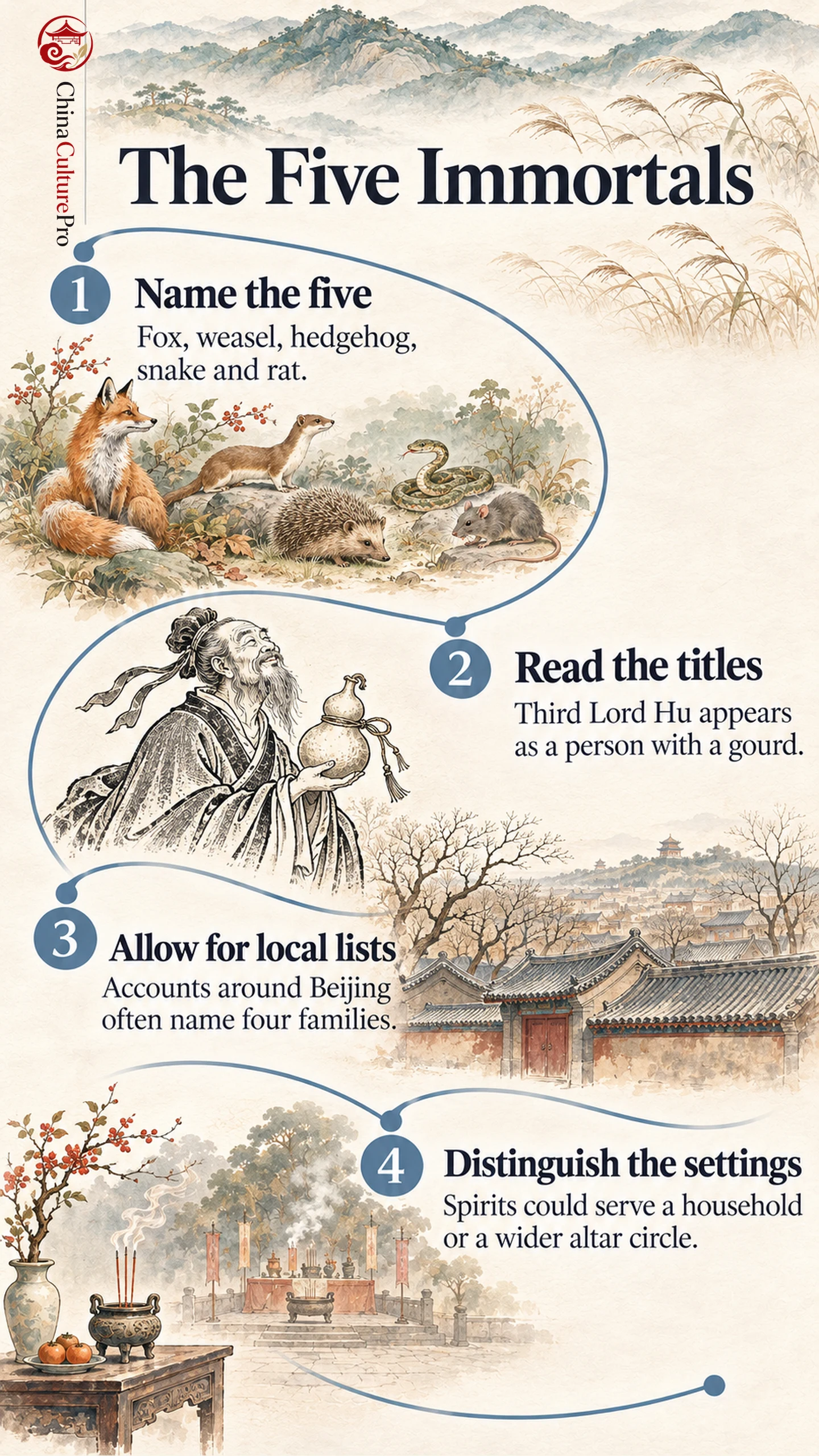
The Five Immortals (五大仙, Wǔ Dàxiān) are animal spirits in northern Chinese folk religion. A widely recorded grouping includes a fox, weasel, hedgehog, snake, and rat. Some communities speak instead of four families, and some accounts use different animals or names for the added fifth spirit.[1][2][3]
- The names: The five are often called Hu, Huang, Bai, Liu, and Hui.
- Local variation: Accounts around Beijing often emphasize the four families without Hui.
- Images: A spirit can appear as a human figure in a devotional print.
Here “immortal” translates a religious title for a spirit or transcendent being.[1][3]
A late Qing woodblock print shows two identifiable animal spirits as seated people. The upper figure represents the weasel, and the figure at lower right represents the hedgehog. Damage to the print makes its third figure uncertain.[1]
Who the Five Immortals Are
The fox spirit is Huxian (胡仙, Húxiān), the weasel is Huangxian (黃仙, Huángxiān), the hedgehog is Baixian (白仙, Báixiān), the snake is Liuxian (柳仙, Liǔxiān), and the rat is Huixian (灰仙, Huīxiān). These are collective names. An honorific can identify one figure within a family of spirits.[1][4]
A print of Third Lord Hu (胡三爺, Hú Sānyé), for example, shows a person with a gourd. The honorific and object help identify the figure, even without an animal body. The guide to Chinese fox spirits gives the wider context for fox figures in tales and worship.[4]
Why Some Accounts Name Four Families
In his study of communities near Beijing, Li Wei-tsu recorded the Four Great Families (四大門, Sì Dàmén) of fox, weasel, hedgehog, and snake. A later study of Beijing mentions settings in which a rat or hare was added under the name Hui. The five names on a museum label can therefore describe a recognizable grouping without covering every local list.[2][3]
The snake also has more than one name. Liu appears in the museum’s list, while the Beijing study records Chang (常, Cháng) as another name. A study of fiction from Northeast China identifies the five animal kinds in a modern literary setting, where the group is part of the background to stories about spirit mediums.[1][3][5]
How Devotion Extends Beyond the Household
In accounts from the western suburbs of Beijing, a household immortal (家仙, jiāxiān) was associated with one family, while an altar immortal (壇仙, tánxiān) could be served through a wider circle around an altar. These terms describe relationships in the accounts rather than levels assigned to every animal in the group.[2][3]
In the same Beijing accounts, people who served at an altar could act as mediums for the spirits. The division between one household and a wider circle helps explain why historical sources describe different scales of devotion within Chinese folk religion was practiced or represented.[2][3]
FAQs About the Five Immortals
Are the Five Immortals the same as the Eight Immortals?
The Five Immortals are associated with kinds of animals and local worship. The Eight Immortals are an ensemble of individually named figures with a different set of stories.[1][2]
What is the fifth animal?
The commonly cited five-animal list includes the rat under the name Hui. In the Beijing material the group can have four members, and a hare can also appear under the Hui name.[1][3]
Do animal spirits always look like animals in art?
No. The late Qing print of the weasel and hedgehog depicts them as people. In such a picture, a title, inscription, or catalogue identification can help.[1][4]
Источники
[1] National Museum of History, Taiwan. Weasel and hedgehog immortals, 07671
[2] Li Wei-tsu, Asian Ethnology. On the Cult of the Four Sacred Animals in the Neighbourhood of Peking
[3] Religions. Neighbours in the City: Four Animal Spirits in Beijing
[4] National Museum of History, Taiwan. Third Lord Hu, 07663
[5] Aiqing Wang. Five Great Families and Telepathy: Folk Religion and Buddhism in Neo-Dongbei Fiction by Zheng Zhi