

Quick Answer: What Is the Farewell Song Songbie?
Songbie (送别, Sòngbié), meaning farewell, is a Chinese song with words by Li Shutong (李叔同, Lǐ Shūtóng). Its melody comes through a Japanese adaptation of John P. Ordway’s American song Dreaming of Home and Mother.[2][5]
- American source: An 1867 Boston print credits Ordway.[1]
- Japanese version: Inudō Kyūkei wrote the words of Ryoshū.[2]
- Chinese context: Li’s words became part of the early school-song repertory.[5]
Use the language and lyricist credit to identify the version of the tune.

Someone who learned the melody under a different title may recognize it before recognizing the words. The shared tune ties the versions together. The words tell you what kind of departure or longing each song describes.
How the Melody Traveled
The Levy Sheet Music Collection holds an 1867 Boston edition of Ordway’s Dreaming of Home and Mother for voice and piano, with a chorus. That print documents the American song before the Asian versions appeared.[1]
The Japanese school-song catalog preserved by the National Diet Library connects the Ordway tune to Ryoshū (旅愁), with Japanese words by Inudō Kyūkei. It gives 1907 as the first edition of the teaching collection. The Chinese words were set to the melody as it circulated in the Japanese adaptation.[2][3]
What Li Shutong Changed in the Words
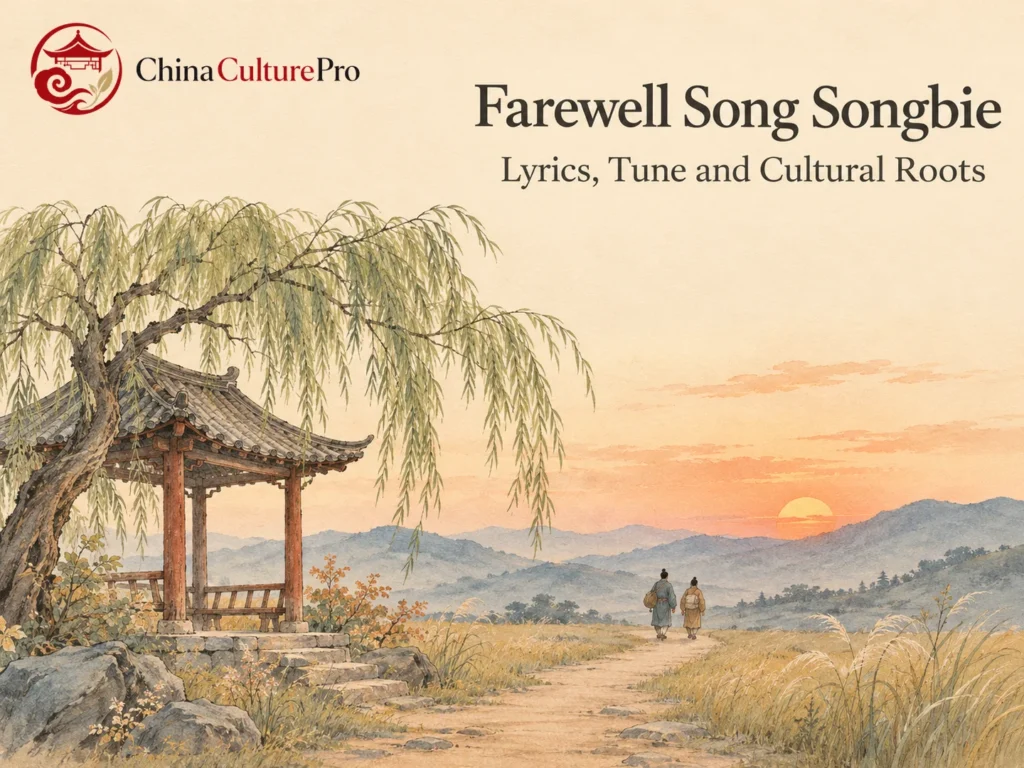
Li’s Chinese text focuses on friends separating. It places a farewell beside a road and pavilion, with grass, a willow in the evening breeze and the sound of a flute. The Japanese words look more toward home and relatives. The melody can carry both scenes because each text directs attention to different images.[3]
The willow and the road are familiar motifs in Chinese friendship and farewell poems. They place the Chinese text in a tradition of Chinese poetry even though the tune came through another route.
From School Song to Film
An early Chinese publication was the 1927 anthology Fifty Famous Chinese Songs, edited by Qiu Menghen and Feng Zikai. The Central Conservatory later featured Songbie in a concert devoted to music textbooks of the Republican period.[4][5]
My Memories of Old Beijing, adapted from Lin Haiyin’s writing, uses the song as a recurring theme. The recurring melody carries the farewell image into a later film setting. Read about modern Chinese literature for the wider world of writing that reached readers and film audiences in this period.[3]
Recognize a Performance by Its Credits
A recording called Farewell could refer to many works. For Songbie, look for the Chinese title and Li Shutong’s lyric credit. Some programs also name Ordway for the tune. When a performance leaves out the voice, follow the melody and compare its phrase endings with a sung version.[1][5]
Three Variations on Yangguan also has a farewell subject and a separate history connected to classical verse and guqin.
FAQs About Songbie
Who wrote the Chinese words to Songbie?
Li Shutong wrote the Chinese text for the existing tune.[5]
Did Li Shutong compose the original melody?
John P. Ordway wrote the earlier American song. The melody circulated in Japan as Ryoshū before Li adapted it with Chinese words.[1][2][3]
Is Songbie the same as Three Variations on Yangguan?
They are separate works. Songbie is the school song with words by Li Shutong. Yangguan belongs to another musical and poetic tradition.[5]
Источники
[1] Johns Hopkins University, Lester S. Levy Sheet Music Collection. Dreaming of Home and Mother, Box 100 Item 069
[2] National Diet Library Digital Collections. Japanese School Song Catalog: Ryoshu
[3] Guangdong Provincial CPPCC. Songbie: Li Shutong and His Circle
[4] Shanghai Jiao Tong University. Five Musical Episodes of Reunion and Farewell
[5] Central Conservatory of Music. Music Textbooks of the Republic: Concert Programme