
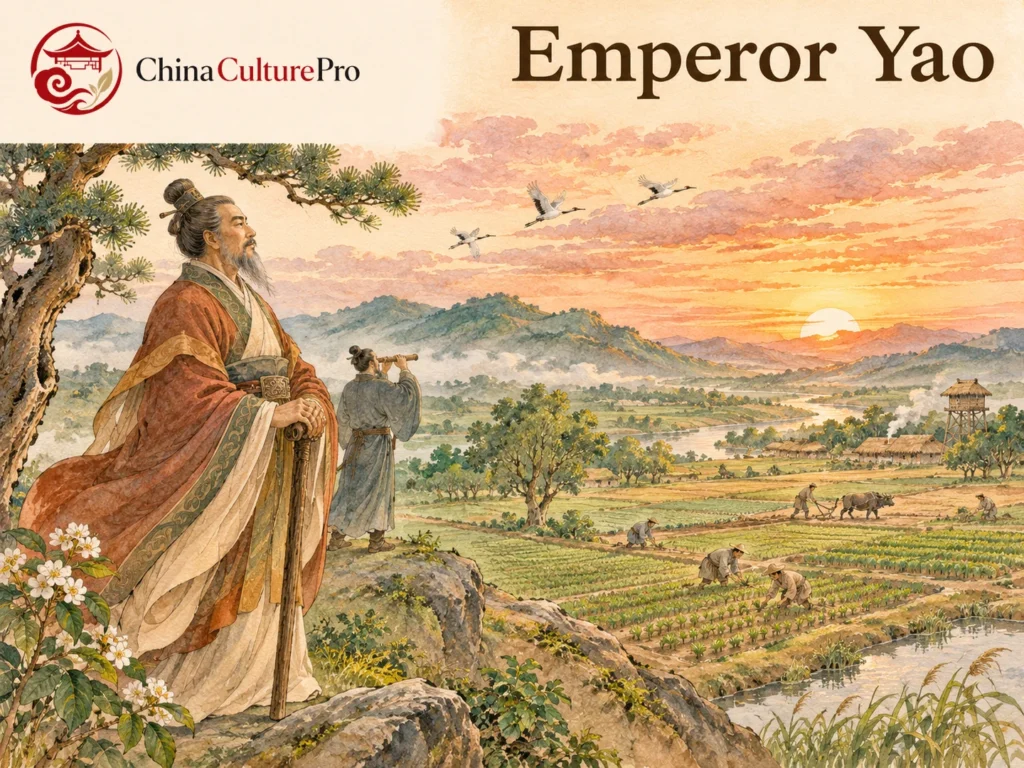

Quick Answer: Who Is Emperor Yao?
Emperor Yao (尧, Yáo) is a sage ruler of legendary antiquity. The *Book of Documents* credits him with ordering observations of the sky and seeking help during a flood. The *Huainanzi* tells how he calls on the archer Yi (羿, Yì) when ten suns appear at once.[1][2]
- Calendar: Officials observe the heavens and establish seasonal timing.
- Ten suns: Yao sends Yi to relieve a crisis that ruins crops.
- Succession: Yao tests or recommends Shun (舜, Shùn), depending on the account.[1][2][3]
The calendar, rescue and succession episodes express different ideas of good rule.
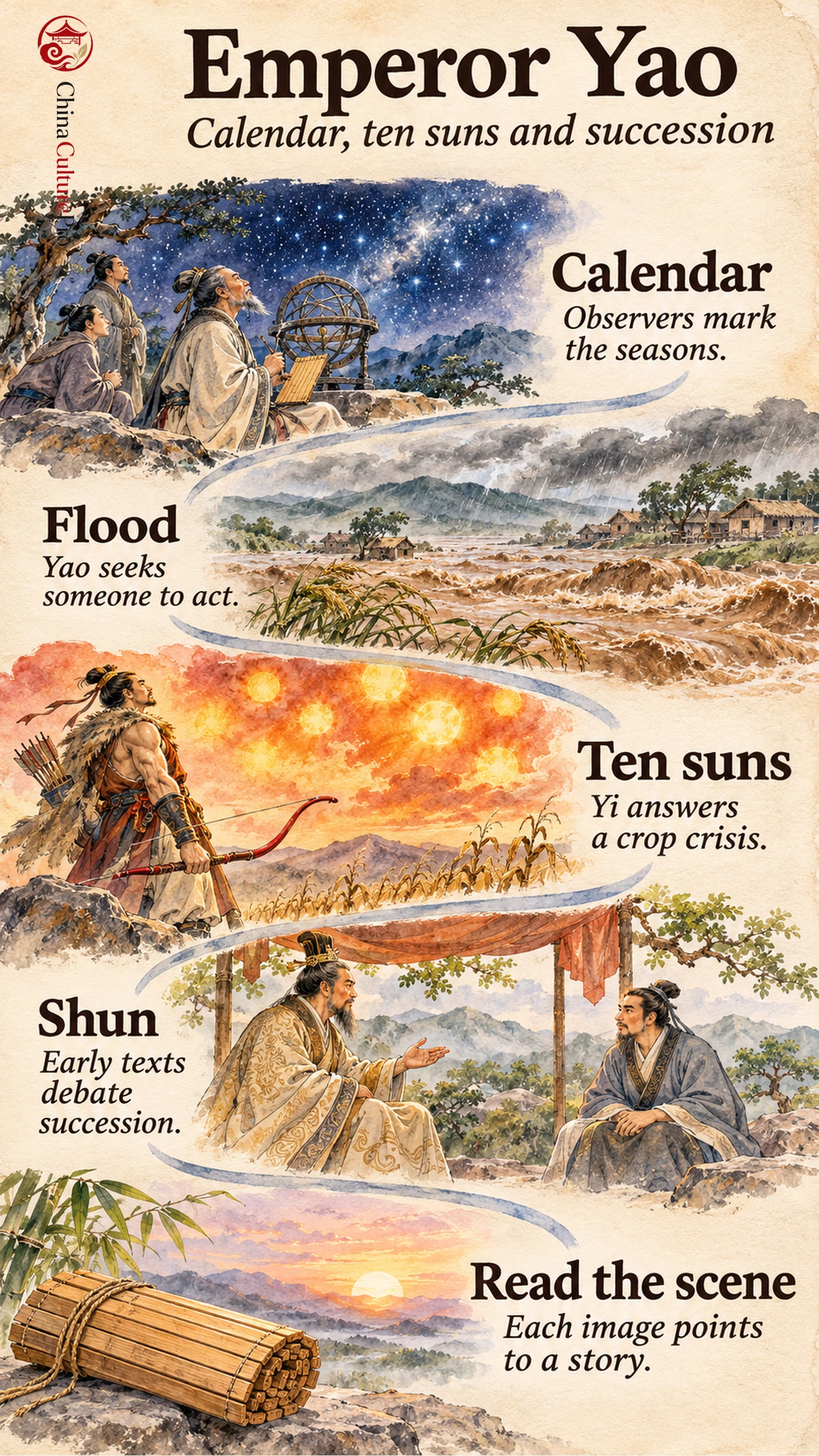
Yao appears in accounts of the sky for two different reasons. One describes observations that help people keep track of the seasons. Another brings ten suns into the sky at once and makes the ruler responsible for finding a way to save the crops.
The Calendar and Flood in the Canon of Yao
The *Canon of Yao* calls the ruler Fangxun (放勋, Fàngxūn). In the opening, he commissions the figures called Xihe (羲和, Xīhé) to observe the movements of the sun, moon and stars and give the people the timing of the seasons. The text divides the work among named observers associated with the directions and seasons.[1]
The received text also describes flooding and a search for someone capable of responding. Yao has doubts about Gun, the proposed candidate, but allows him to be tried. The account says the work fails to succeed.[1] It presents choosing the right person as a recurring problem of government.
The written name in the calendar passage also appears in the story of Xihe as mother of the suns. The latter passage identifies her as the wife of Dijun and describes her bathing the suns.[5] The shared name gives readers a point of comparison between the texts.
Why Yao Sends Yi Against the Ten Suns
In the *Huainanzi*, ten suns appear together in Yao’s time. The heat scorches crops and kills vegetation, leaving people without food. Yao orders Yi to shoot at the suns and deal with other threats below. The account puts the rescue of the people at the center of the episode.[2]
Read that version alongside Dijun’s gift of a bow to Yi. In the *Huainanzi*, Yao gives the order in a specific emergency. The bow gift belongs to a passage in the *Classic of Mountains and Seas*. The two episodes can be placed side by side before they are combined in a retelling.
How Yao Chooses Shun in Different Texts
In the *Canon of Yao*, Shun comes to the ruler’s attention because of his conduct in a difficult family. The text describes Yao giving him responsibilities and observing how he handles them.[1]
In the *Mencius*, Yao can recommend Shun, but the acceptance of the successor appears through his conduct and the people’s response.[3] Different early bamboo-slip texts also discuss Yao giving way to Shun. Research on those manuscripts identifies a broader debate about whether merit or heredity should determine succession.[4]
Reading Yao as a Model of Rule
The calendar story concerns the ruler’s responsibility for regular public life. The ten suns story concerns action in a sudden crisis. The succession texts ask how a ruler identifies someone fit to hold power. Their different questions explain why Yao may appear as an organizer, patron or judge.
The name’s position in lists of the Three Sovereigns and Five Emperors belongs to that history of writing about ideal rulers. When viewing a modern illustration, look for the episode implied by the scene. Observers watching the sky suggest calendar work, while an archer and several suns suggest the rescue story.
FAQs About Emperor Yao
Did Yao shoot down the suns himself?
In the *Huainanzi*, Yao sends Yi. The archer is the one who shoots at the suns.[2]
Is the Xihe in the Canon of Yao the mother of the suns?
The *Canon of Yao* describes observers responsible for seasonal timing. The southern *Classic of Mountains and Seas* passage gives the same written name to the woman who bears ten suns.[1][5]
Was Yao’s reign a verified historical period?
The stories belong to accounts of legendary antiquity. The texts and manuscripts can be dated as evidence for the tradition, without verifying dates for Yao’s rule.[4]
Источники
[1] Chinese Text Project. Book of Documents: Canon of Yao
[2] Chinese Text Project. Huainanzi: Basic Canon, Passage Six
[3] Chinese Text Project. Mencius: Wan Zhang I
[4] National Endowment for the Humanities. Sarah Allan’s Study of Early Chinese Abdication Texts
[5] Chinese Text Project. Classic of Mountains and Seas: Great Wilds of the South