


Quick Answer: What Was the Eight Princes Rebellion?
The Eight Princes Rebellion (八王之乱, Bā Wáng zhī Luàn) was a struggle among relatives of the ruling family of Western Jin (西晋, Xī Jìn), usually dated 291–306 CE. Palace coups escalated into regional warfare over control of the court and Emperor Hui (晋惠帝, Jìn Huìdì). The war weakened Western Jin, which survived until 316. [1][2][4][5]
- 291: Rival palace factions used imperial orders and troops to remove their opponents.
- 300–306: A succession crisis and a prince’s seizure of the throne set off wider fighting.
- Aftermath: The dynasty lost its two capitals in 311 and 316. [1][2][4][5]
The eight princes entered the conflict at different stages and often fought in changing coalitions. [1][4]
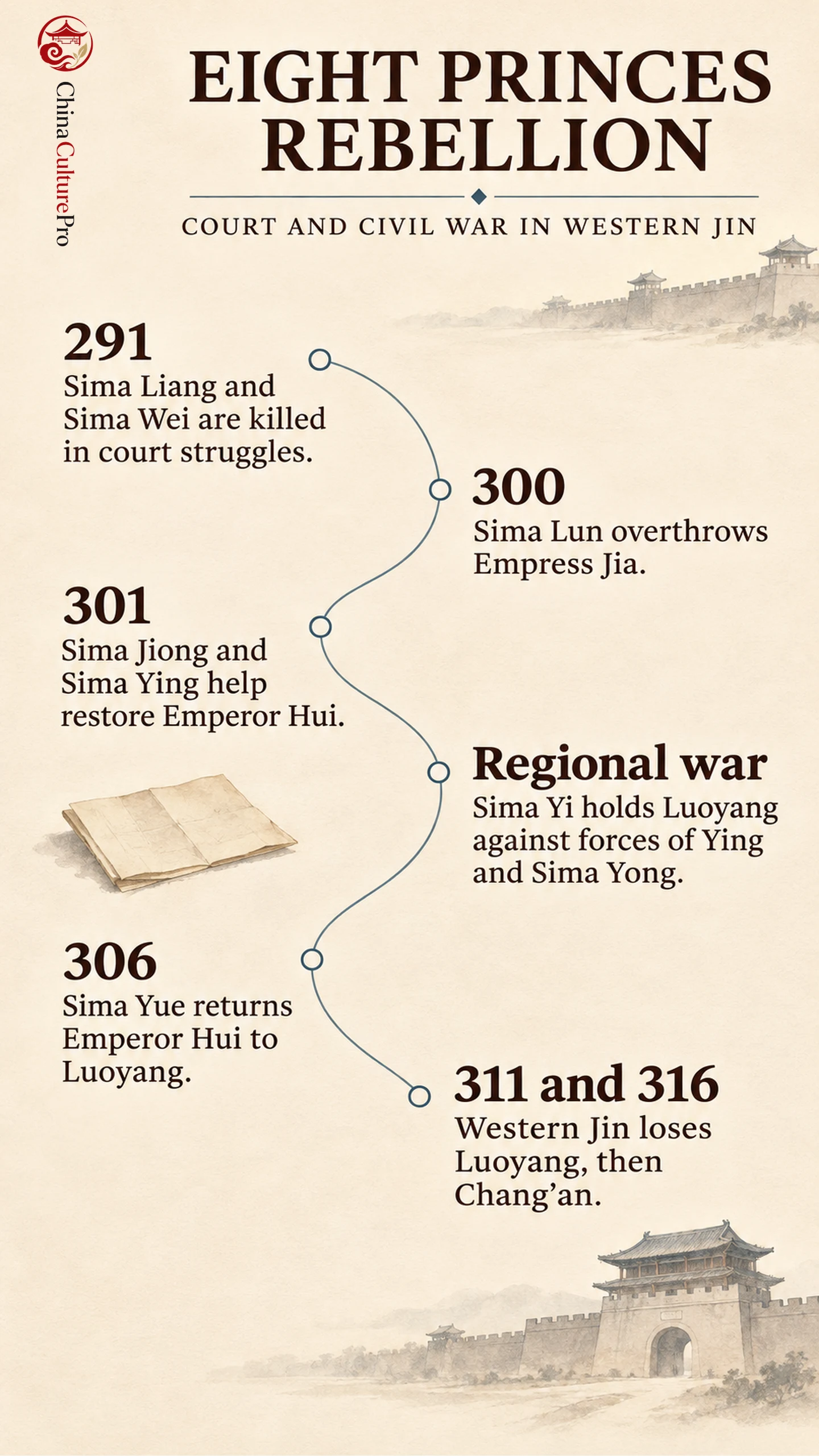
Control of the emperor made it possible to issue orders in his name. Control of soldiers made it possible to challenge those orders. The Western Jin court became the prize in a conflict that could shift between the palace and the provinces.
Why the Western Jin Court Became a Prize
The founding emperor of the Jin dynasty, Sima Yan (司马炎, Sīmǎ Yán), assigned principalities to members of his own clan. Some held military commands that gave them resources beyond the court. His son, Emperor Hui, inherited the throne in 290. Rival groups soon competed for control of appointments and access to the emperor. [1][2][4]
In 291, Empress Jia Nanfeng (贾南风, Jiǎ Nánfēng) and her allies removed the regent Yang Jun. Sima Liang (司马亮, Sīmǎ Liàng) briefly took a leading role at the capital, Luoyang (洛阳, Luòyáng). Jia used Sima Wei (司马玮, Sīmǎ Wěi) against him, then had Wei executed. Jia dominated court politics for much of the next decade. The fighting of 291 did not continue uninterrupted. [1][2][3][4]
Who Were the Eight Princes?
The standard list follows the grouping in the Book of Jin, compiled centuries after the events. The princely titles identify the men, but an assigned principality did not necessarily mark where its prince held military command. [1][4]
| Prince | Title | Role in the conflict |
|---|---|---|
| Sima Liang | Runan | Took a leading role at court after Yang Jun’s fall. |
| Sima Wei | Chu | Led troops against Liang and was then executed. |
| Sima Lun (司马伦, Sīmǎ Lún) | Zhao | Removed Jia and later seized the throne. |
| Sima Jiong (司马冏, Sīmǎ Jiǒng) | Qi | Helped overthrow Lun and restore Emperor Hui. |
| Sima Yi (司马乂, Sīmǎ Yì) | Changsha | Held Luoyang against rival armies. |
| Sima Ying (司马颖, Sīmǎ Yǐng) | Chengdu | Challenged the Luoyang court from his military base at Ye. |
| Sima Yong (司马颙, Sīmǎ Yóng) | Hejian | Controlled the emperor through one of his commanders. |
| Sima Yue (司马越, Sīmǎ Yuè) | Donghai | Defeated rival forces and returned the emperor to Luoyang. |
How Palace Coups Became a Regional War
The conflict resumed after the deposition and death of Crown Prince Sima Yu in 300. Lun overthrew Jia in 300, then took the throne in 301. Jiong, Ying and other princes combined forces against him and restored Hui. The victory restored the emperor while leaving the rivalry over the court unresolved. Jiong took a leading position and was later overthrown by Yi. [1][2][3][4]
Yi held Luoyang when forces associated with Ying and Yong attacked. Palace officers seized him from within the city. Yue took part in his removal, and the forces outside Luoyang then had an opening. The emperor subsequently came under different factions’ control. A commander could claim to be protecting him while using his presence to legitimize military action. [1][2][4]
Forces serving Yong took Hui to Chang’an (长安, Cháng’ān). Yue raised troops against Yong and brought Hui back to Luoyang in 306. Moving Hui allowed rival commands to claim his authority from different cities. Holding Luoyang alone could no longer settle who spoke for the court. [1][2][4][5]
Why the War’s End Did Not Save Western Jin
Yue’s success ended the main struggle among the princes. The northern regions remained divided among competing forces. Commanders outside the Sima family gained power as the war unfolded. Liu Yuan (刘渊, Liú Yuān) established a rival Han regime in 304, while the princes were still fighting. Its forces took Luoyang in 311, and Chang’an fell in 316. [4][5][6]
The Jin line continued in the south as Eastern Jin (东晋, Dōng Jìn) under Sima Rui. Yue had given Rui a southern command in 306. That earlier appointment was part of the political background to his later rise. By the time Rui established the southern court, rivals in the north had already dismantled Western Jin’s hold on its capitals. [5][6]
FAQs About the Eight Princes Rebellion
Did all eight princes fight at the same time?
No. Liang and Wei were killed in 291. Most of the other princes became central to the struggle during the renewed conflict from 300 onward. [1][2][4]
Why is the conflict also called the War of the Eight Princes?
The English names translate or summarize the traditional term for the disturbances associated with eight titled members of the Jin ruling family. Other people, including empresses, ministers and commanders, also shaped the conflict. [1][3][4]
Did Western Jin fall in 306 CE?
No. Sima Yue prevailed in the war among the princes in 306. Western Jin survived the fall of Luoyang in 311 and ended after its remaining court at Chang’an fell in 316. [4][5]
Источники
[1] Fang Xuanling and other compilers. Book of Jin, Volume 59: Biographies of the Eight Princes
[2] Fang Xuanling and other compilers. Book of Jin, Volume 4: Annals of Emperor Hui
[3] Fang Xuanling and other compilers. Book of Jin, Volume 31: Biographies of Imperial Consorts
[4] Damien Chaussende. Western Jin, in The Cambridge History of China
[5] Charles Holcombe. Eastern Jin, in The Cambridge History of China
[6] Scott Pearce. The World Shegui Entered, in Northern Wei (386–534): A New Form of Empire in East Asia