


Quick Answer: What Are Dong Kuan Oral Traditions?
Among the Dong (侗族, Dòngzú), Kuan (款, kuǎn) can refer to an alliance joining nearby villages. Its agreements are known as Kuan covenants (款约, kuǎnyuē). Kuan gatherings (款会, kuǎnhuì) provide an occasion to discuss and announce agreements. The verbal art of Kuant cix (款词, kuǎncí) can preserve rules as well as stories and ceremonial verse.[1][2][3]
- Alliances and meetings can operate at different scales.[1][4]
- Oral recitations can use both internal and end rhyme.[3]
- In one Liping alliance, villages take turns hosting the autumn gathering.[4]
The four terms identify a group, an agreement, a meeting and a recitation genre.
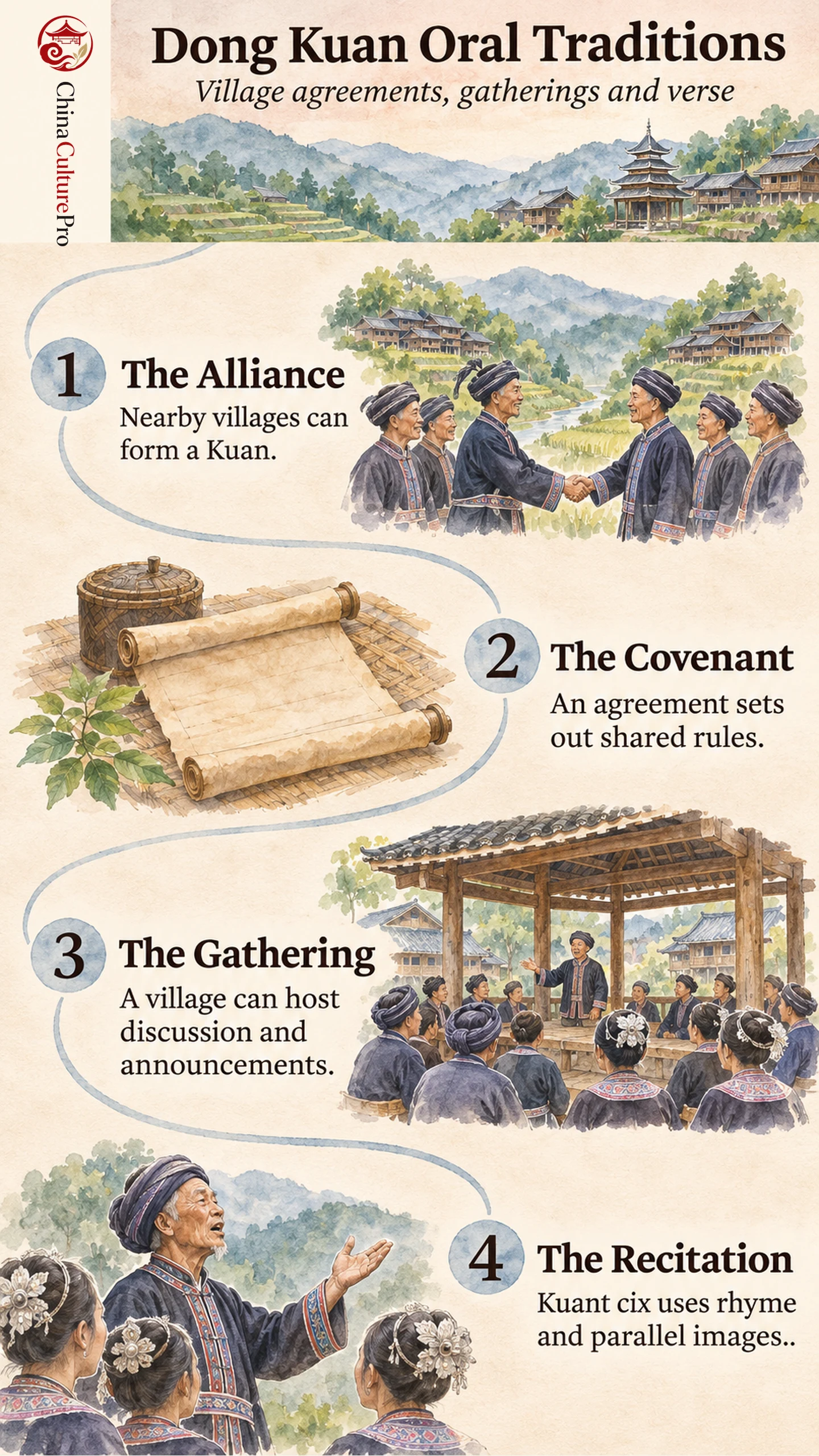
An agreement needs to reach the people who will remember it. In the Dong tradition, the public gathering and the sound of recited verse both help explain how that can happen.
Alliance, Agreement and Assembly
Historical descriptions distinguish alliances of nearby settlements from larger groupings. The agreement set out shared rules. Some assemblies took place on an open ground reserved for the alliance. This gives a wider setting for community discussions than the familiar Dong drum tower gathering within a village.[1]
What a Kuant Cix Recitation Sounds Like
Listen for rhymes within lines as well as at their ends, and for paired images or ideas. The genre includes accounts of customary rules, origins and ceremonies. Some recitations were written down using Chinese characters to represent Dong speech. These transcriptions preserve some pieces of an oral tradition.[3]
The Thirteen-Village Example in Liping
The national heritage entry describes thirteen villages in the Shidong association in Liping, Guizhou. They rotate hosting duties, and public discussion and announcement of the covenant sit at the center of the gathering.[2][4] The event can also include rites for Sa Sui, Dong Grand Song and opera.[2] These activities place the covenant within a wider occasion of Dong community life.
FAQs About Dong Kuan Oral Traditions
Does Kuan mean a poem?
Kuan can name the alliance. Kuant cix names a form of verbal art associated with it.[1][3]
What can the recitations cover besides rules?
Examples include origin narratives, praise of heroes and verses for customary occasions.[3]
How do the Liping villages choose a host?
The thirteen villages in the Shidong example take turns hosting the autumn event.[2]
Источники
[1] National Ethnic Affairs Commission. Dong historical development
[2] China Intangible Cultural Heritage Digital Museum. Dong covenant customs in Liping
[3] Deng Minwen. Dong Oral Poetry: Kuant Cix
[4] China Intangible Cultural Heritage Digital Museum. Ethnic communities and intangible heritage