

Quick Answer: What Is the Zhongyong?
The Zhongyong (中庸, Zhōngyōng), usually called the Doctrine of the Mean, is a short philosophical text in the Confucian tradition (儒家, Rújiā). It connects ethical cultivation, fitting conduct in changing circumstances and the relationship between human life and the wider order of the world.[1][2]
- Central concern: Respond appropriately without excess or deficiency, rather than mechanically splitting every difference.
- Learning task: Cultivate judgment, genuine conduct and understanding through sustained effort.
- Textual place: Preserved in the Book of Rites (礼记, Lǐjì) and later established among the Four Books (四书, Sìshū).[1][4]
“Mean” here names an ethical ideal, not a mathematical average or a rule to accept every compromise.
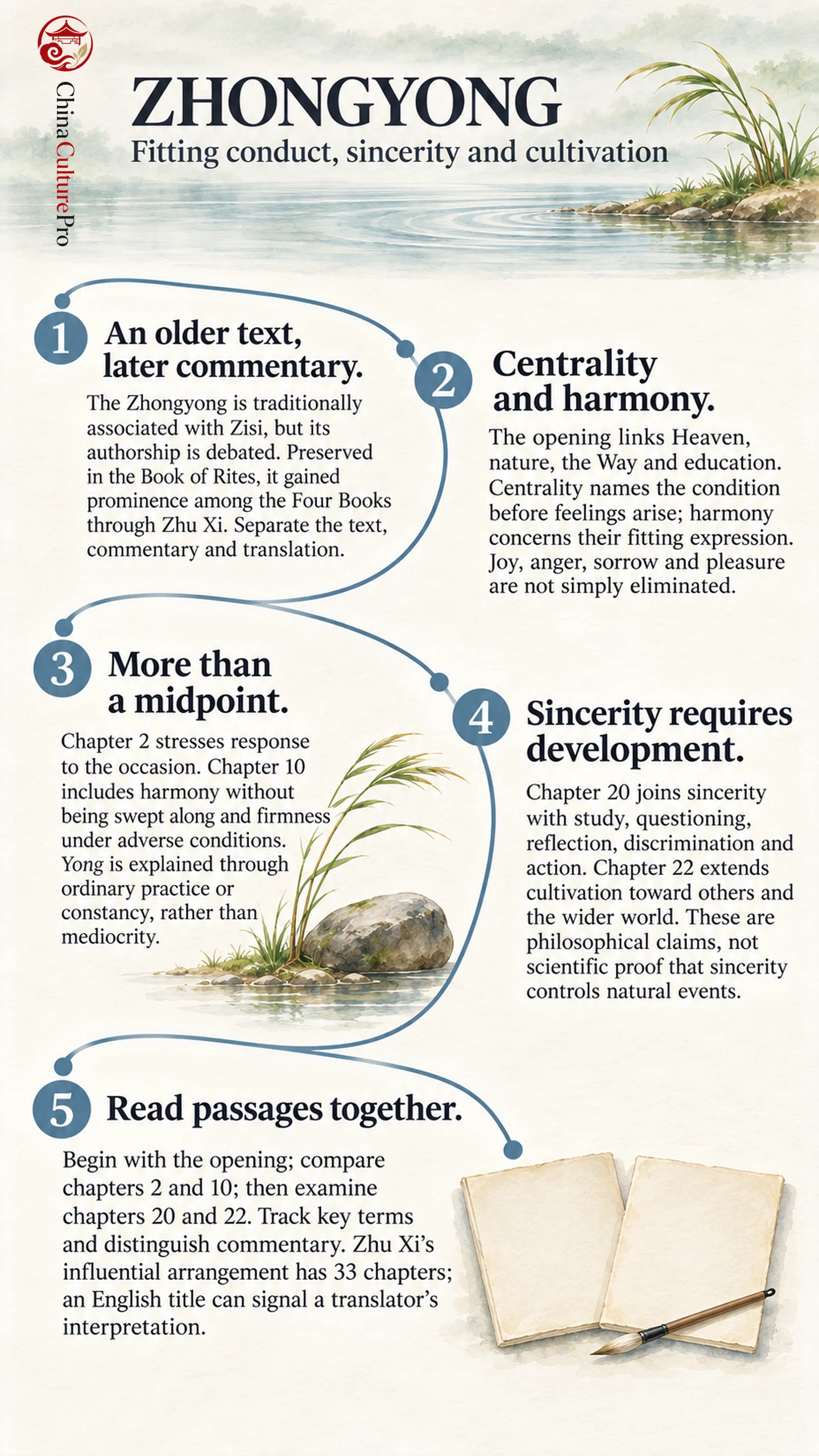
A text called the Doctrine of the Mean can sound like advice to avoid strong feelings or firm decisions. The Zhongyong asks something more demanding: how to respond fittingly, sustain moral judgment and connect personal cultivation with relationships and the wider world.
From the Book of Rites to the Four Books
The work is traditionally associated with Zisi (子思, Zǐsī), the grandson of Confucius (孔子, Kǒngzǐ). That attribution is important to its reception, but modern scholarship debates its composition and authorship. The traditional association does not settle the authorship of every passage in the received text.[3]
The received text is preserved within the Book of Rites. In the twelfth century, Zhu Xi (朱熹, Zhū Xī) gave it a prominent place in the Four Books, with the Great Learning (大学, Dàxué), Analects (论语, Lúnyǔ) and Mencius (孟子, Mèngzǐ). His commentary shaped a particularly influential approach to reading it.[2][4]
Keep three layers distinct: the older text, Zhu’s explanations and an English translator’s interpretation. A bilingual edition may print all three together, but their claims do not all come from the same period or author.
The Opening: Nature, the Way and Harmony
The opening establishes a sequence linking the source of human life to its cultivation. Its claims locate ethics within a larger order:[1]
| Термин | Function in the opening |
|---|---|
| Heaven (天, tiān) | The source of the human endowment. |
| Nature (性, xìng) | What human beings receive and are called to fulfill. |
| The Way (道, dào) | The course associated with following that nature. |
| Education (教, jiào) | Cultivating and ordering that course. |
| Centrality and harmony (中, zhōng; 和, hé) | Distinguish the condition before emotions arise from their fitting expression. |
Joy, anger, sorrow and pleasure are named explicitly. Before they arise, the text speaks of centrality; when they arise in due measure, it speaks of harmony. The aim is not to erase emotion. The distinction makes the quality of response, rather than the mere presence of feeling, ethically important.[1]
Why the Mean Is More Than Compromise
The title’s yong (庸, yōng) also needs attention. Zhu explains it through the ordinary or everyday, while an earlier explanation he includes stresses constancy. These readings concern sustained ethical practice, not mediocrity.[2] Chapter 2 describes the exemplary person’s centrality as responsive to the occasion. Zhu’s explanation stresses that the center is found according to the situation.[2]
Chapter 10 provides a useful test. In an exchange with Zilu (子路, Zǐlù) about strength, the text praises harmony without being swept along and steadiness without leaning away from principle. Firmness, including under adverse political conditions, belongs within its account of good conduct.[2]
Reading these passages together prevents “moderation” from becoming mere indecision. Accommodating other people and maintaining a moral commitment can both be required. What matters is the fitting response, not whether a choice appears halfway between two proposals.
Sincerity, Learning and the Wider World
Cheng (诚, chéng), often translated as sincerity, concerns making one’s moral life genuine and fully realized. It is more demanding than speaking honestly while leaving one’s conduct unchanged.[2]
Chapter 20 distinguishes sincerity as the Way of Heaven from the human work of becoming sincere. Its learning sequence includes broad study, careful questioning, reflection, discrimination and committed action. The passage allows for effort and development; it does not assume everyone begins with effortless understanding.[2]
Chapter 22 extends this vision from fulfilling one’s own nature to that of others and of things, then to participation in the transforming and nourishing activity of Heaven and Earth. This is the text’s philosophical account of humanity’s place in the world, not a modern scientific finding that private sincerity controls natural events. It connects ethical cultivation with a wider Chinese philosophy of nature.[2]
The final chapter returns attention to quiet influence and what is not publicly displayed. Ethical influence is presented as growing from inward formation, rather than conspicuous performance.[2]
A Reading Path Through the Zhongyong
- Read the opening: Identify its claims about nature, the Way, centrality and harmony before turning them into practical advice.
- Compare chapters 2 and 10: Put timely response beside moral firmness, and ask what each passage rules out.
- Read chapters 20 and 22: Trace how learning and sincerity lead from personal development toward wider relationships.[2]
The opening’s concern with shendu (慎独, shèndú), watchfulness when alone, provides another thread through the text. Look for how attention to what is hidden relates to the closing account of unobtrusive conduct.[2]
Choose a translation that explains its vocabulary and separates commentary from the base text. Doctrine of the Mean is the familiar English title; Focusing the Familiar is another influential translation’s title. Such differences signal interpretive choices, so compare the same Chinese passage rather than expecting every English keyword to match.[4]
FAQs About the Zhongyong
Does Zhongyong mean choosing the midpoint every time?
No. Its account of fitting response includes firmness and resistance to being swept along by others.[2]
Does the text ask readers to suppress emotion?
No. The opening distinguishes feelings before arising from feelings expressed in due measure.[1]
Did Zhu Xi write the Zhongyong?
No. He was a later commentator whose treatment helped establish its importance within the Four Books.[4]
How many chapters does the Zhongyong have?
Zhu Xi’s influential arrangement has 33 chapters. Earlier placement in the Book of Rites and other editorial divisions should be distinguished from that numbering.[2]
Источники
[1] Public-domain Chinese text in the Book of Rites. Zhongyong, in the Liji
[2] Zhu Xi, public-domain Chinese commentary. Zhongyong Zhangju: text and commentary
[3] Tu Wei-ming, Routledge Encyclopedia of Philosophy. Zhongyong (1998), article summary
[4] Roger T. Ames and David L. Hall, University of Hawai‘i Press. Focusing the Familiar: A Translation and Philosophical Interpretation of the Zhongyong (2001)