

Quick Answer: How Did the Civil and Military Exams Differ?
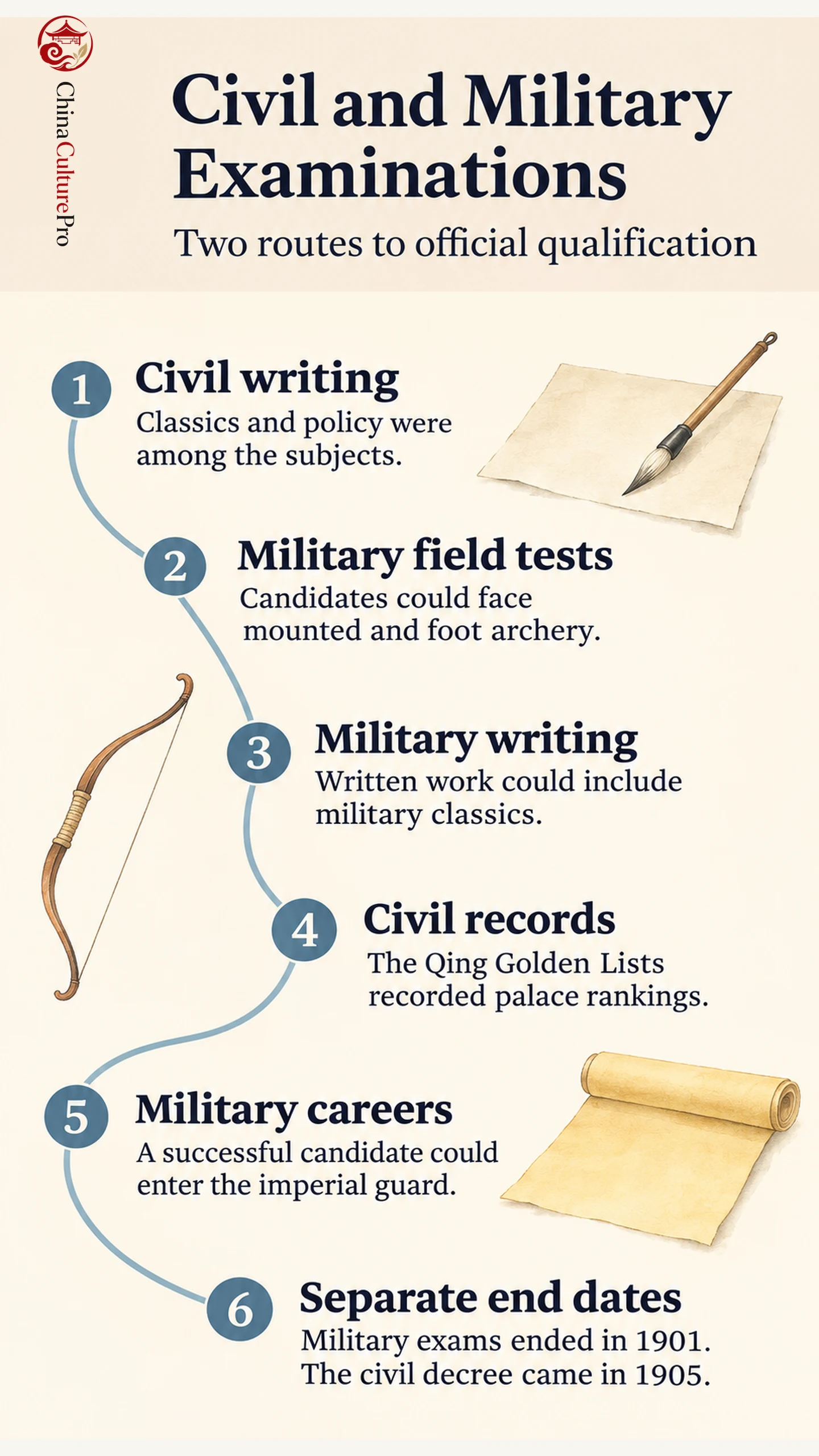
Civil examinations (文科, wénkē) and military examinations (武科, wǔkē) were parallel routes for selecting officials in imperial China. In the Qing, the civil route relied on written assessments. The military route combined practical and written tests.[1][2][3]
- Civil route: Candidates wrote about canonical texts and matters of government policy.[1]
- Military route: Mounted and foot archery, strength tests and a written section were part of Qing military examinations.[2][3]
- Results: The two routes could use similar titles and levels. The type of examination determined the kind of qualification a title represented.[1][2][4]
The subjects, standards and assignments changed over time. The comparison below uses Qing rules and records unless a different period is named.[1][2][4]
A civil script and a military archery score answer different questions about a candidate. Reading the two examinations together shows how the court assessed people for different work and recorded what they had passed.
What Candidates Were Tested On
The late imperial civil curriculum included the Four Books (四書, Sìshū) and the Five Classics (五經, Wǔjīng). Qing written examinations could combine questions on canonical texts, a poem and an essay on policy. The form of the response also mattered. For some classical essays, candidates worked within the conventions of the eight-legged essay.[1]
The military selection system, also called wuju (武舉, wǔjǔ), assessed performance in several ways. One Qing arrangement put mounted archery first, foot archery and other physical skills second, and writing third. Candidates might draw a heavy bow, handle a heavy saber or lift a stone. The thresholds and sequence could change. Written tests included questions on strategy and military texts in some periods. Later examinations could ask candidates to reproduce passages of military classics from memory.[2][3]
| Характеристика | Qing civil track | Qing military track |
|---|---|---|
| Early screening | Written scripts were central to the competition. | Candidates could have to meet practical thresholds before writing. |
| Written assessment | Classical interpretation and policy writing were among the tests. | Strategy questions or written reproduction of military texts could be used, depending on the period. |
| Examination levels | The route led from local qualification to provincial, metropolitan and palace stages. | The Qing also used provincial, metropolitan and palace stages for military candidates. |
The order of the tests mattered. Some Qing rules kept candidates who missed an archery threshold from proceeding to the next session. The required number of hits and the equipment used could vary over time. One set of rules recorded stone weights of 200, 250 and 300 jin (斤, jīn). The graded equipment gave examiners an observable performance to record. For written civil work, clerks could conceal the candidate’s identity and copy the script for grading.[1][2] See how examination anonymity worked for those written papers.
What Passing Meant for a Career
In the Qing civil route, passing the provincial examination conferred juren (舉人, jǔrén) status. Successful candidates at the later palace stage were ranked within the jinshi (進士, jìnshì) categories. The Qing civil Golden Lists preserve these rankings in Chinese and Manchu on yellow paper. They are records of examination outcomes. The palace examination was the stage that assigned the final civil ranks.[1][4]
The military track used such titles as wu juren (武舉人, wǔ jǔrén) and wu jinshi (武進士, wǔ jìnshì). Under different Qing appointment rules, a successful military candidate could be assigned to an imperial guard position or a military command post. Rank among the candidates and the rules in force mattered to the placement. A roster of graduates identifies the qualification. For the office a particular person held, look for an appointment record.[2] The civil examination degree names are useful for reading the parallel but distinct civil records.
How the Two Examination Tracks Changed
A military examination program was introduced in 702 during Wu Zetian’s reign. Its tests included shooting from horseback and using a lance while mounted. Recommendation and other means of finding military officers also had a place in the history of recruitment. Later dynasties used military examinations with varying regularity. In the Ming, the system was set on a triennial schedule in 1504.[3][7]
The late Qing ended the two tracks separately. The military examination was abolished in 1901 as the government turned toward military academies and new training. The civil abolition decree came in 1905 and ended the old provincial and metropolitan competitions from the next scheduled cycle in 1906. The civil decree tied the end of the competitions to the expansion of schools.[1][3][5][6]
FAQs About Civil and Military Examinations
Were Military Examinations Just Tests of Strength?
Qing military candidates were assessed in mounted and foot archery as well as prescribed tests involving strength. Written work also formed part of the system. The content changed over time.[2][3]
Did the Two Tracks Use the Same Titles?
They used parallel terms at several levels. A military record can add wu to distinguish its qualifications, as in wu juren. The examination track and rank category give the title its meaning.[1][2]
Did Both Examination Tracks End in 1905?
The Qing ended the military examination in 1901. The 1905 decree abolished the old civil examinations. The dates are useful for identifying which kind of reform a late Qing document refers to.[1][3][5][6]
Источники
[1] Museum of the Institute of History and Philology, Academia Sinica. Archives of the Grand Secretariat
[2] Draft History of Qing. 武科
[3] Hong Kong Museum of History. By Might and Wit, Imperial Examination Teaching Kit
[4] UNESCO Memory of the World. Golden Lists of the Qing Dynasty Imperial Examination
[5] Academy of Chinese Studies. Strengthening the Military and Building New Armies
[6] United States Department of State, Office of the Historian. Minister Rockhill to the Secretary of State, September 19, 1905
[7] Jun Fang. A Ming Minister’s Advice on Controlling and Selecting Military Commanders