


Quick Answer: What Is Chop Suey?
Chop suey (杂碎, zásuì) is a flexible dish of meat and mixed vegetables in a thickened savory sauce. Its English name comes from Cantonese words for mixed pieces, and its Chinese-American forms became closely associated with immigrant restaurants.[1][5]
- Ingredients: Chicken or pork, celery, bean sprouts and other vegetables are common choices.[5]
- Structure: The mixture and gravy usually accompany rice, rather than requiring noodles as their base.[5]
- Variation: The vegetable and protein mix changes between cooks and places.[4][5]
“Mixed pieces” describes flexibility, not permission to use spoiled food.
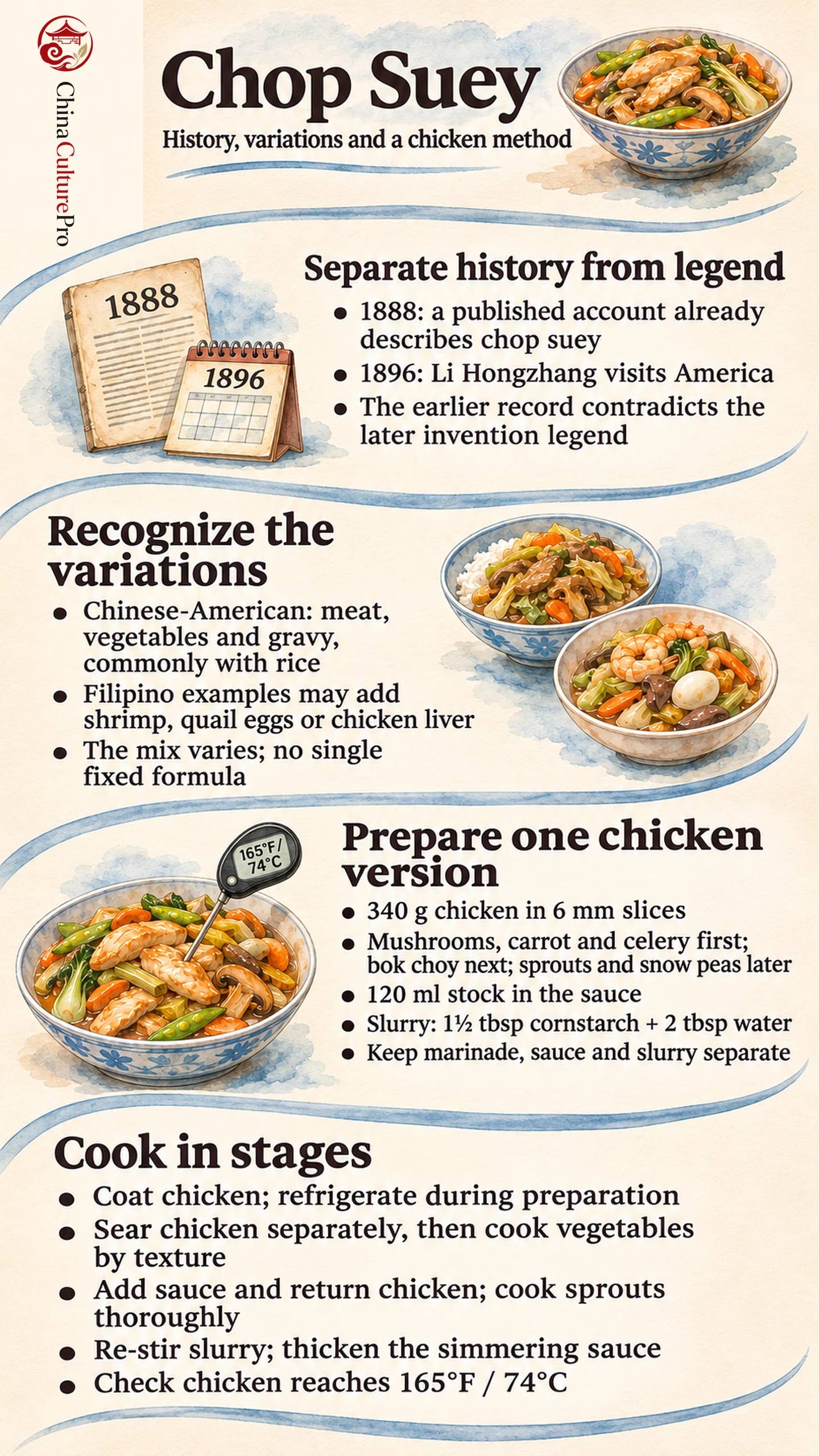
Chop suey works best when the ingredients retain some individual character. The practical task is to cut the meat evenly, group vegetables by how quickly they cook, and thicken the juices without burying everything in paste.
The Name and the History Behind the Dish
The name connects with southern Chinese mixed dishes, while the restaurant food developed through migration and adaptation. Late nineteenth-century Chinese cooks adjusted ingredients and service to their surroundings; chop suey became a visible part of Chinese-American food culture.[1][2]
An account published in 1888 already described chop suey. That predates the 1896 American visit of Li Hongzhang (李鸿章, Lǐ Hóngzhāng), around which a famous invention story formed. The dated evidence does not support saying his visit created the dish.[2]
Restaurants advertised chop suey so prominently that “chop suey houses” became a familiar description. The dish helped generate work for Chinese immigrants; its popularity reflects both cooks and customers shaping the cuisine.[2]
Chinese-American and Filipino Variations
- Chinese-American versions: Sliced chicken or pork, celery, sprouts and other vegetables meet a starch-thickened gravy, commonly served with rice. Bamboo shoots (竹笋, zhúsǔn) and water chestnuts appear in some descriptions, but they are not requirements for every version.[5]
- Filipino versions: Mixed vegetables may accompany chicken, pork, shrimp, boiled quail eggs or chicken liver. Some recipes combine several proteins; others are simpler. Ingredients still enter the pan according to cooking time.[4]
These are examples of culinary settings, not two standardized national formulas. The chicken version below is one practical route through the many possible combinations.
Ingredients for a Chicken Chop Suey
For four servings with rice, use US tablespoons of 15 ml and teaspoons of 5 ml. Keep marinade, sauce and starch slurry separate.
- Chicken marinade: 340 g boneless, skinless breast in 6 mm slices; 3 tablespoons water; 1 tablespoon oyster sauce (蚝油, háoyóu); 1 teaspoon Shaoxing cooking wine (绍兴料酒, Shàoxīng liàojiǔ); 1 teaspoon oil; 2 teaspoons cornstarch.[3]
- Sauce: 120 ml low-sodium chicken stock; ¼ teaspoon sugar; 1½ tablespoons soy sauce (酱油, jiàngyóu); 1 teaspoon dark soy sauce (老抽, lǎochōu); 1½ tablespoons oyster sauce; ½ teaspoon toasted sesame oil; ⅛ teaspoon white pepper.[3]
- Vegetables: First group: 4 sliced mushrooms, ½ thinly sliced small carrot and ⅔ cup thinly sliced celery; leafy group: 170 g chopped bok choy (小白菜, xiǎo báicài); final group: ¾ cup mung bean sprouts and 1 cup snow peas.[3]
- Pan: 3 tablespoons oil, 2 chopped garlic cloves and 1 tablespoon wine.[3]
- Slurry: 1½ tablespoons cornstarch mixed with 2 tablespoons water.[3]
How to Cook Chop Suey
- Mix chicken with its water, oyster sauce and teaspoon of wine, then coat with marinade oil and starch. Refrigerate while preparing vegetables. Combine the sauce separately.[3][6]
- Heat 2 tablespoons pan oil. Spread chicken in a single layer, sear, then remove to a clean bowl; it will finish cooking in the sauce.[3]
- Add remaining oil and garlic. Cook the first vegetable group, then add the leafy group and tablespoon of wine. Add sauce and the final vegetable group; return the chicken. Cook sprouts thoroughly, not merely warm them as a garnish.[4][7]
- Re-stir the slurry and drizzle it into the simmering sauce while tossing, stopping when it coats the ingredients. Continue until chicken reaches 165°F/74°C with a food thermometer and the vegetables are cooked. Serve promptly with rice.[4][6]
FAQs About Chop Suey
How is chop suey different from chow mein?
Чоу-мейн (炒面, chǎomiàn) generally centers on fried noodles. Chop suey centers on the meat-and-vegetable mixture and its gravy. Serving noodles alongside it does not make every menu use of the names identical.[4][5]
Can I make vegetable chop suey?
Yes. Use tofu (豆腐, dòufu) or more vegetables, vegetable stock and a suitable vegetarian sauce in place of ordinary oyster sauce. Removing chicken alone does not change the stock or condiments.[3]
Why does the sauce turn watery?
Vegetables release moisture. Avoid crowding, re-stir settled starch, and let the sauce simmer before adding more thickener.[4]
How long can I keep leftovers?
Refrigerate in shallow containers within two hours, or one hour above 90°F/32°C. Keep at 40°F/4°C or colder for 3–4 days and reheat to 165°F/74°C. The vegetables will soften with storage.[6][8]
Источники
[1] Charles W. Hayford, Association for Asian Studies. Who’s Afraid of Chop Suey?
[2] Haiming Liu. Chop Suey as Imagined Authentic Chinese Food
[3] The Woks of Life. Chop Suey
[4] Vanjo Merano, Panlasang Pinoy. Chop Suey
[5] Andrew F. Smith. Chop Suey: Oxford Encyclopedia of Food and Drink in America
[6] CDC. Preventing Food Poisoning
[7] FDA. Selecting and Serving Produce Safely
[8] USDA FSIS. Suggested Refrigerator Storage Times for Chicken