


Quick Answer: What Is Chinese Tea Sun Drying?
Chinese tea sun drying uses sunlight to reduce moisture during manufacture. In Yunnan tea, shaiqing(晒青,shàiqīng)describes the sun-dried material produced after earlier leaf-processing stages.[1]
- Purpose: Reduce moisture as part of making tea.
- Position: Its place in the sequence distinguishes drying from an earlier wilting stage.
- Result: A processing choice that can affect flavor, rather than a universal tea grade.
Sunlight may be used at different points in different tea traditions. A photograph of leaves outdoors does not identify the whole method, and “sun-dried” alone does not establish origin, age or quality.
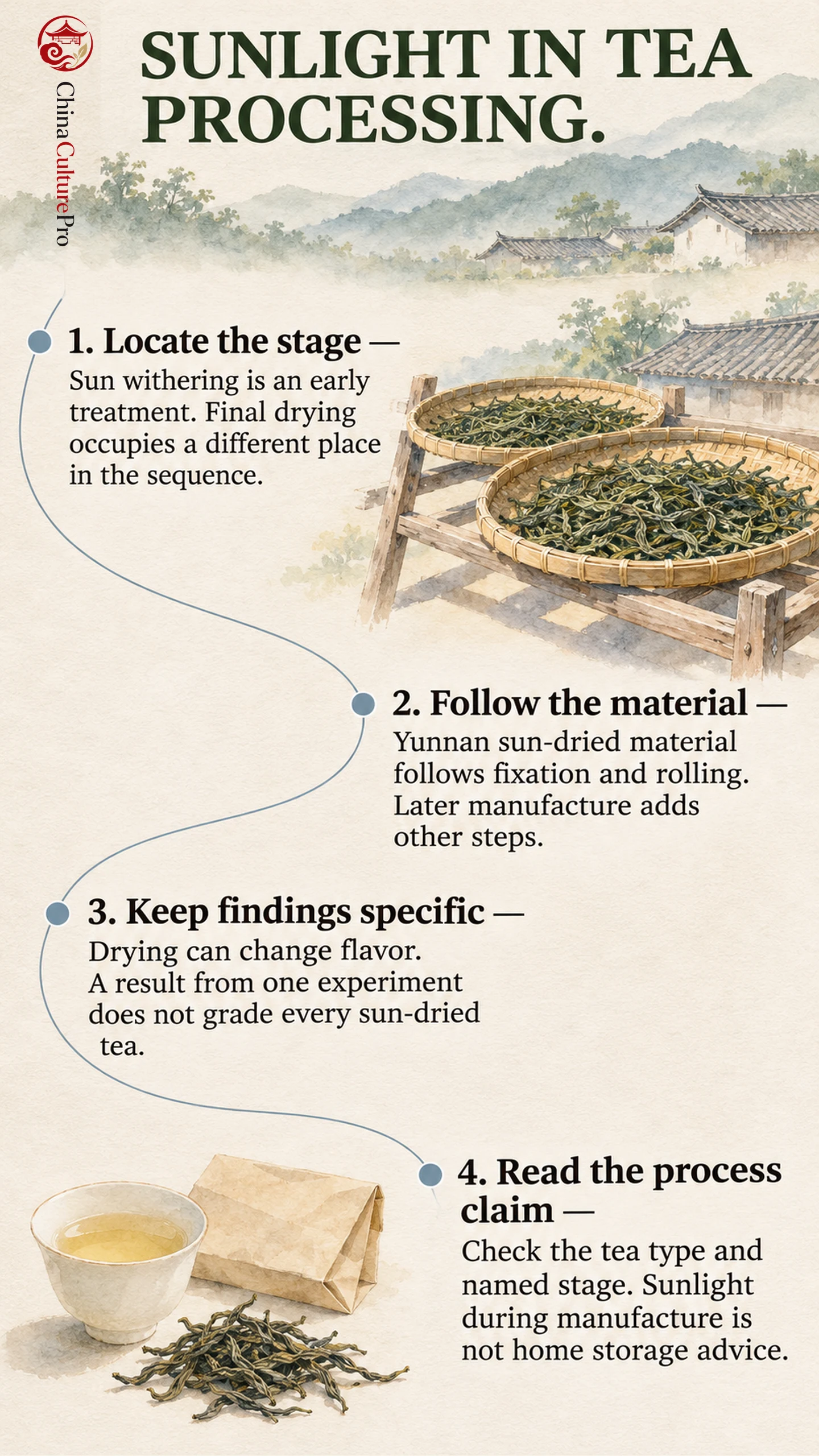
A photograph of tea spread across bamboo trays tells you where the leaves are, but less about what is happening to them. They might be at an early wilting stage or approaching the end of initial manufacture. Understanding the surrounding steps makes “sun-dried” a useful description rather than a vague promise of traditional quality.
Sun Drying and Sun Withering Occupy Different Stages
Sun withering(日光萎凋,rìguāng wěidiāo)is an early treatment of fresh leaves. For example, Taiwan’s Tea and Beverage Research Station places sunlight exposure near the beginning of Dongding oolong manufacture. Indoor withering and stirring, fixation(杀青,shāqīng), shaping, drying and roasting follow.[2] Those leaves have seen sunlight without necessarily receiving their final drying from it.
White tea provides another clear example. In a published experiment using the Longjing 43 cultivar, one group was withered under sunlight and subsequently finished in a tea dryer. The sun treatment and the final machine drying were separate operations.[3] This demonstrates one documented method; it does not prescribe every white tea’s manufacture.
| Пример | Where sunlight appears | What the description establishes |
|---|---|---|
| Yunnan sun-dried material | After fixation and rolling | Sunlight supplies a drying stage |
| Dongding oolong | Early withering | Later processing and drying still follow |
| Experimental white tea | Withering before machine drying | Sun-withered need not mean sun-finished |
Ask which steps came immediately before and after exposure. “The tea was put in the sun” is incomplete information. Our guide to tea withering explores the earlier stage in more detail.
Yunnan Sun-Dried Tea and the Pu-erh Production Chain
Yunnan offers a well-documented context for sun drying. The 2008 geographical-indication announcement for Pu-erh(普洱茶,Pǔ’ěr chá)sets out a raw-material sequence: spreading fresh leaves, fixation, rolling, loosening clumps and sunlight drying.[1] Sunlight does not replace the earlier heat treatment.
The resulting maocha(毛茶,máochá)is tea at the initial-manufacture stage. The same document separates later paths: sheng(生,shēng)Pu-erh involves refining, steaming and pressing, while shou(熟,shú)Pu-erh includes post-fermentation. Compressed tea also undergoes drying after steaming.[1] A finished cake’s production history therefore contains more than the original exposure to sunlight.
Keep the material, intermediate stage and finished product distinct. Calling something “sun-dried” does not by itself supply its growing location, cultivar or subsequent treatment. Nor does every use of sunlight elsewhere in Chinese tea production make the result Pu-erh.
For the related processing distinction, see raw versus ripe Pu-erh. For the earlier heat treatment, see tea fixation.
What Sun Drying Can Change in Flavor
Drying can influence the cup as well as remove water. A 2026 experiment compared three drying methods after spreading, fixation and rolling of Mengku large-leaf material. Within that experiment, the sun-dried group had stronger sweetness and umami than the hot-air-dried and pan-dried groups, with a mellow, thick mouthfeel and sweet aftertaste.[4]
That result belongs to the tested material and conditions. It is evidence of a sensory difference, rather than a guarantee that any packet marked “sun-dried” will taste sweeter than any heated tea.
A separate study of sun-dried black tea used two cultivars and found that their chemical responses differed. Sun drying changed taste, aroma and infusion color, but cultivar influenced the changes in catechin and amino-acid components.[5] The starting leaf and earlier manufacture remain part of the explanation.
For drinking, record aroma, basic tastes, mouthfeel and finish separately. A pleasant smell does not tell you whether the liquor feels thick, whether bitterness persists or whether sweetness appears afterward. Likewise, “sunshine aroma” on a label is a sensory description, rather than independent proof of a manufacturing record.
Compare samples within a clearly defined question. Two teas of similar origin and production style offer a more focused drying comparison than an unrelated white tea and a heavily roasted oolong. If several variables differ, describe the cups without assigning every difference to sunlight.
The drying experiments discussed here measured finished samples, not decades of storage. Their flavor results cannot establish a universal promise that a particular cake will improve with age.
Weather, Processing Claims and Drinking the Finished Tea
Sunlight-based processing need not mean leaves exposed on bare ground. Taiwan’s National Cultural Memory Bank documents a modern Dongding withering arrangement with a light-transmitting roof, shade netting and adjustable ventilation. Its description explains how the sheltered space responds to changing weather before leaves move indoors.[6] This is a withering example, not a description of every Yunnan drying operation.
Equipment and shelter need context. Seeing a roof does not prove sunlight was absent; seeing open trays does not establish that the leaf was fully dried. The stage and the producer’s account matter more than a picturesque photograph.
When reading a product description, look for the tea type, origin and production date alongside the named processing stage. Ask whether “sun-dried” refers to initial material or whether “sun-withered” describes an earlier operation. A specific account helps explain manufacture; a broad claim such as “all natural” does not identify the processing stage.
Brew the finished tea according to its particular style and the product guidance. A sun-dried raw-material history is not one brewing recipe shared by every resulting tea. Record the leaf amount, water and infusion conditions if you want to compare cups fairly.
Manufacturing sunlight exposure also is not an instruction to re-sun purchased tea. Follow the finished product’s storage directions; the next useful step is understanding its production history, rather than trying to reproduce a factory stage at home.
FAQs About Chinese Tea Sun Drying
Is sun drying the same as sun withering?
No. They can occupy different stages. Check the surrounding steps rather than translating every sunlight treatment as final drying.
Is all sun-dried tea Pu-erh?
No. Sunlight is a processing resource, not a complete tea identity. The material and subsequent manufacture matter.
Does sun drying guarantee better flavor or aging?
No. Flavor findings depend on the tested tea and conditions, and a drying comparison is not a long-term aging trial.
Should I put purchased tea in the sun?
No. A manufacturing description does not instruct consumers to repeat the process. Follow the product’s storage guidance.
Источники
[1] AQSIQ. 2008 Announcement No. 60: Pu-erh Geographical-Indication Protection
[2] Tea and Beverage Research Station. Dongding Oolong Tea
[3] Frontiers in Nutrition. Heated Withering Methods for White Tea from Longjing 43
[4] Zhengfei Luo et al. Taste and Mouthfeel of Raw Pu-erh Tea under Different Drying Methods
[5] Chenxin Xie et al. Taste Chemical Characteristics of Sun-Dried Congou Black Tea
[6] National Taiwan Craft Research and Development Institute. Modern Dongding Oolong Manufacture: Sun Withering