


Quick Answer: What Was a Chinese Stern Rudder?
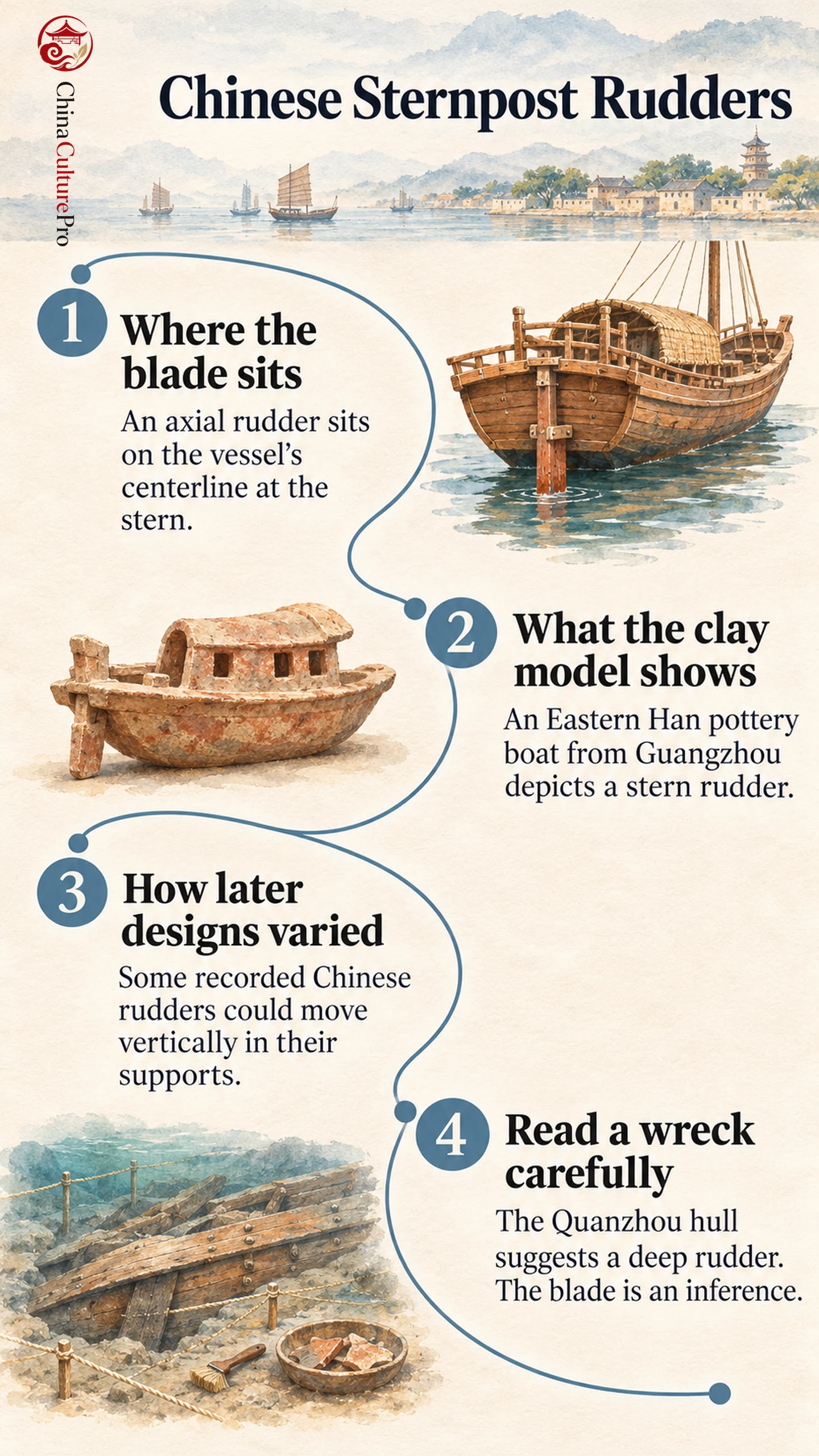
A stern rudder (舵, duò) steers from the back of a vessel. A pottery boat from Eastern Han Guangzhou shows one on the vessel’s centerline. Later Chinese ships used more than one way to hold or suspend a rudder in that position.[1][2][3][4]
- Where it sat: An axial rudder lies on the vessel’s centerline at the stern.[1][3]
- Early evidence: The Guangzhou pottery boat preserves a representation of the stern and steering gear.[1][2]
- Later variation: Some recorded Chinese rudders could move vertically in their supports.[4]
A centerline position alone leaves the method of attachment open.[1][3][5]
Look at the back of a boat model before deciding what kind of rudder it shows. A blade at the center of the stern tells you where the steering took place. A claim about the attachment needs evidence from the support or mounting. That distinction matters when descriptions use “sternpost” for several different arrangements.[1][3]
What the Position of the Rudder Tells You
A rudder blade changes the direction of water flowing past it when turned, which helps turn the vessel. An axial rudder sits on the centerline. A steering oar can also help change direction, but its location, support and way of working can differ from those of a rudder mounted at the stern. Historical depictions can show more than one kind of steering equipment on a single boat.[3][5]
A stern-mounted rudder is identified by where it sits. “Sternpost-mounted” makes a narrower claim about which part of the hull supports the assembly. In Chinese maritime history the broad term is useful when a model shows an axial blade but the surviving evidence does not resolve how it was fixed.[1][3][4]
A rudder works in combination with the hull and rig. The traditional Chinese sail types describe how the rig gathered wind. The form of the hull and the depth of the rudder influenced how a ship responded once it was moving.[4][5]
What the Guangzhou Pottery Boat Shows
An Eastern Han ceramic boat from Guangzhou is among the early surviving representations of a stern rudder. The published museum exhibit shows an anchor at the bow and the rudder at the opposite end, with its shaft held at the stern. That arrangement gives the viewer two identifiable points even when the shape of the hull is hard to read.[1][2]
Burial models from Guangzhou include wooden and ceramic examples, with different equipment and details preserved. A model can establish that a form was represented when the object was made. It does not provide the dimensions, fastening details or performance of a full-size ship. The local collection gives this model a broader context of boatbuilding during the Han dynasty.[1][2][3]
When comparing two illustrations, check the source’s object description. A photograph, a museum reconstruction and a drawing of a surviving piece can each be informative, but they may show different amounts of original evidence. The technique of reading the object and its interpretation separately is also useful for Chinese historical sources.[1][2][5]
What Later Ships Add to the Evidence
Recorded Chinese vessels include rudders held in wooden supports that allow some vertical movement. A large rudder could also be suspended from above. The ability to move it mattered because the depth suitable in open water could differ from the depth available near the shore. These arrangements concern the support and use of the blade as well as its position.[4]
Shipwreck studies may have to work from indirect evidence. In the published analysis of the Quanzhou wreck, the shape of the surviving hull helped suggest a large, deep rudder. That is a reasoned reconstruction from hull characteristics, distinct from measuring a complete steering assembly in place. The same wreck provides a useful comparison for Chinese ship bulkheads, where surviving timbers answer different questions about the inside of the hull.[5]
FAQs About Chinese Stern Rudders
Is every stern-mounted rudder a sternpost rudder?
Stern-mounted describes the rudder’s position. Sternpost-mounted refers to a specific support. When only the position is clear, “stern-mounted” or “axial” is the more precise description.[3][4]
Why could some traditional Chinese rudders be raised?
A vertically movable blade could be raised when the vessel entered shallower water. Recorded support arrangements allowed that movement on some boats.[4]
Does the Han model establish who invented the rudder?
The model establishes that a stern rudder was represented in Eastern Han Guangzhou. It cannot identify a first inventor or the date the design first went into use.[1][2][3]
Источники
[1] National Museum of China. Guangzhou Qin and Han Archaeology Exhibition: Eastern Han Pottery Boat
[2] Guangzhou Museum. Han Dynasty Boat Models Excavated in Guangzhou
[3] Abphirada Komoot. Maritime Connections in the Indian Ocean World, Part 2
[4] Michael Flecker. The Temasek Wreck, Temasek Working Paper No. 4
[5] Nick Burningham and Jeremy Green. Description of the Quanzhou Ship