
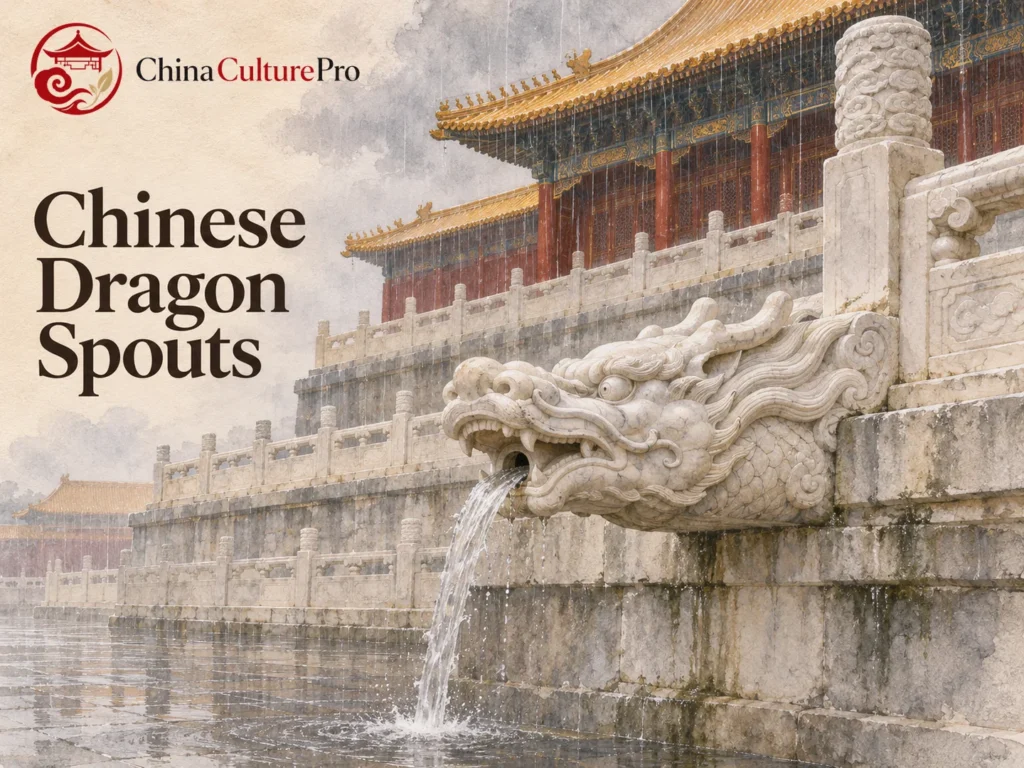

Quick Answer: What Are Chishou Dragon Spouts?
At Beijing’s Forbidden City, the Palace Museum calls the carved stone dragon spouts around the Hall of Supreme Harmony terrace chishou (螭首, chīshǒu). They project from the platform below the railing. Rainwater leaves through a passage in the mouth of a working spout.[1][2]
- Find the edge: Look beneath the terrace railing and its upright posts.[1][2]
- Find the opening: An outlet through the mouth identifies the working drain.[2][3]
- Look up separately: Large animals on the roof ridge have their own names and functions.[1][4]
“Gargoyle” is a useful English description for a carved water outlet. On this palace terrace, the structure doing the draining sits below the hall.[1][2]

The distinction becomes visible during rain. Water falls away from the edge of the platform in separate streams, from the mouths of the working outlets.[2]
How the Stone Dragon Drains a Terrace
The three principal Outer Court halls share a large, tiered platform. Along its edge, the railings stand above a series of carved heads. Water landing on the platform follows the slight fall of its paved surface. An inlet at the edge leads into the stone spout, and the opening in its mouth releases the water outside the face of the terrace.[1][2][5]
The projecting head carries the outlet clear of the stonework below. From the courtyard, the mouth may look like an opening carved for expression alone. From the platform side, the inlet reveals where the channel begins.[2][5]
In heavy rain, the streams are popularly described as “a thousand dragons spouting water.” Accounts distinguish large corner heads from the smaller pierced heads along the railing. Check for a through-opening before identifying an individual carving as a working outlet.[2][3]
How Terrace Spouts Differ From Roof-Ridge Dragons
Dragon imagery appears at several heights in traditional Chinese architecture. The Palace Museum calls a large terminal at the end of the main roof ridge a zhengwen (正吻, zhèngwěn). It covers the junction of roof surfaces and often appears to grip the ridge in its jaws.[1][4]
| Характеристика | Where to look | What the fitting does |
|---|---|---|
| Dragon spout on a palace terrace | Below the balustrade, projecting outward | Releases water from the platform through a channel |
| Large roof-ridge terminal | At the end of the highest horizontal ridge | Covers and helps weatherproof the roof junction |
The direction of the mouth offers another clue. The terrace outlet faces out over the platform edge. A roof-ridge dragon typically faces inward toward the ridge it appears to grasp.[1][2][4]
Why the Same Stone Heads Have Different Names
The Palace Museum uses chishou in its English presentation. Some Chinese accounts call the heads corner beasts, and a Beijing Daily account proposes gongfu (蚣蝮, gōngfù), drawing on a traditional water-associated creature. Published names differ for these palace drains.[1][2][5]
For a description of the building, identify the object and its job first. “Carved stone dragon spout beneath the terrace railing” tells a reader where to look and how the fitting works. The name can then follow the source discussing that example.[1][2][5]
FAQs About Chinese Roof Gargoyles
Are the Forbidden City’s chishou spouts on the roof?
The best-known working examples project from the tiered stone platform below the Outer Court halls. The roof’s large animal terminals occupy the main ridge ends.[1][4]
Does every stone dragon head discharge water?
A working spout has a passage through the stone. Some prominently carved corner heads are described separately from the pierced heads along the terrace edge.[2][3]
What does gargoyle mean in this context?
It describes a carved figure that functions as a water outlet. “Dragon spout” also identifies the shape and the drainage role.[1][2]
Источники
[1] Музей Гугун. Five Features to See at the Forbidden City
[2] Beijing Daily. The Forbidden City’s Dragon Spouts During Rain
[3] China.org.cn. Dragon Motifs in the Forbidden City
[4] Palace Museum. Architectural Glossary: Main-Ridge Terminal
[5] Beijing Daily. How the Forbidden City Drained Rainwater