
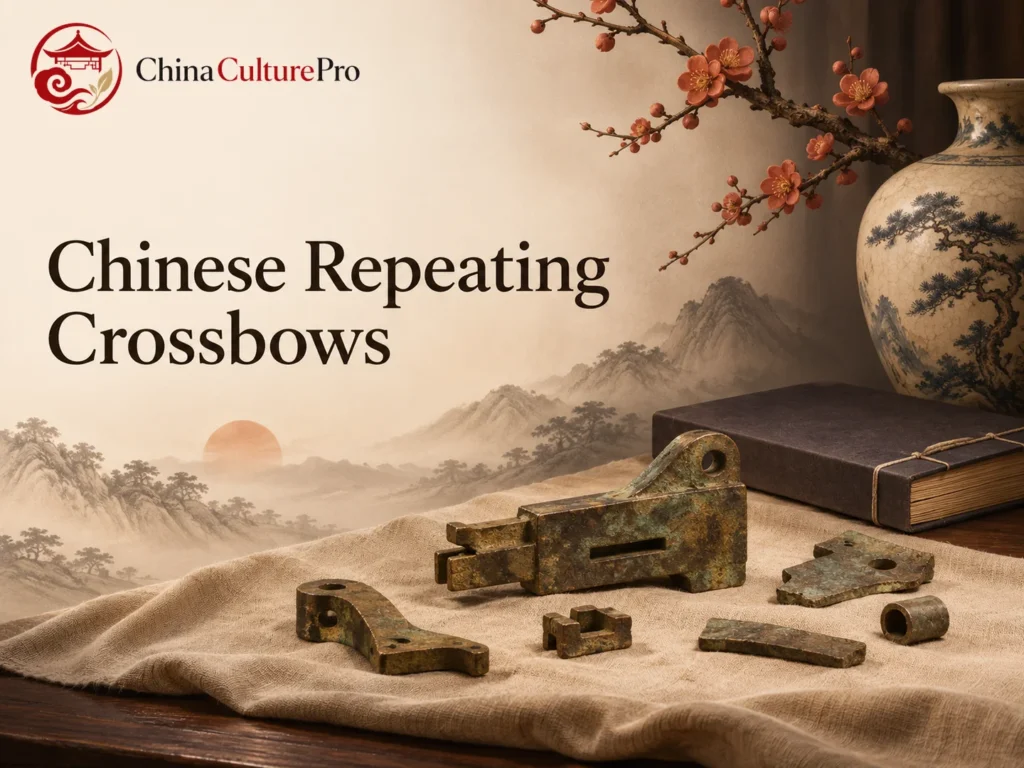

Quick Answer: What Was a Chinese Repeating Crossbow?
A Chinese repeating crossbow (连弩, liánnǔ) was a historical weapon made to discharge bolts in succession. The name covers objects from different centuries, including a Warring States find from Chu and examples in nineteenth-century collections.[1][2][4][5]
- Earliest physical evidence: A Chu tomb at Qinjiazui in Hubei contained an early example.[1][2]
- The famous attribution: A later text credits Zhuge Liang (诸葛亮, Zhūgě Liàng) with an improved repeating crossbow.[3]
- Surviving later examples: Museum records use names such as “Chu-ko-nu” for objects made centuries after his lifetime.[4][5]
The tomb find places the idea of a repeating crossbow well before the Three Kingdoms period. The famous name comes from a later association.[1][2][3]

The story usually begins with a person’s name. The objects tell a longer story. A find from an excavated tomb supplies a date range. A transmitted historical account preserves a claim about someone. A later museum specimen records the name used for a surviving object. Comparing the three records shows how a much older technology acquired a name still used in catalogues.
What the Warring States Find Establishes
In 1986, excavators recovered an early repeating crossbow from Tomb 47 at Qinjiazui in present-day Hubei. The site lay in the territory of Chu during the Warring States period. The burial context puts the find several centuries before Zhuge Liang.[1][2]
The excavated object preserves wood and bronze, a useful combination for reading a technology often represented by isolated metal finds. The museum identifies the piece as a type designed for repeated discharge, with the unusual capacity to discharge a pair of bolts together. The burial documents that form in Chu. Its broader use is harder to establish from one find.[2]
The excavation number matters as much as the familiar label. A record that identifies Tomb 47 can be compared with other objects from the site and with accounts of when the burial was excavated. An isolated find from an old collection may still be informative, but may offer less certainty about the place or period in which it was used. The same difference matters when reading primary and secondary sources for Chinese history.[1][2]
Why the Crossbow Carries Zhuge Liang’s Name
Zhuge Liang served Shu Han in the third century CE, during the Three Kingdoms period. The name Zhuge crossbow (诸葛弩, Zhūgě nǔ) preserves his association with a repeating form. One later compilation transmits a passage from the Wei Shi Chunqiu (魏氏春秋, Wèishì Chūnqiū) that calls a repeating crossbow improved by him “Yuanrong” (元戎, yuánróng). The attribution concerns an improvement to an existing form.[3][4]
Read the passage alongside the Chu find. The passage tells us that an association between Zhuge Liang and a repeating crossbow circulated in the written tradition. Tomb 47 tells us that people made a repeating form well before he lived. Neither source identifies the exact relationship between the artifact in the tomb and the object named in the passage.[1][2][3]
The distinction also explains why the same name can mean different things in two places. A history may use it while discussing Zhuge Liang’s career. A museum catalogue may use it as a name for a later type. The catalogue label can be accurate even when the object was made many centuries after the person who gave the type its familiar name.[3][4][5]
How to Read Later Museum Examples
The Horniman Museum lists object 7.334i as a repeating crossbow and a Zhuge crossbow. The Bath Royal Literary and Scientific Institution uses the older spelling “Chu-ko-nu” for its Chinese example FA044 and assigns that specimen to the nineteenth century. These catalogue entries give readers two spellings to look for and two independently identified objects to compare.[4][5]
In a museum entry, separate the object’s date from the earliest date discussed in the description. Then check whether the record identifies where the piece was found, when it entered the collection or how it was dated. A nineteenth-century specimen demonstrates the type existed at that point. Connecting it to the object described in a much earlier source requires additional evidence.[1][3][4][5]
FAQs About Chinese Repeating Crossbows
Did Zhuge Liang invent the repeating crossbow?
A transmitted text associates him with improving a repeating crossbow. The Warring States find at Qinjiazui places a repeating form several centuries before his lifetime.[1][2][3]
What does Chu-ko-nu mean?
Museum collections use “Chu-ko-nu” as an older romanized name for the Chinese repeating crossbow associated with Zhuge Liang. In modern pinyin, the corresponding name is Zhūgě nǔ, meaning Zhuge crossbow.[4][5]
Is the earliest surviving example the first one ever made?
An excavated object shows that a technology existed by the period of its burial. Earlier objects may not have survived or been found, so the earliest known specimen gives a date by which the technology existed.[1][2]
Источники
[1] Roger Blench. Ethnographic and Archaeological Correlates for a Mainland Southeast Asia Linguistic Area
[2] Jingzhou Museum curator Yang Kaiyong and colleagues. The Warring States Repeating Crossbow in the Jingzhou Museum Collection
[3] Chinese Text Project. Shu Zhong Guang Ji, Volume 69
[4] Horniman Museum and Gardens. Repeating Crossbow, Object 7.334i
[5] Bath Royal Literary and Scientific Institution. Arms and Armour Collection, FA044