


Quick Answer: What Were the Five Night Watches?
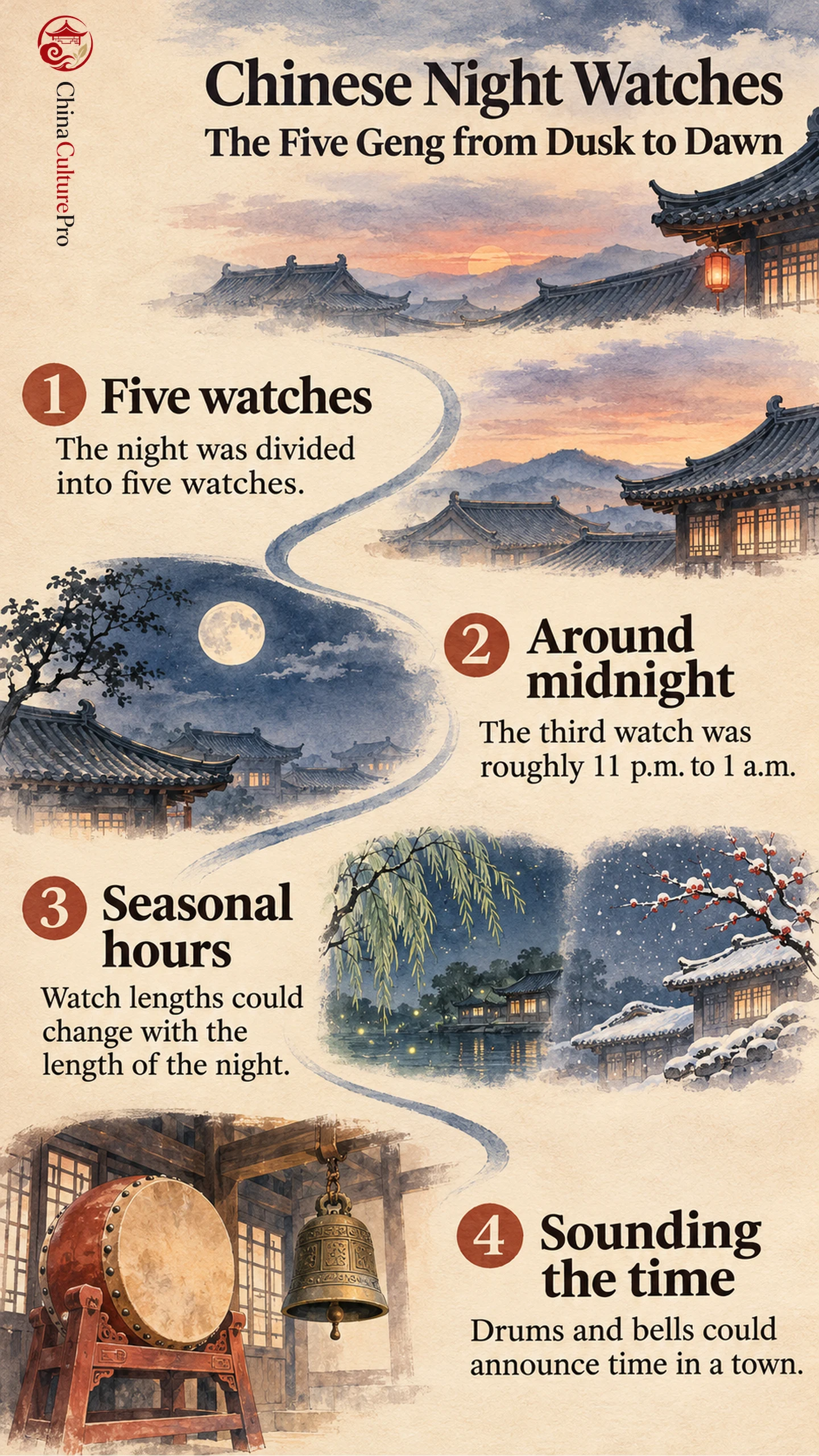
In traditional Chinese timekeeping, a night watch (更, gēng) was one of five divisions of the night. In a common modern conversion they run from about 7 p.m. to 5 a.m., with the middle interval straddling midnight. Historical watch lengths could vary with the season. [1][2][3]
- Start: The first watch (初更, chū gēng) marks early night, conventionally around 7 to 9 p.m. [1][2]
- Midnight: The third watch (三更, sān gēng) spans about 11 p.m. to 1 a.m. [2][4]
- Before dawn: The fifth watch (五更, wǔ gēng) is conventionally about 3 to 5 a.m. [1][2]
Use the clock times as a reading aid. A watch in a historical account usually gives a part of the night.
At a monastery near Mount Tiantai, the Ming traveler Xu Xiake heard a voice in a dream during the fifth watch and could hardly sleep afterward. At dawn he rose to climb the mountain. The diary gives the moment in the night by counting watches. [7]
The Five Watches and Their Approximate Times
In a description of timekeeping, the term five watches (五更, wǔ gēng) can name the whole system. When a diary says something happened at the fifth watch, the same characters identify the final interval before dawn. The table uses the clock equivalents supplied by the editors of Xu Xiake’s diaries. [1][2]
| Watch | Approximate clock time | Part of the night |
|---|---|---|
| First watch (初更, chū gēng) | 7 to 9 p.m. | Early night |
| Second watch (二更, èr gēng) | 9 to 11 p.m. | Late evening |
| Third watch | 11 p.m. to 1 a.m. | Around midnight |
| Fourth watch (四更, sì gēng) | 1 to 3 a.m. | After midnight |
| Fifth watch | 3 to 5 a.m. | Before dawn |
A separate system divided the full day into twelve double hours (时辰, shíchén). In the modern clock conversion, the middle watch coincides with the double hour around midnight. The watch number and the name of a double hour tell you which system a passage is using. [2][3][4]
Why the Watches Changed with the Seasons
The Palace Museum describes the watches as beginning at sunset and ending at sunrise. Where timekeepers adjusted the schedule to the length of the night, the five watches were longer in winter and shorter in summer. An account that gives only a watch number leaves the exact minute uncertain. [1][3]
Song court records describe a finer scheme in which each watch was divided into five points (点, diǎn). Drums marked the watches and bells marked the points. When both units appear in a Song court record, the point narrows the timing to part of the named watch. [3][5]
How a Watch Became Audible
People could hear the time in the streets. In Beijing, the Drum and Bell Towers served the old city’s timekeeping and announcing functions. The editors of Xu Xiake’s diaries describe officials overseeing bell or drum signals in towns and cities, with night watchmen often announcing time in villages. Bells and drums were among the instruments used to communicate time after it had been measured. [2][3][6]
Xu Xiake sometimes uses a numbered drum in place of a numbered watch. In the convention adopted by the editors, a third drum would correspond to the third watch. The idiom in the middle of the night (三更半夜, sān gēng bàn yè), also uses the third watch to suggest the hours around midnight. [2][4]
FAQs About Chinese Night Watches
Did the third watch begin at midnight?
The usual modern equivalent spans 11 p.m. to 1 a.m., with midnight near the center. [2][4]
Is a watch always two hours?
Two hours is the common modern equivalent. Historical schedules based on dusk and dawn could change with the season. [1][2][3]
Источники
[1] Музей Гугун. Гэн
[2] University of Washington Press. Conventions in the Travel Diaries of Xu Xiake
[3] People’s Tribune. Timekeeping Systems in Historical China
[4] Taiwan Ministry of Education. In the Middle of the Night
[5] History of the Song. Volume 70, Water Clocks
[6] Beijing Municipal Government. The Drum and Bell Towers
[7] Xu Xiake, translated in Wading Barefoot through a Mountain Stream. A Sightseeing Trip to Mount Tiantai