


Quick Answer: What Is KTV in China?
KTV is a common Chinese term for a venue where people sing karaoke (卡拉OK, kǎlā OK). Friends, relatives or colleagues can book a private room (包厢, bāoxiāng) with microphones, a song catalogue and a screen that displays the lyrics over the backing track.[1][2]
- Setting: The room gives one group control of the music and an audience of people they know.[1]
- Occasions: KTV has been used for birthdays and other gatherings as well as informal evenings out.[1]
- Participation: People take turns choosing songs, sing duets or join in during familiar choruses.[1]
The setup makes it possible to spend an evening together even when only a few people want the microphone.
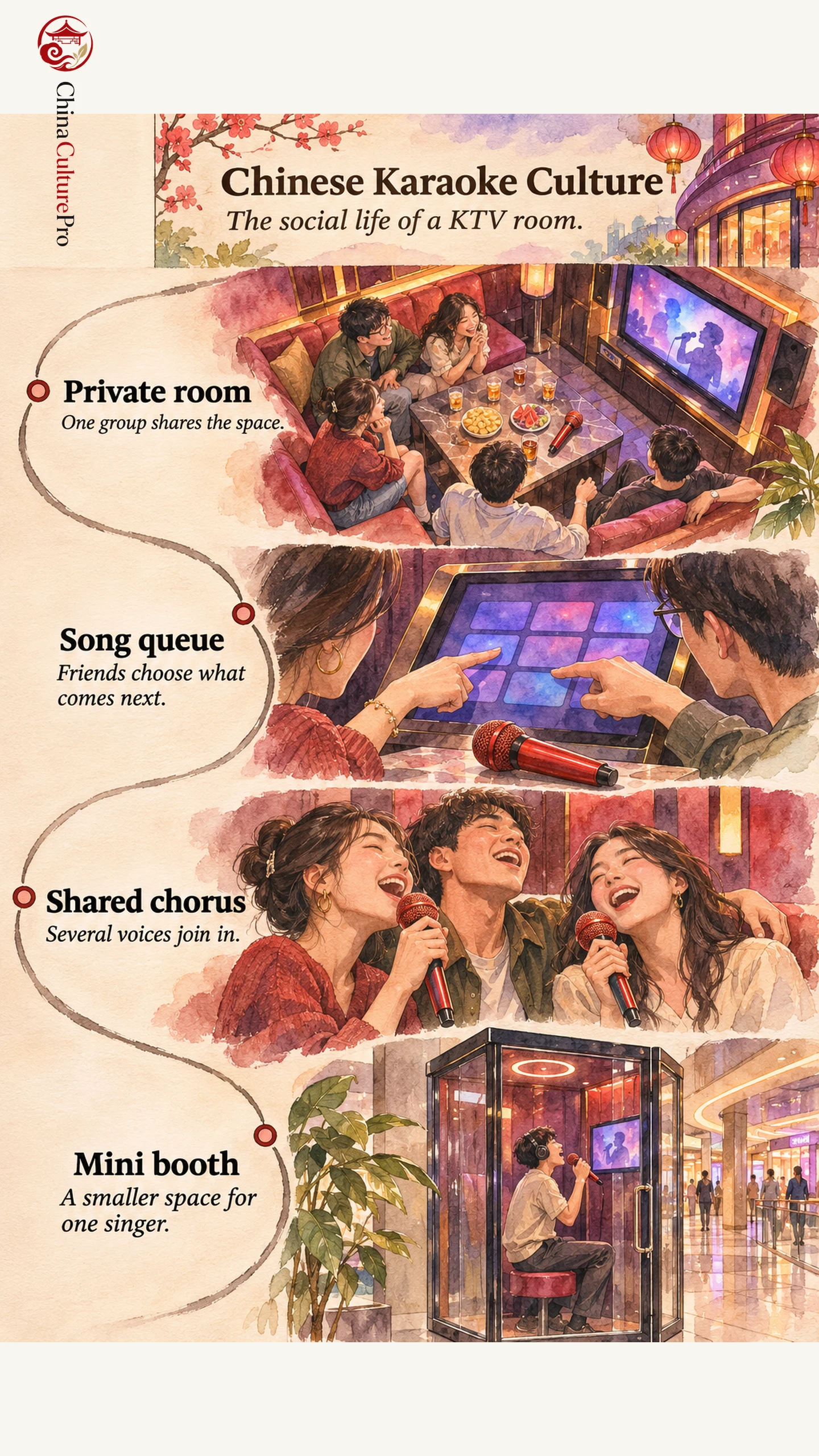
A song ends, someone passes a microphone across the sofa and the next set of lyrics appears. Inside a KTV room, the group gets to make its own programme. That small change in who controls the music helped turn karaoke into an occasion for socializing.[1]
Inside a Chinese Karaoke Room
A typical room places sofas and a table in front of a large screen. A touchscreen or other controller lets the group search the catalogue and queue up songs. The singers follow the on-screen lyrics while the rest of the room listens, talks or sings along. The backing track keeps going even when a chorus attracts more voices than there are microphones.[1][2]
A large group may develop a queue in which several people take a turn. Duets and shared choruses give quieter participants a way to join in without carrying a whole song. Someone can also sit out and catch up with friends between tracks.
How KTV Changed Group Singing
Historical reporting from Beijing describes early karaoke halls where customers sang in front of other patrons. By the early 1990s, smaller venues with private rooms had begun to offer a different experience. The room mattered socially because customers could choose music and perform among acquaintances.[1]
The later spread of self-service KTV (量贩式KTV, liàngfànshì KTV) made this format familiar to a wider public. A Beijing newspaper recorded a family celebrating a grandfather’s birthday in one such room in 2002. Family gatherings were one use alongside outings with friends, and customers could bring different generations of music into the same session.[1][2]
What the Song Queue Reveals
A queue can move from a Cantopop ballad to a Mandarin duet and then to a song someone remembers from school. Eason Chan’s Cantonese song King of Karaoke became associated with the room experience itself. Someone who knows an older chorus can lead it, then hand the microphone to a friend who knows the next track.[2]
Fans may request a song by an artist they follow, but the room offers a different role from the organized audiences in Chinese idol culture. Here a listener can become the singer, change the mood with a different selection or invite someone else to take the next verse.
Karaoke Beyond the Private Room
Small karaoke booths appeared in places such as shopping centres and offered a shorter, more individual session. Some also let customers save and share a recording. Phone apps gave people another way to sing and record without arranging a venue. In a room, the shared queue and immediate reactions are still central to the experience.[1][3]
The private room can also find a new audience. In a 2025 account, a group of retired colleagues in Beijing met in a karaoke room to sing and talk during the day. They chose songs across decades, including Dao Lang and Jay Chou.[4]
FAQs About Chinese Karaoke Culture
What Does KTV Stand For?
KTV stands for Karaoke Television. In China the abbreviation usually refers to a karaoke venue, especially one offering private singing rooms.[4]
Do You Have to Sing at KTV?
You can listen, help pick a song or join a chorus. A private room gives the group room to decide how much each person wants to take part.
Does Chinese KTV Only Have Mandarin Songs?
No. Cantopop is part of the repertoire, and individual catalogues can vary by venue. If a language or artist matters to your group, look for that selection in the catalogue.[2]
Источники
[1] Beijing Daily via China News Service. From self-service karaoke halls to singing on phones
[2] Xinhua. KTV’s past and changing business formats in China
[3] Xinhua via State Council Information Office. Mini KTVs make a noise in China
[4] Xinhua. China Focus: The changing social life of karaoke