


Quick Answer: How Do Paths and Windows Shape Chinese Garden Views?
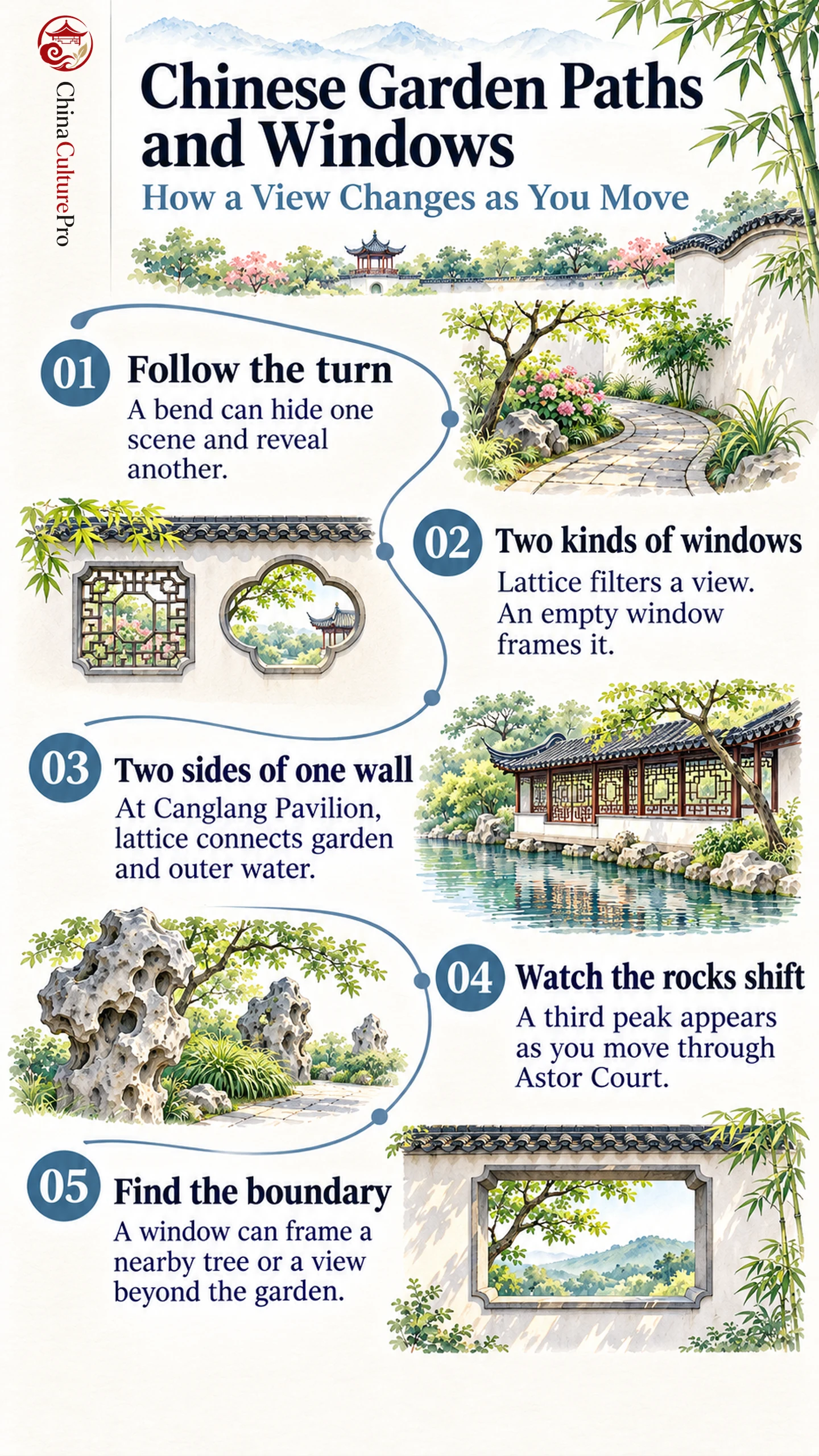
A Chinese garden path can reveal a scene in stages. A lattice window (漏窗, lòuchuāng) filters the scene through a pattern, while an empty window (空窗, kōngchuāng) gives an unobstructed opening within its frame. At Canglang Pavilion (沧浪亭, Cānglàng Tíng), a corridor and its windows connect views toward the garden and the water outside. [1][2][3]
- A turn changes what you see. A rock, wall or column can hide a detail until you reach a different angle. [1][4][5]
- A window connects views across a wall. Its size and pattern determine which parts of the other side are visible. [1][3][6]
- Movement and openings work together. A new object can enter the scene while the earlier view drops away. [4][6][5]
Compare what you can see from the middle of an opening and from a few steps to one side.
Through one opening you see the branch of a tree. A step to the side brings its trunk into view and hides part of the branch. Walking through a garden makes a series of small changes like this into a larger experience.
What a Winding Path Does
A path connects rooms, gates and views. In a classical garden, it can also control when a scene appears. A turn at a wall might lead from a short sightline to an open view across water. A covered walk can follow the shape of the ground or the edge of a pond, offering repeated changes of angle along the way. [1][4]
Movement and pausing do different work in Chinese garden design. On a covered walk, a nearby column or rock can shift across the line of sight faster than a feature on the far bank. At a stop such as a pavilion, the eye can settle on the relationship between them. Both a route and pavilions can make a particular part of a scene easier to notice. [1][6][5]
The Huntington’s account of its Suzhou-inspired Chinese garden compares the changing scenes to unrolling a painted scroll. The analogy is about the sequence of looking. From one part of the path, you can see the part available at that moment, while another section of the landscape lies ahead. [6]
Lattice Windows and Empty Windows
A lattice window has decorative openwork within the opening. It preserves the separation between two areas while allowing partial views between them. The pattern can make a branch or roofline appear in fragments. At another angle, the same pattern can obscure a different part of the scene. [1][3]
An empty window leaves the opening free of an internal lattice. It crops the scene at its outer edge. A gourd-shaped window at The Huntington is a modern example of how a distinctive outline can be both a frame and an object to look at. [1][6]
A doorway can work as a frame too. A moon gate also carries a walking route through the wall. The practical difference becomes clear if you ask whether a person stays on the near side to see the view or passes through the opening. [1][7]
The Double Corridor at Canglang Pavilion
At Canglang Pavilion, a double corridor follows water just outside the garden. The Suzhou garden bureau describes openwork windows connecting the views on both sides. The water and its bank can be seen in relation to the garden’s slopes and planting. The two sides remain divided by a wall. The openwork gives a person on one side glimpses of the scene on the other. [1][2]
Among the Suzhou gardens, this example is useful because the corridor has scenery on both sides. One side meets the inner garden. The other faces water beyond it. The lattice windows filter the view between them, turning the length of the corridor into a sequence of partial connections. [2][3]
A Scene That Changes in Three Steps
From the approach, notice what blocks part of the scene. It might be a wall, a pillar or a taller rock. At the next turn, look again to see which object still overlaps the others. From a place to pause, check whether another feature has come fully into view. These small shifts can make a short walk feel varied. [1][4][6]
The Met’s Astor Court, modeled on a Suzhou garden courtyard, provides a specific example. Its guide describes how a viewer can initially see two peaks to the right of the half-pavilion. A third peak appears from behind the central one as the viewer goes farther along the walk. The rocks remain in place while the line of sight shifts. [5]
An inscription can also give a route a theme. In a Suzhou garden bureau example, nine characters from a poem by Li Bai appear in nine patterned windows along a winding corridor. The verse evokes a breeze and moonlight that cost nothing. Garden names and plaques can make reading part of the pace of looking, especially when the words are distributed along the path. [4]
Framing, Borrowing and What You Can See
A frame can select something inside the garden, such as a planted bank or tree. A view that incorporates something beyond the garden can also involve borrowed scenery. The outside water at Canglang shows how the two ideas can work together along one route. [1][2][7]
First look at the outline and any lattice. Then locate the feature in relation to the garden boundary. The opening sets the edges of the view. The route takes you to another angle on the same scene. [1][3][6]
FAQs About Chinese Garden Paths and Windows
What is a lattice window in a Chinese garden?
It is an opening with decorative openwork that allows partial views through a wall. The pattern itself can also become part of the scene. [1][3]
What is the difference between an empty window and a moon gate?
An empty window provides a view through an open frame. A moon gate also serves as a passage a person can cross. [1][7]
Why do some garden paths bend?
A bend can follow the shape of the garden and change what becomes visible. One stretch may hide a view, and the next may bring a courtyard, pond or rock into sight. [1][4][5]
Источники
[1] Suzhou Bureau of Gardens and Landscaping. Architecture in Garden Design
[2] Suzhou Bureau of Gardens and Landscaping. Canglang Pavilion
[3] Suzhou Local Gazetteers Office. The Art of Lattice Windows in Suzhou Gardens
[4] Suzhou Bureau of Gardens and Landscaping. Winding Corridor
[5] The Metropolitan Museum of Art. A Chinese Garden Court
[6] The Huntington. Chinese Garden
[7] Smarthistory. The Garden of the Humble Administrator in Suzhou