


Quick Answer: How Did Chinese Fan Translation Develop?
Chinese fan translation includes subtitles and other translations made by people connected to a work or community. Online subtitle groups, or zimuzu (字幕组, zìmùzǔ), became prominent in the early 2000s as fans translated animation, television and film for Chinese-speaking viewers. Researchers describe teams sharing jobs such as translation, editing and timing. Some groups later translated for streaming services on commission. [1][2][3][4]
- History: Anime and imported television series were important early subjects. [1][2][3]
- Teamwork: Subtitles reflect both language choices and decisions about what fits on screen. [1][3][4]
- Distribution: A volunteer translation and permission to circulate the underlying work are separate questions. [1][2]
Read a subtitle’s credits and release context to understand who made it and for whom.
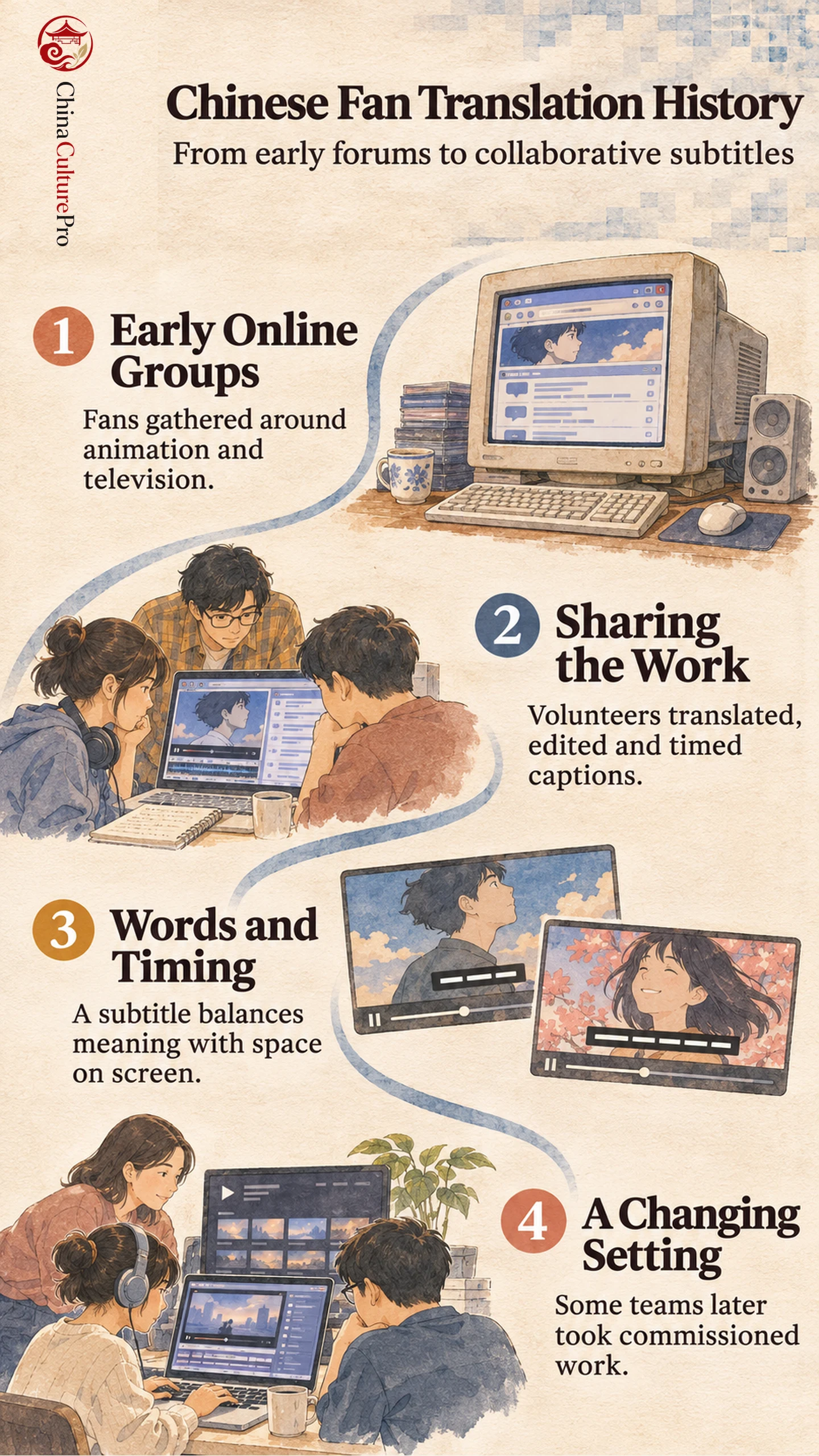
A translated line has to fit the time a character is speaking. A joke may also depend on a cultural reference the viewer has never heard of. In Chinese fan translation groups, several people could work on those problems before an episode reached its audience. [1][3][4]
How Online Subtitle Groups Became Visible
Studies place the rise of organized Chinese fansubbing around the turn of the century and its wider spread in the early to mid-2000s. The dates vary because studies trace different milestones, including individual fan translations, organized groups and coverage by mainstream media. Japanese animation and American television series both became subjects for volunteer translators. [1][2][3][4]
A study of audiovisual translation describes F6, a forum devoted to Friends that formed in 2003. Later research discusses groups such as YYeTs and Last Fantasy in more detail. Some forums formed around one show. Larger groups could work across several programs. The guide to Chinese fan communities gives the wider context for these forms of collaboration. [1][3][4]
What a Subtitle Team Did
The study of YYeTs describes an internal division of labor and ways to recruit and train volunteers. A translator works on meaning and tone. An editor checks the text and consistency across scenes. A timer decides when a caption appears and disappears. The roles can be assigned to different people or overlap in a smaller team. [1][4][5]
Timing affects how a joke lands. If a punch line appears too early, the viewer can read it before the actor says it. A caption that lasts too briefly can be hard to finish. A usable subtitle therefore depends on both the wording and its relationship to the sound and image. [1][3][5]
Why Some Fan Subtitles Look Different
Researchers have documented colloquial language and brief explanatory notes in Chinese fansubs. A group might keep a place name or title and add a short explanation, or choose wording a local audience understands more quickly. An explanation gives the viewer extra context. A familiar expression can be quicker to read. Extra context can help, but it also takes time and screen space. [1][3]
That trade-off is one reason the same line may look different across releases. The source dialogue, intended viewers, subtitle space and editorial choices all affect what appears. ACG culture in China explains one of the wider fan settings in which translations helped viewers discuss imported work. [1][3][4]
How Streaming Changed the Setting
As licensed streaming developed, some volunteers did commissioned work for media services. Wang and Zhang report that YYeTs was hired in 2010 to subtitle Lost for Sohu. That example shows that a group known for fan work could also produce translation for a commissioned release. The commission covered that particular release. [2]
For a particular release, check the credits and the publisher or platform behind it. For related questions about prose rather than timed captions, the guide to Chinese online literature and copyright culture covers a different publication setting. [1][2]
FAQs About Chinese Fan Translation
What does zimuzu mean?
It means subtitle group. In this context it refers to teams that worked together to make fan subtitles, sometimes sharing roles such as translating, editing and timing. [1][4][5]
Is fan translation the same as fansubbing?
Fansubbing is the subtitle branch of fan translation. Fan translation can also involve material such as written stories, comics or game text. [1][3][4]
Why do two subtitles for the same show differ?
Teams can use different wording, levels of explanation and timings. Their editors can also make different decisions about how much information fits a scene. [1][3][5]
Источники
[1] Dingkun Wang, The Journal of Specialised Translation. Fansubbing in China, with Particular Reference to the Fansubbing Group YYeTs
[2] Dingkun Wang and Xiaochun Zhang, Target. Fansubbing in China: Technology-Facilitated Activism in Translation
[3] Peng Gao, CLINA. Spanish Culture on Chinese Screen
[4] University of Manchester research repository. Amateur Translation and the Development of a Participatory Culture in China
[5] Cogent Arts & Humanities. Chinese Viewers’ Attitudes Toward Fansub Videos and Sponsorship