

Quick Answer: What Is Chinese Fan Dance?
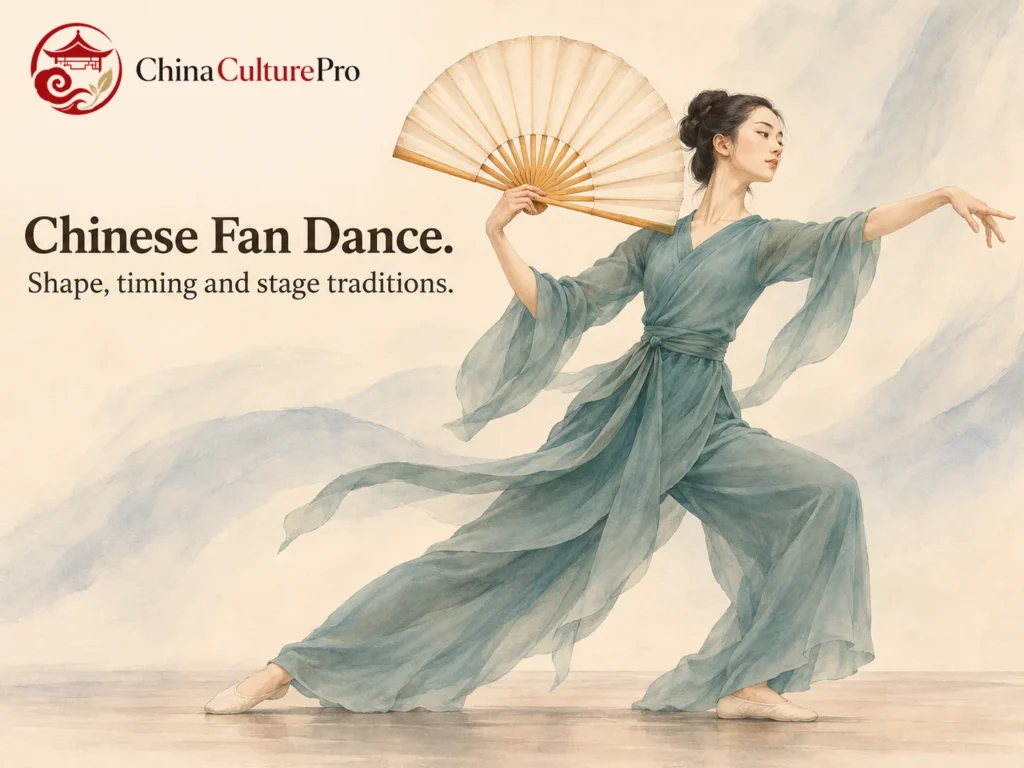
Chinese fan dance describes performances that use fans as part of their movement. In a regional folk form, a fan can belong to a particular role or routine. In a classical stage work, its shape can extend the line of a dancer’s arm or suggest another art, such as calligraphy.
A folding fan can open into a broad surface and close into a narrow line. Its timing can make a turn, pause or change in direction visible. The work’s title, the performers and the occasion help identify the tradition.
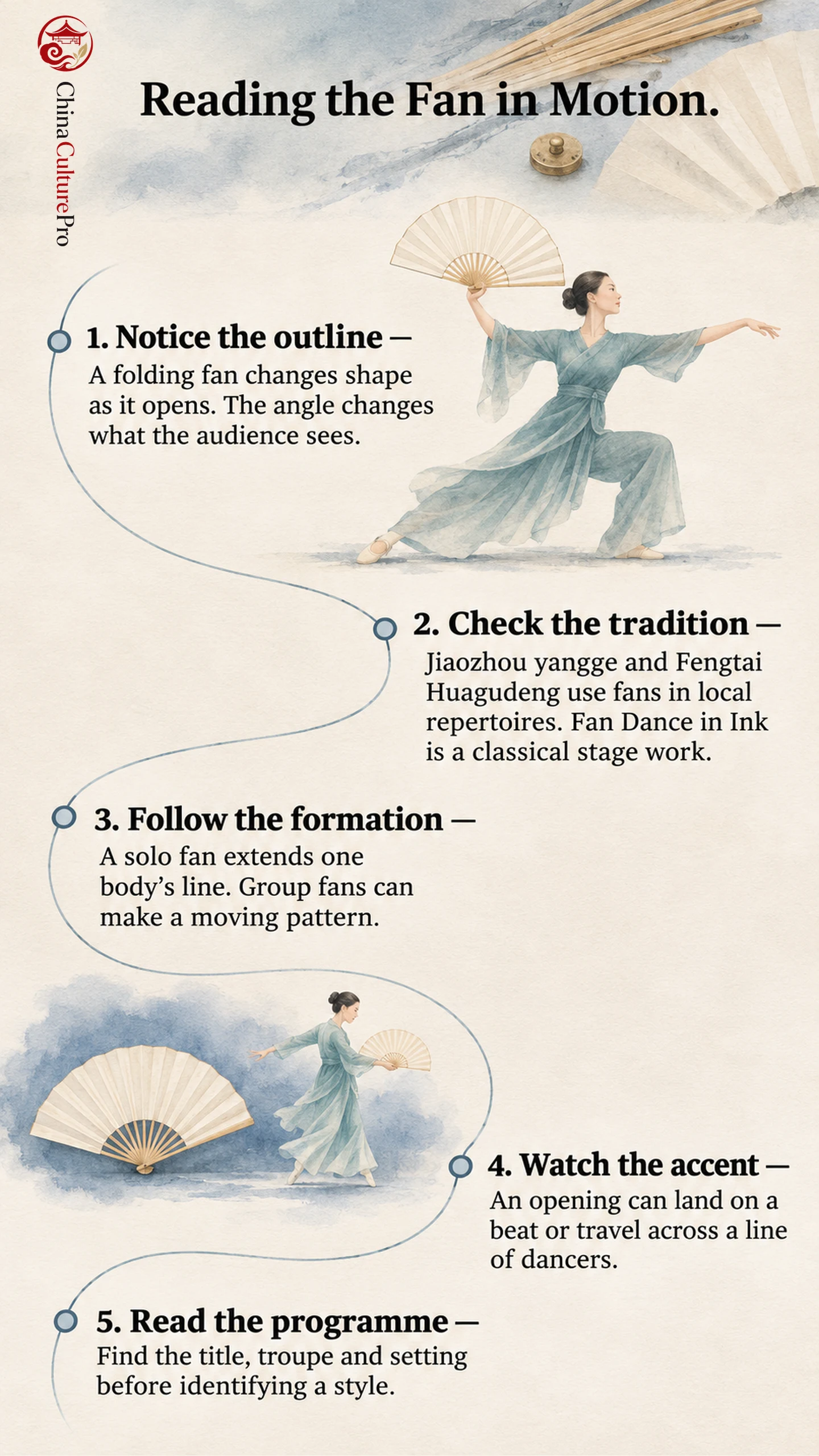
A fan can open after the dancer has already turned. For a moment, the audience sees a hand and then a broad surface of color. Following the gap between those two actions is a way to understand what the prop contributes.
What the Fan Adds to a Movement
A folding fan changes outline as its ribs spread. Held open, it shows a broad surface when the dancer faces it toward the audience and a narrow edge when turned sideways. A fixed fan keeps its shape, so angle and distance do more of the visual work. In both cases, the fan carries the movement beyond the hand.
A quick opening can accent the end of a gesture. A slowly moving open fan can make the direction of an arm more legible across a stage. Look first at how the object changes with the dancer. An open fan can extend a line in a solo or make a group formation easier to see.
Folk Dance and Classical Stage Examples
Fan movement takes different forms in Chinese traditional dance. A named role may carry the fan. An entire choreography may use it as a visual theme. These examples show how the same kind of prop can serve different purposes.
| Пример | Ситуация | What the fan does |
|---|---|---|
| Jiaozhou yangge(胶州秧歌,Jiāozhōu yānggē) | A Shandong form of yangge | The local repertoire includes a fan-bearing role and named fan gestures within a larger performance. [1] |
| Fengtai Huagudeng(花鼓灯,huāgǔdēng) | Folk dance and music from the Huai River area in Anhui | Varied fan movements are part of a style that emphasizes cooperation between roles. [2] |
| *Fan Dance in Ink*, Shanwu Danqing(扇舞丹青,Shànwǔ Dānqīng) | A Chinese classical dance work in the Beijing Dance Academy repertoire | The folding fan helps evoke the changing line and rhythm of calligraphy. [3] |
The Jiaozhou and Fengtai examples belong to regional repertoires, each with its own music and patterns of movement. *Fan Dance in Ink* is a named work within a modern stage and training discipline. You can compare what the fans do without assuming the dancers learned one shared choreography. [4]
Reading Fans in Group and Solo Work
In a group, look at where the fans sit in relation to one another. A row of open fans can make a line easy to see. If people turn at different moments, the visible surface can pass across the line from dancer to dancer. The group makes a single gesture into a pattern the audience can follow.
In solo work, you can focus on the relation between the fan and the performer’s body. Does the fan arrive at the same time as the step, or just after the dancer settles? Does the dancer turn the broad surface toward the audience or draw it toward the body? These choices shape the space around a single person.
How Choreography Uses Shape and Timing
Watch the outline when a fan is closed, opened or turned edge-on. In a classical work inspired by calligraphy, a sweep can suggest a stroke and a brief stop can suggest a change of direction. The audience sees a visual analogy, even without identifying a written character. [3]
Timing also gives a group movement structure. When several fans open on an accent, the change can be seen across the stage at once. When they open one after another, the eye follows the pattern through the group. Ribbon dance offers a useful contrast because a ribbon can continue tracing a path after the hand has changed direction.
How to Identify a Fan Dance Performance
Check the title, troupe and setting. A programme may name a local dance, an academy work or an excerpt from theatre. Those details help distinguish works that use similar props.
Then pick one short passage. Follow the arm through a change of direction and see whether the fan opens before, during or after it. If there are other dancers, compare their timing. The exercise works whether you are looking at a festival routine or a concert-stage solo.
FAQs About Chinese Fan Dance
Is there one traditional Chinese fan dance?
Fans appear in several forms. The local tradition or title identifies a particular performance.
Are all Chinese dance fans folding fans?
A folding fan is one option. Fixed fans and other fan shapes also give performers different outlines and ways of moving.
Is Fan Dance in Ink a folk dance?
It is a named Chinese classical stage work. Its folding fan helps evoke calligraphic movement.
Источники
[1] China Intangible Cultural Heritage Digital Museum. Jiaozhou Yangge
[2] China Intangible Cultural Heritage Digital Museum. Fengtai Huagudeng
[3] Beijing Dance Academy. Classical Dance Programme Featuring Fan Dance in Ink
[4] Beijing Dance Academy. Department of Chinese Classical Dance