
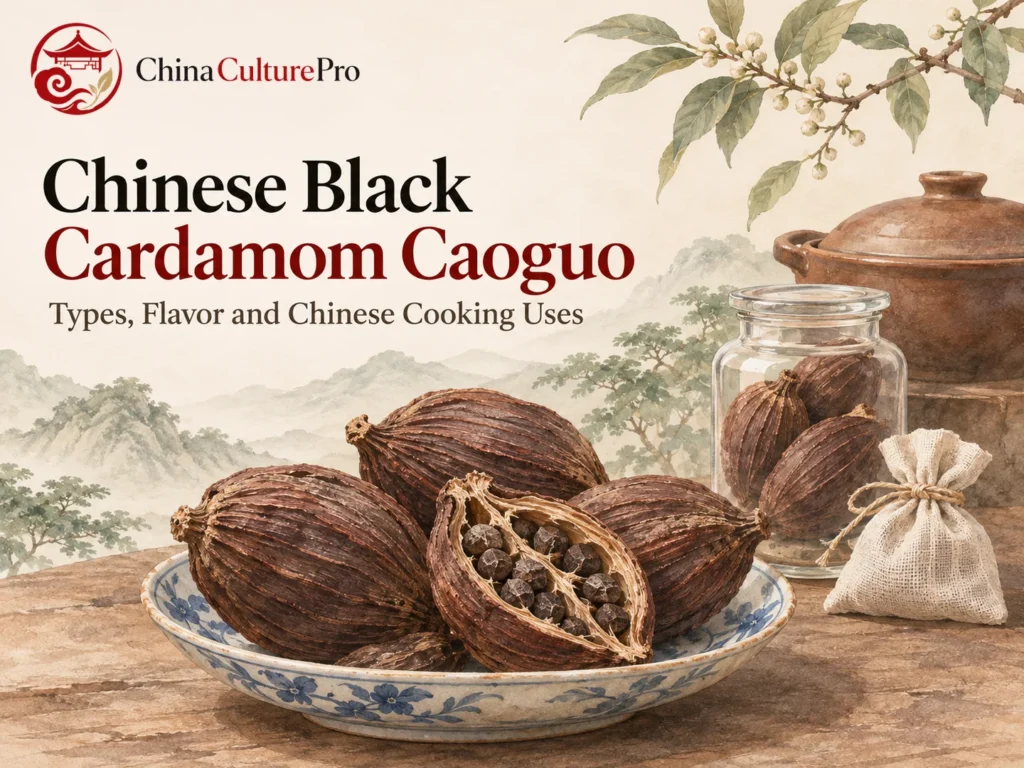

Quick Answer: What Is Chinese Black Cardamom?
Chinese black cardamom, or caoguo (草果, cǎoguǒ), is an aromatic dried fruit spice from the ginger family. Also sold as tsaoko or tsao ko, it has a ridged pod containing small seeds and is used in savory cooking.[1][2]
- Identity: Lanxangia tsao-ko, formerly called Amomum tsao-ko.
- Aroma: Piney, camphor-like and warm, with a smoky layer in smoked products.
- Food role: A supporting aromatic, rather than a source of chili heat or numbing flavor.
Check the name: “black cardamom” can refer to another plant.
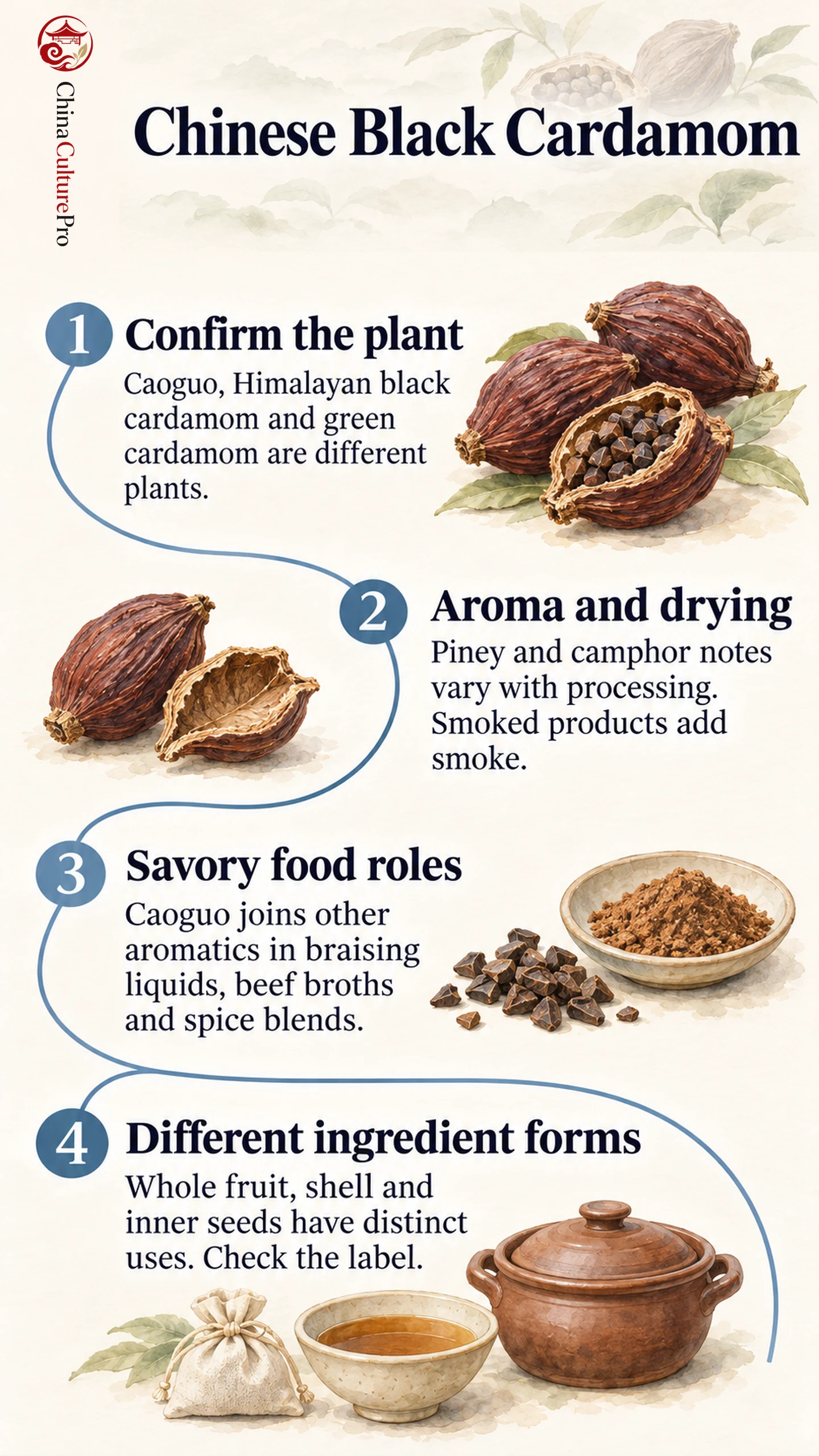
A dark, ridged pod in a spice packet can contribute a powerful aroma to the liquid around it. The useful distinctions are the plant behind the label, the effect of drying, and whether the preparation uses the whole fruit, shell or inner seeds.
Caoguo, Himalayan Black Cardamom and Green Cardamom
The accepted botanical name is Lanxangia tsao-ko. Older ingredient descriptions and packets may use Amomum tsao-ko. These names refer to the same plant, whose native range includes Yunnan and northern Indochina.[1]
| Shopping name | Ботаническая принадлежность | Важное различие |
|---|---|---|
| Caoguo or Chinese black cardamom | Lanxangia tsao-ko | The large-podded spice discussed here. |
| Himalayan or Indian black cardamom | Amomum subulatum | A separate plant used in South Asian rice dishes and meat preparations. |
| Green cardamom | Elettaria cardamomum | Another plant, with a sweet, floral aromatic profile and both sweet and savory uses. |
Caoguo pods are generally larger than Himalayan black cardamom pods, but size alone does not identify a product. Confirm the name; these are different plants, rather than large and small grades of the same spice.[2][3][4]
Piney Aroma, Camphor Notes and Smoked Products
Caoguo’s aroma can suggest pine, camphor and citrus alongside warmer spicy notes. Research comparing sun-dried, wood-dried and oven-dried fruits found distinct aroma profiles. Drying is therefore part of the finished spice’s character; not every dried caoguo should be assumed to have the same smokiness.[5]
A smoked product illustrates the difference: its smoky layer accompanies the piney character of the inner seeds. The smoke is part of processing, rather than a sign that every dark cardamom pod is the same spice.[6]
Pungent fragrance is different from mala (麻辣, málà), the combination of numbing and chili heat. Caoguo contributes aroma; Sichuan peppercorns and chilies perform other jobs in a spice mixture.
Braising Liquids, Beef Broths and Sichuan Spice Mixtures
Caoguo joins other aromatics in meat braises and lu shui (卤水, lǔshuǐ), a seasoned braising liquid. Spice selections vary by preparation.[2][7]
Some preparations of Lanzhou beef noodles (兰州牛肉面, Lánzhōu niúròu miàn) and braised beef noodle soup include caoguo in their broth.[2]
Sichuan hot pot and dry pot mixtures offer further uses. Caoguo’s aroma accompanies the other seasonings; it does not replace a complete blend.[6]
Whole Pods, Inner Seeds and Shopping Labels
Whole dried pods include both shell and seeds. Cooks may use the whole fruit, the shell alone, or ground inner seeds. These forms contribute differently to a spice mixture.[6]
Whole pods are generally removed before serving, as are whole bay leaves. The aromatic is a fruit in one case and a leaf in the other.[2]
Check whether a product contains whole fruit, seeds or powder, and read the full ingredient list for blends. Keep dried spice tightly closed, away from moisture and light.[2]
FAQs About Chinese Black Cardamom
Is every product labeled black cardamom caoguo?
No. Himalayan black cardamom is a different plant. Look for caoguo, tsaoko or the botanical name.
Is caoguo the same as green cardamom?
No. Green cardamom comes from Elettaria cardamomum and has different culinary uses and flavor.
Does caoguo make a dish mala?
No. Its fragrance is separate from the numbing and chili heat described by mala.
Do you eat the whole caoguo pod?
Whole pods used as broth aromatics are normally removed. Ground seeds in a spice mixture are a different form.
Источники
[1] Royal Botanic Gardens, Kew. Lanxangia tsao-ko: Accepted Name and Synonyms
[2] The Woks of Life. Black Cardamom: Chinese Culinary Uses and Product Forms
[3] Spices Board, India. Large Cardamom: Amomum subulatum
[4] McCormick Science Institute. Green Cardamom: Botanical Source and Flavor
[5] Hongjin Yang and colleagues, Journal of Food Composition and Analysis. Key Flavor Compounds of Amomum tsao-ko Under Different Drying Methods
[6] The Mala Market. Smoked Cao Guo: Product Form and Culinary Uses
[7] Yunnan Botanical Society. Fruits and Cuisine: Caoguo as a Culinary Spice