
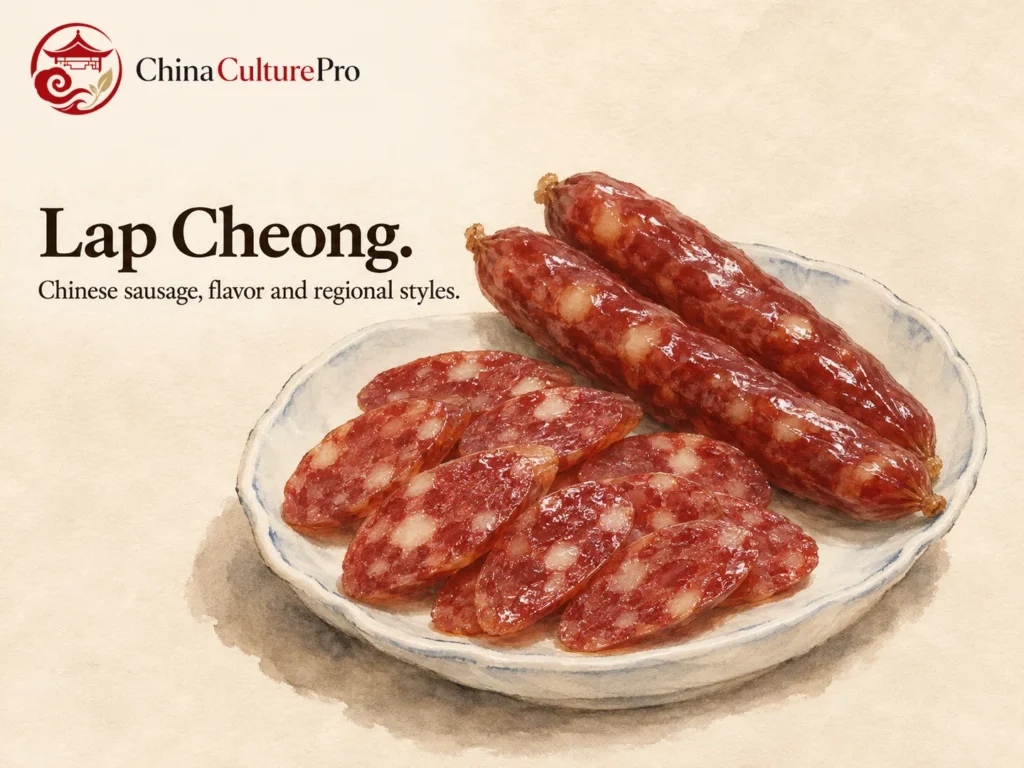

Quick Answer: What Is Lap Cheong?
Lap cheong(腊肠,làcháng)is Chinese cured sausage, especially familiar in its Cantonese sweet-savory pork version. “Lap cheong” is a Cantonese-derived English menu spelling; làcháng is the Mandarin pinyin reading, not its Cantonese pronunciation.[1]
- Structure: Chopped pork and fat are seasoned and packed into a casing.
- Processing: Curing and drying create a firm, concentrated ingredient.
- Use: Slices or small pieces flavor rice, steamed dishes and other foods.
Chinese sausage is a wider category with different seasonings and meats. The familiar dried links should not be assumed ready to eat merely because they have been preserved.
A few glossy sausage slices can change the aroma of an entire bowl of rice. Their reddish meat is dotted with pale fat, and their flavor may lean sweet and wine-scented, peppery, or rich with liver. Understanding the filling, processing and product style makes choosing a packet much easier than judging its color alone.
Pork, Fat and the Casing
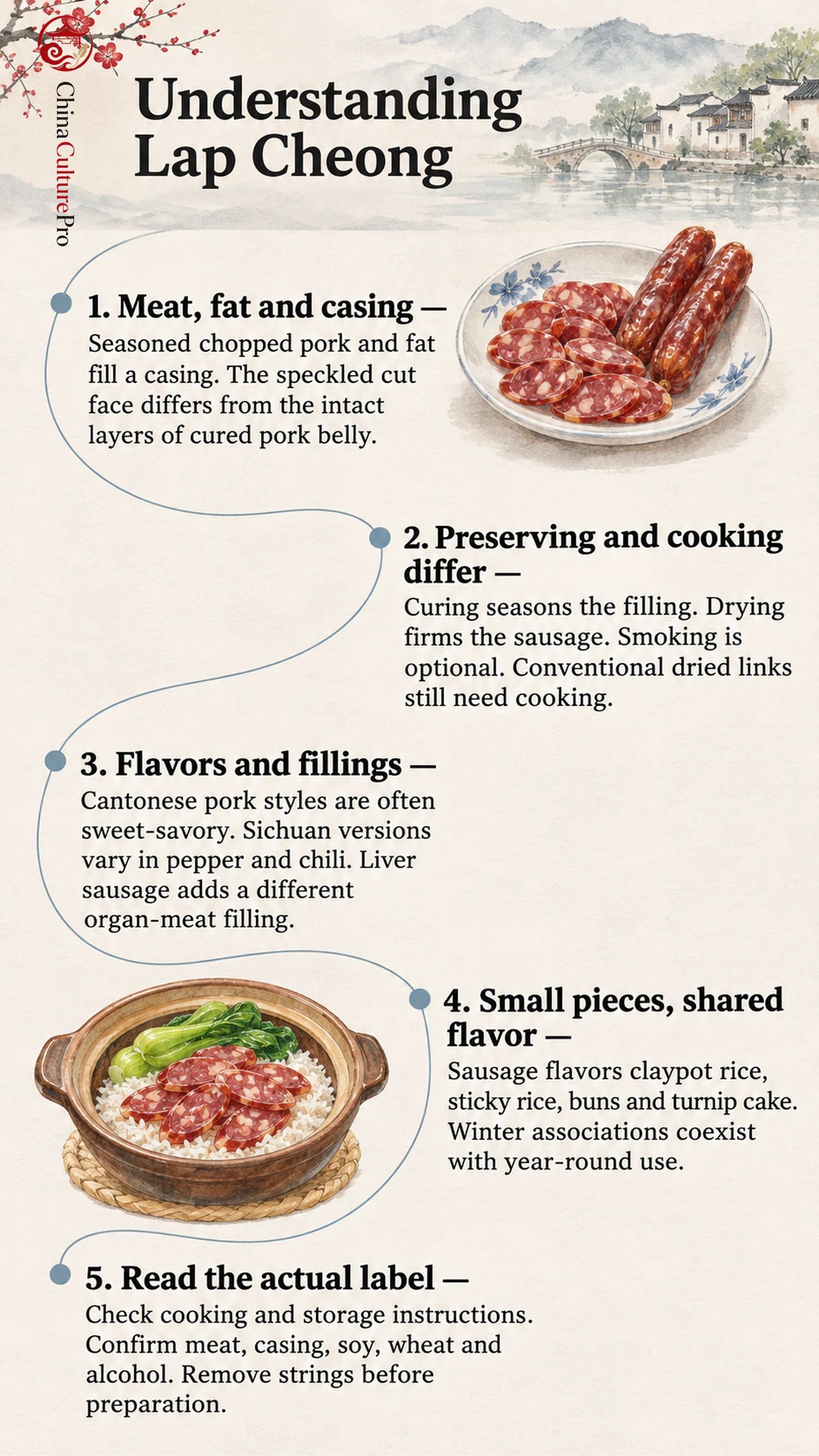
The sausage has three visible elements: meat, pieces of fat and a thin outer casing. Unlike whole-cut cured pork, its filling has been chopped or ground before stuffing. That produces a speckled cross-section instead of intact belly layers.[2]
The balance of lean and fat affects firmness and richness. A producer may offer leaner links, a fuller-fat style or different soy-seasoned products; these are variations within the category.[3] No single fat-to-lean ratio defines every sausage sold under the name.
A casing holds the filling together through processing and cooking. It should not be confused with wax, and packaging strings are not ingredients. Casing materials can differ, so follow the product’s preparation instructions rather than automatically peeling every link or assuming every outer covering is edible.
How Curing and Drying Change the Sausage
At the level of process, meat is cut, mixed with seasonings, stuffed and dried. Depending on the style, smoking may also be used. Chinese production rules distinguish this cured, stuffed-meat category from other meat products and classify it as non-ready-to-eat.[2]
Curing develops seasoning throughout the filling; drying reduces moisture and firms the link. These are different operations from cooking it for a meal. This distinction is central to Chinese food preservation: a product can keep differently from fresh meat while still requiring heat before eating.
The cooked texture depends on both the product and how it is prepared. A study of six commercial Sichuan-style sausages found differences between products and changes after steaming, supporting a practical point: the dry link’s hardness does not describe every cooked slice.[4]
Cantonese, Sichuan and Liver-Sausage Styles
Names on a packet can suggest a flavor direction, but ingredients provide the more useful detail. These examples share a stuffed-sausage form but differ in seasoning or filling; they are not an exhaustive classification.[1][3][4]
| Product style | Typical distinction | Useful ingredient check |
|---|---|---|
| Cantonese-style pork sausage | Often sweet-savory, with a wine or liquor aroma | Sugar, soy sauce and the actual alcohol used |
| Sichuan-style sausage | Chili and Sichuan pepper appear in many versions | Heat level and spices vary between products |
| Liver sausage | Pork is combined with duck or pork liver | Confirm which liver and other meats are included |
The first style fits a familiar Cantonese flavor profile. A Сычуань label does not establish a fixed level of chili heat: sampled products use different spice lists. Liver sausage, often called yun cheong on Cantonese menus, has a more pronounced organ-meat flavor. It is a different filling, not simply ordinary pork sausage that has darkened.[3][4]
Rice Dishes, Dim Sum and Winter Meals
Sausage works as both a distinct bite and a seasoning for its surroundings. In claypot rice, slices sit above the grains while their seasoned fat contributes to the dish. In sticky-rice preparations, smaller pieces distribute the flavor more widely. It also appears inside steamed buns.[1]
Diced sausage is one possible savory addition to Cantonese turnip cake, where it contrasts with the pale radish-and-rice-flour base. The sausage adds savory pieces; radish and rice flour form the cake.[5]
Hong Kong food reporting places cured-meat rice dishes particularly in autumn and winter, while noting that the ingredients are available year-round.[5] The seasonal association continues alongside everyday meals and year-round sales.
Cooking, Storage and Dietary Checks
Buy from a reliable supplier and read the label for ingredients, storage and preparation. Proper curing requires controlled processing; normal color or smell cannot establish that those controls were followed.[6] Redness is not a cooking test.
Cook conventional dried sausage as directed. A separately cooked product labeled ready to eat is a different case, so check the actual packet. Remove strings and the attached end portions before preparation. Hong Kong’s Consumer Council advises refrigerating Chinese sausage.[7] Follow the manufacturer’s directions for its packaged state, opening and freezing; there is no single storage period for every product.
Check the meat as well as the seasoning. Traditional pork sausage is neither vegetarian nor suitable for someone avoiding pork; a poultry filling may still use an animal casing from another species. Soy sauce can introduce soy and wheat, and wine or liquor may be present. Shared utensils matter when avoiding allergens. Removing sausage pieces after they have cooked with rice does not remove their dispersed fat and flavor.
FAQs About Lap Cheong
Is lap cheong already cooked?
Usually, dried lap cheong is an ingredient requiring cooking. Rely on the product’s explicit ready-to-eat labeling, not its firm texture or red color.
Is every Chinese sausage sweet?
No. Sweet-savory Cantonese styles are familiar, but other products emphasize salt, spices, chili or different meats.
Is liver sausage the same as lap cheong?
It is a related cured sausage containing liver, often alongside pork. Ask for the filling rather than choosing by color.
Can lap cheong be gluten-free?
Some products may be, but soy sauce and other seasonings require checking. A pork-based filling alone does not guarantee a gluten-free sausage.
Источники
[1] The Woks of Life. Dried, Cured and Pickled Ingredients: Sausages
[2] State Administration for Market Regulation, China. Meat Products Production Licensing Review Rules
[3] HK JEBN. Preserved Meat Product Descriptions
[4] Cai Xuemei and colleagues, Meat Research. Quality Differences of Commercial Sichuan-Style Sausages Before and After Steaming
[5] MICHELIN Guide. Cantonese Cured Meat in Winter
[6] Centre for Food Safety, Hong Kong. Chinese Preserved Meat and Food Safety
[7] Consumer Council, Hong Kong. Chinese Sausage Consumer Tips