
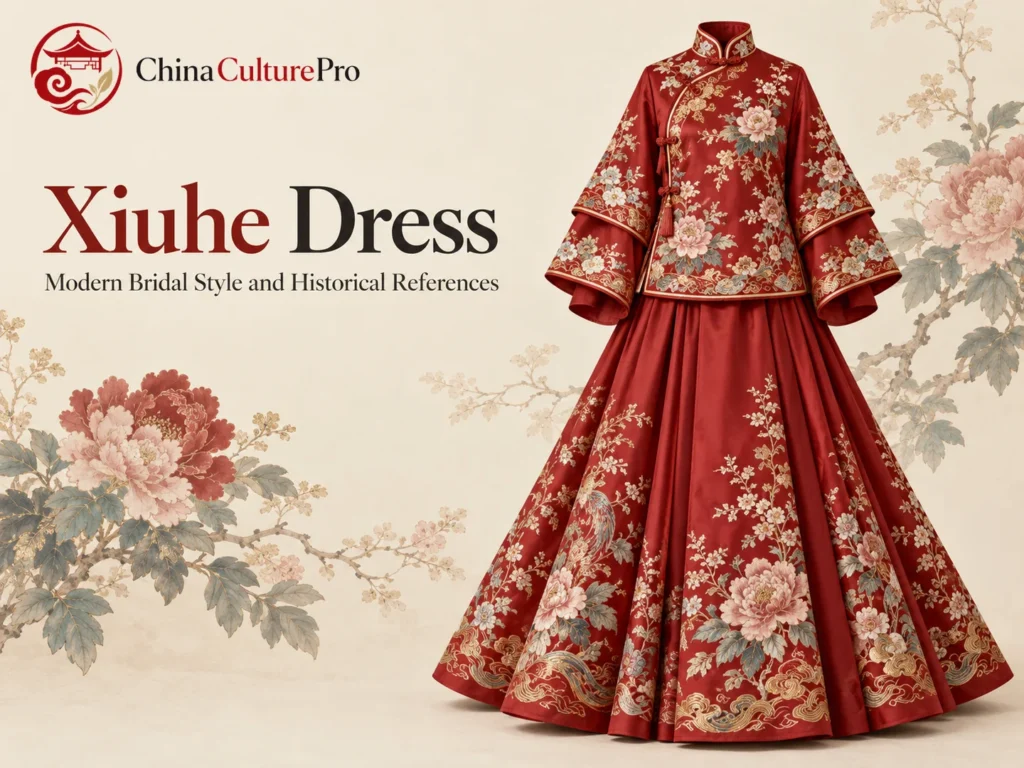

Quick Answer: What Is a Xiuhe Dress?
A Xiuhe dress (秀禾服, xiùhé fú) is a modern Chinese bridal style built around an embroidered jacket and a separate long skirt. Its name comes from the character Xiuhe, played by Zhou Xun in the television drama Ripening Orange (橘子红了, júzi hóngle), also known as Orange Is Red.[1]
- Name: A screen character supplied the modern clothing label.
- References: Older jacket-and-skirt fashions contributed to the design vocabulary.
- Appearance: Contemporary versions vary in fastening, collar, sleeve and skirt shape.
A historically inspired garment can be meaningful wedding clothing without being an exact reconstruction of an ancient uniform.

A full skirt and broad embroidered sleeves can make a Xiuhe outfit look immediately historical. Yet the label tells only part of its story. To understand the dress, separate the screen costume that gave it a name, the older garments it references and the particular version offered today.
How a Screen Costume Gave the Style Its Name
The wedding costume designed for Xiuhe became a recognizable bridal category beyond the drama. The designer was Tim Yip, also known as Ye Jintian, working with director Li Shaohong. The drama reached mainland television audiences around Lunar New Year in 2002.[1]
The design was a creative screen interpretation. In a February 2002 interview, Yip described drawing on traditional Chinese clothing and selected ethnic-minority dress while adding his own imagination. That explanation matters because it prevents a misleading conclusion: the costume’s old-fashioned appearance does not make every detail a record of what brides wore in a particular year.[2]
The name later travelled into wedding fashion. A present-day Xiuhe dress need not reproduce Zhou Xun’s costume stitch for stitch. The screen connection explains the label; it does not prescribe a single pattern for every garment sold under it.[1]
Historical References Without a Single Period Uniform
The jacket-and-skirt combination has a history older than the modern name. Aoqun (袄裙, ǎoqún) describes a jacket-and-skirt ensemble within the wider range of traditional Chinese clothing. For a reader following Chinese clothing history, the useful question is which older features a modern outfit has borrowed, rather than whether its new name appears in a dynasty’s dress regulations.
An early twentieth-century wedding ensemble preserves a revealing comparison: a straight-cut jacket resembling an official robe, paired with a pleated skirt derived from the mamianqun (马面裙, mǎmiànqún), or horse-face skirt. Its rectangular front panel helps explain that skirt name. The combination also reflects European two-piece influences alongside local elements.[3]
This surviving outfit is evidence for historical bridal experimentation, not proof that it was called a Xiuhe dress. Likewise, a modern skirt with a full silhouette should not automatically be identified as a mamianqun. Look for the actual panel and pleat arrangement. A historical reference, a reproduction and a contemporary adaptation are different claims, even when all three share red cloth and embroidery.
Recognizing Modern Xiuhe Dress Variations
Common contemporary examples have a relatively roomy upper garment and a full skirt, often with broad or layered sleeves. However, the category includes variations in collars and closures. A diagonal overlapping front is a useful cue in many examples; center-front openings are also offered. A standing collar is common, but round-collared versions exist too.[4]
The same caution applies to decoration. Red-and-gold combinations are familiar, but embroidery may use colored threads and floral, bird or dragon-and-phoenix designs. The trade label does not establish the fiber content, whether stitching is handmade or which regional technique was used. Those are separate questions to ask about the actual garment.[4]
For a closer look at technique, Chinese embroidery provides the wider craft context. A catalogue’s style name is insufficient to identify a regional stitch tradition; request a description of how the particular garment was made.
Xiuhe, Qun Kwa and Qipao
These names are useful starting points for comparison, but commercial hybrid designs can blur the visual boundaries. The table describes common forms rather than compulsory specifications.
| Garment | Basic identifying form | What the name does not guarantee |
|---|---|---|
| Xiuhe dress | A modern bridal jacket-and-skirt set, commonly with a fuller silhouette. | An exact Qing-period pattern or one mandatory closure. |
| Qun kwa (裙褂, qún guà) | A Cantonese bridal jacket and long skirt, often richly embroidered in metallic thread. | That every example has the same cut or embroidery density. |
| Qipao (旗袍, qípáo) | A one-piece dress, also widely called a cheongsam in English. | That it is exclusively bridal clothing. |
The separate pieces distinguish both bridal sets from the one-piece qipao. Within the two-piece group, examine cut and decoration together rather than using one fastening detail as an absolute test.[5]
Choosing a Dress for the Wedding Day
Start with the intended use. A dress for photographs alone faces different movement demands from one worn while travelling between venues, greeting relatives or serving tea. The broader Chinese wedding dress comparison helps place that choice within the whole celebration.
At a fitting, try sitting, walking and lifting both hands as though holding a tray. If the outfit will be used for a wedding tea ceremony, check the movements your family actually plans. Wide sleeves can look graceful in a photograph while needing attention around cups; a full skirt still needs a practical hem length.
Ask about fabric, lining, embroidery, closures and permitted adjustments separately. A rental, an existing design made in a chosen size and a newly developed custom outfit are different arrangements; confirm which is being offered.[4] Try the intended wedding jewelry and footwear during the fitting rather than judging comfort from a catalogue image.
Choose an outfit whose construction works for the wearer and whose role in the ceremony is clear to the family. Its modern name can be described honestly alongside its historical references.
FAQs About Xiuhe Dresses
Is a xiuhe dress an ancient wedding uniform?
No. The modern name comes from a television character. Its designers drew on older clothing, but the named bridal category should not be presented as a fixed ancient dress regulation.
Must a xiuhe jacket fasten diagonally?
No. Overlapping diagonal fronts are common, but center-front designs also exist. Check the actual garment rather than treating one closure as a universal requirement.
Is xiuhe the same as qun kwa?
They are related choices within modern Chinese bridal clothing, but the names have different histories. Both can be two-piece outfits; fuller Xiuhe silhouettes and metallic-embroidered Cantonese qun kwa are useful common comparison points, with exceptions.
Sources
[1] He Xiyu, Cover News. Tim Yip: A Screen Costume That Became a Clothing Category
[2] Daily News, interview with Tim Yip. Tim Yip on Costume Design for Juzi Hongle
[3] The Metropolitan Museum of Art. Woman’s Wedding Jacket and Skirt
[4] Dragon Seed Bridal. Xiuhuafu: A Traditional and Elegant Chinese Wedding Dress
[5] Hong Kong Memory. The History of Chinese Cheongsam and Kwan Kwa