
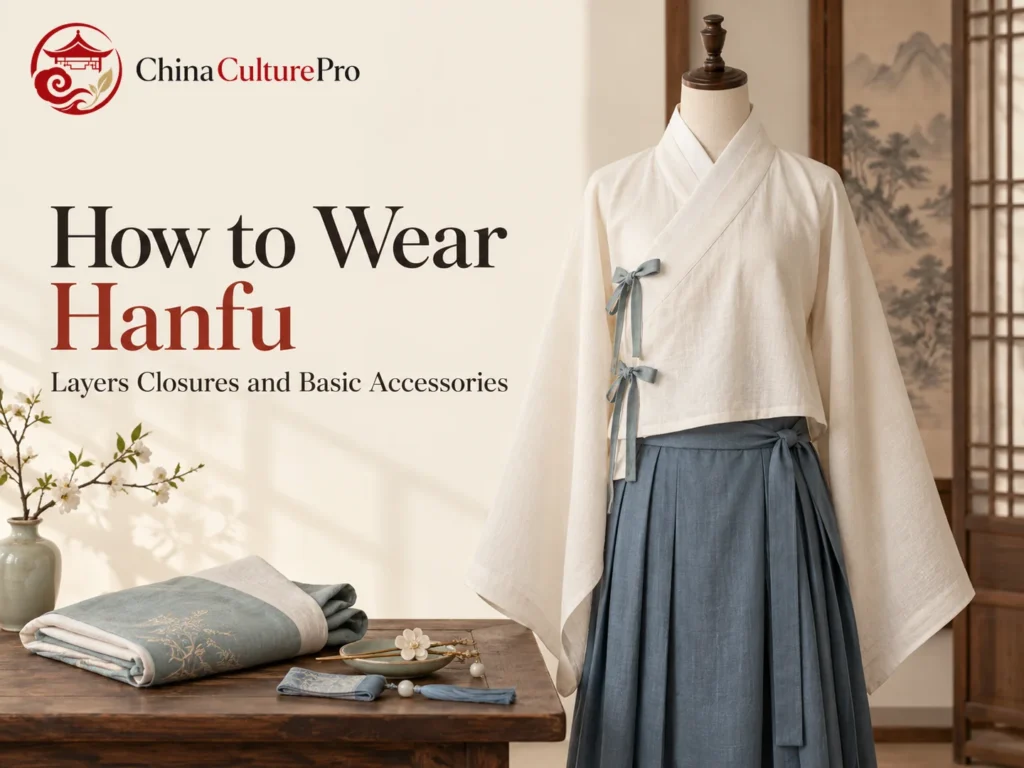

Quick Answer: How Do You Wear Hanfu?
To wear Hanfu(汉服,hànfú), identify the pieces and their closures before following a generic sequence. An outfit built around a wrapped skirt differs from a robe or a buttoned jacket.
- Prepare: Choose suitable underlayers and locate the inside ties, outer fastenings and waistband.
- Dress: Put on the base and main pieces in the order their overlap requires; secure each supporting closure before adding decorative layers.
- Check: Walk, sit and reach in the finished outfit, then add accessories that stay secure.
The sequence below suits many modern sets, with adjustments for the construction and instructions of the particular garment.
Two long ribbons may look alike while doing different jobs: one holds a skirt in place, while another decorates the waist. Learning to recognize those functions makes dressing easier. This practical guide to Hanfu begins with the pieces you own, rather than a rule that every outfit requires the same layers.
Before Dressing: Identify the Pieces
Lay out the outfit and find its front, back, neckline and fastenings. Separate the base layer, upper garment, skirt or trousers, and any outer layer. Compare the contents with the maker’s diagram; a styled photograph may include an extra shawl, belt or hair ornament. The Hanfu styles overview explains which names identify full combinations and which identify individual garments.
Check where the lower garment is designed to sit. A skirt cut for a higher position cannot necessarily be worn at the natural waist without changing its length and fit. Inspect any tie passage or opening before putting it on. Do not push a ribbon through a gap merely because the gap is visible.
Choose an underlayer for the actual neckline, fabric and coverage. A modern thin top may work for casual styling; a deliberately visible inner collar requires a compatible garment. Examine sheer areas in ordinary light. Extra layers are useful when they serve the outfit, rather than because every Hanfu set is assumed to contain three.
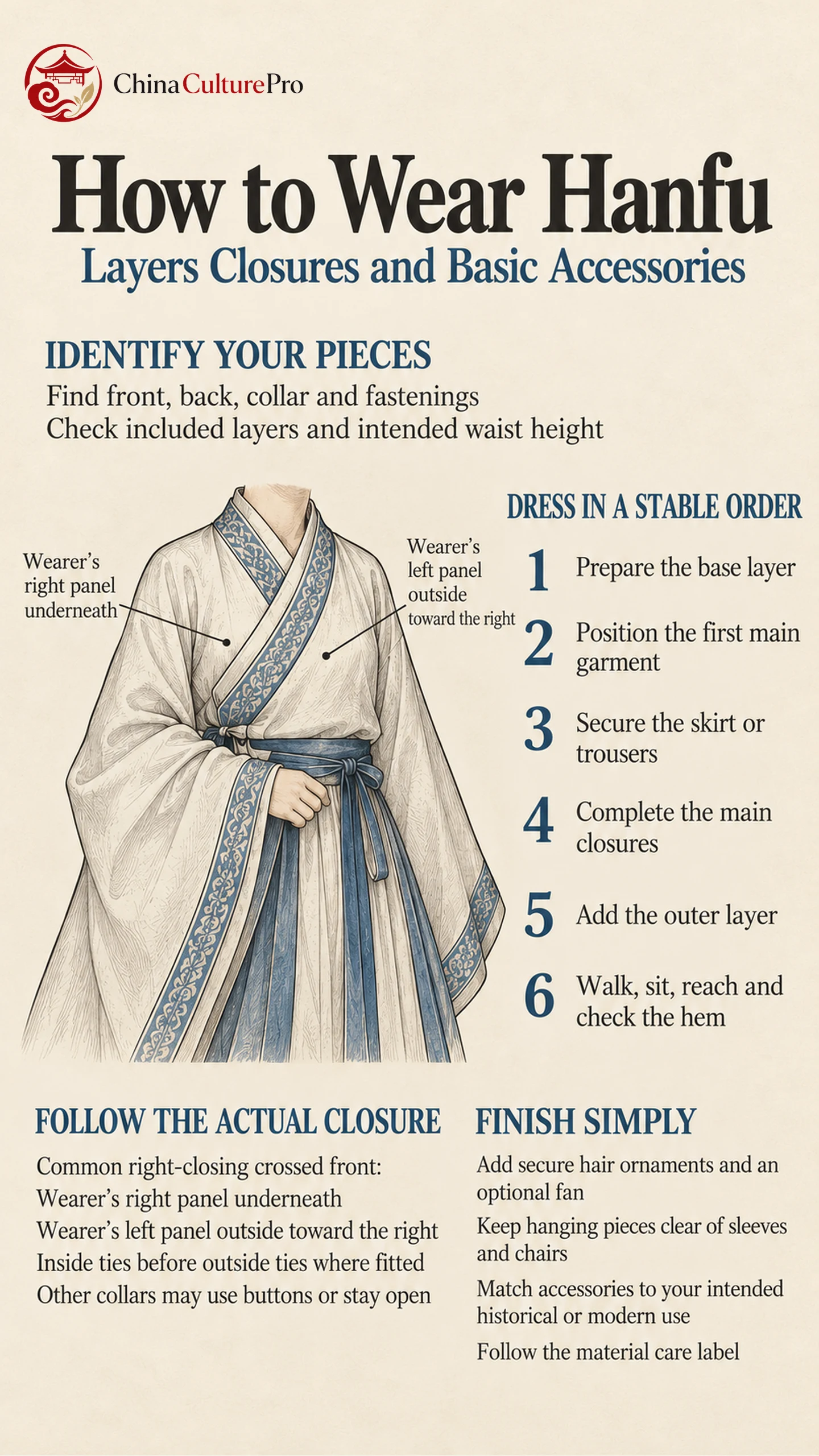
A Practical Dressing Sequence
- Prepare the base: Put on underwear and the selected underlayer. Smooth bunching at the shoulders and waist. Keep the main garments nearby with their ties untangled.
- Position the first main garment: For a top-and-skirt set whose top sits beneath the waistband, put on the top first. For a jacket intended to cover the skirt waist, establish the skirt before adding that jacket. Set the shoulders evenly and leave access to supporting ties.
- Secure the lower garment: Wrap or fasten the skirt or trousers according to their pattern. With a mamianqun(马面裙,mǎmiànqún), identify the flat central areas and side pleats before arranging the overlap. Tie the waistband securely while retaining comfortable breathing and sitting room.
- Complete the main closures: Fasten the remaining inside and outside ties or buttons. For a robe, follow its own front overlap and belt arrangement in place of the separate top-and-skirt steps. Smooth the back and check that the neckline is not being pulled sideways.
- Add the outer layer: Put on any intended overgarment or shawl once the main outfit supports itself. Arrange its front edges and sleeves without pulling up the layers beneath. Check that the skirt remains secure before adding a decorative sash.
- Test the complete outfit: Wearing the intended shoes, walk, sit, reach forward and step up carefully. Check the hem, overlap and waistband from several angles. Readjust anything that shifts before adding small or trailing accessories.
Its flat panels overlap while the pleats fall toward the sides.[4] For a closer view of the skirt itself, see the mamianqun guide. The aim is a stable arrangement of its actual panels, rather than one memorized number of waistband wraps.
Crossed Fronts, Ties and Buttons
For the common right-closing overlap(右衽,yòurèn), the wearer’s right front panel lies underneath, and the wearer’s left front panel crosses over it toward the right side. This panel-by-panel description avoids ambiguous English shorthand. A current Han-inspired ceremonial-dress guideline uses this same definition; its recommendations concern that design framework, rather than every historical Chinese garment.[1]
On a crossed top with paired inside and outside ties, secure the inner pair before the outer pair so the underlapping panel remains in place. Trace each tie to its attachment point rather than assuming every ribbon belongs with its nearest neighbor. Keep the fastening flat and releasable. Pulling hard on a decorative edge can distort the collar without making the garment more secure.
Apply crossed-front instructions only to crossed fronts. A parallel-front outer garment may hang open; a standing-collar jacket may close with buttons. A surviving Song gauze jacket even has a fabric button at its parallel front, demonstrating why “all Hanfu uses only ties” is too broad.[2]
Basic Accessories and the Finished Outfit
Add an ornament only after the garment fits and supports itself. A modest hair ornament can be enough for a modern outfit. The Chinese hairpins guide separates pin forms, while the hairstyle guide places historical hair arrangements in context. A large headdress is not a general requirement for wearing Hanfu.
A fan is optional and occupies a hand; choose it for the intended activity. Different Chinese fan types have distinct constructions, and a folding fan opens differently from a rigid round fan. Secure hanging ornaments where they will not catch on the sleeve or chair.
For historical reconstruction, select accessories from the same evidence framework as the clothing. Museum reconstruction work can preserve a studied cutting method while adjusting the original dimensions for a current wearer; exact ancient measurements are not the same objective as wearable reconstruction.[3] For casual modern styling, describe mixed elements as personal choices rather than evidence of a documented historical ensemble.
Finally, check the material label before steaming or washing the outfit. Silk clothing terminology helps distinguish fiber from weave; the garment’s own care directions should govern treatment.
FAQs About Wearing Hanfu
Do I need three layers every time?
No. The necessary layers depend on the outfit’s cut, opacity, weather and intended appearance. Add an inner or outer garment for a specific function, rather than a fixed numerical rule.
What if the skirt keeps slipping?
Recheck its intended waist position, panel overlap, tie routing and size. Tightening repeatedly can hide an assembly problem while making sitting uncomfortable. Ask the maker for the correct diagram if the closure remains unclear.
Do I need long hair or special shoes?
Neither is a general requirement for modern casual wear. Choose secure hair styling and shoes that work with the hem. A reconstruction project or organized event may set more specific expectations.
Can I mix historical and modern pieces?
Yes, for a modern interpretation. If your goal is a documented historical ensemble, check the period and context of the combination rather than treating visual compatibility as historical evidence.
Sources
[1] Xi’an Municipal Administration for Market Regulation. DB 6101/T 3227—2025: Design Guidance for Han-Dynasty-Inspired Ceremonial Dress
[2] China National Silk Museum. Luo Gauze Unlined Jacket
[3] China National Silk Museum. Reconstructing Southern Song Jackets and Two-Piece Wrap Skirts
[4] Yichang Museum. Ming-Dynasty Mamianqun and Jacket Ensembles