


Quick Answer: What Is a Mamianqun?
A mamianqun(马面裙,mǎmiànqún), commonly translated as horse-face skirt, is recognized by flat overlapping areas at the front and back, with pleated fabric toward the sides. Historical examples are especially associated with Ming and Qing women’s dress.
- Structure: Separate skirt sections overlap around the body and are supported at the waist.
- Appearance: Flat areas give decoration a clear surface, while side pleats create a different rhythm and volume.
- Use: The skirt appears in historical ensembles and contemporary interpretations, including modern Hanfu(汉服,hànfú)outfits.
It is one lower garment, not a complete outfit; the Hanfu styles overview explains that distinction.
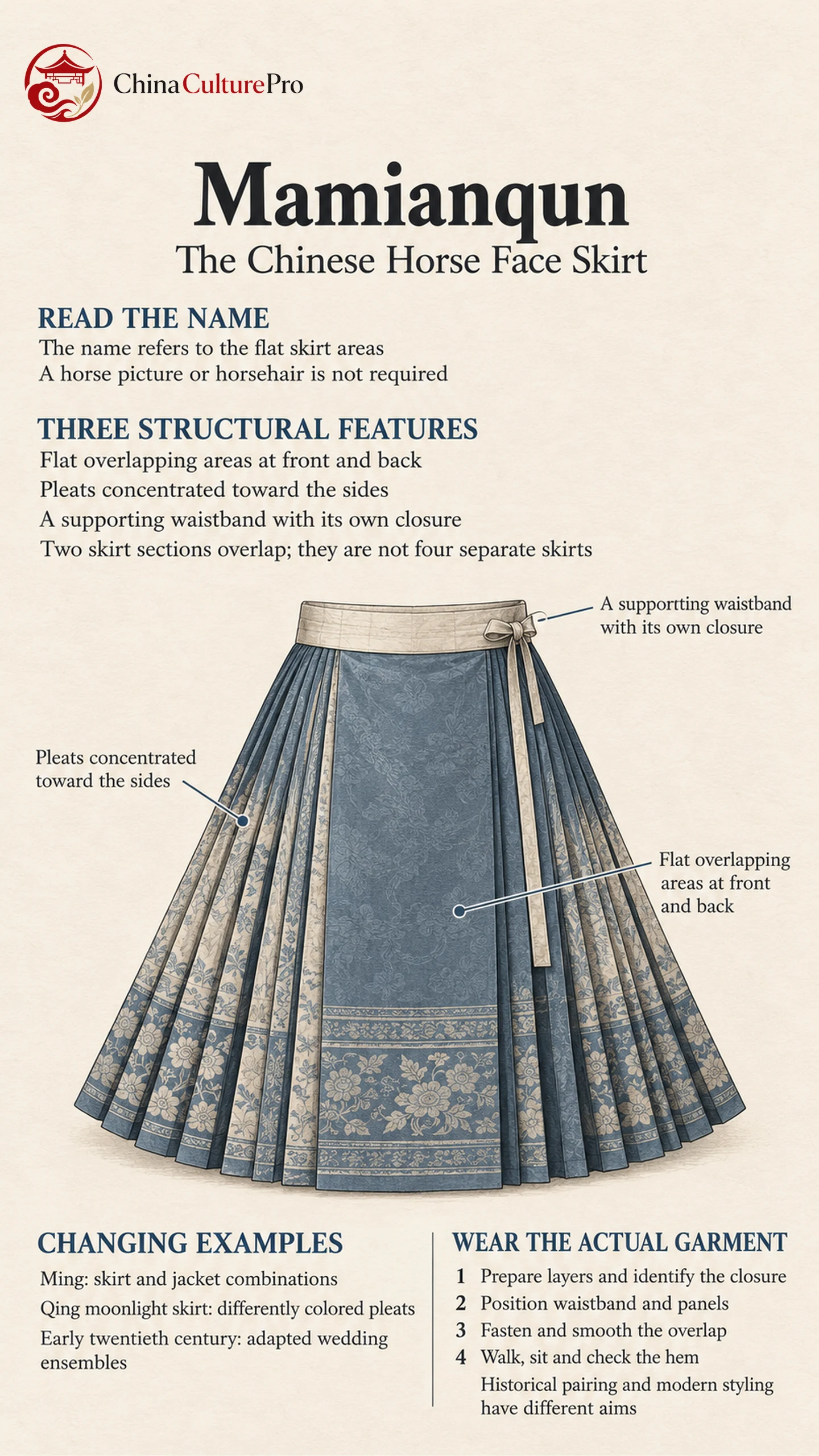
A broad flat panel framed by pleats gives the mamianqun its recognizable appearance. Turn the skirt or examine its waistband, however, and its overlapping construction becomes clearer. This part of traditional Chinese clothing is best understood through its panels, historical examples and the way the actual garment fastens.
What Does Horse-Face Refer To?
The English phrase translates the Chinese garment name. Museum descriptions use “mamian” for the flat skirt areas also called skirt doors(裙门,qúnmén). A Qing example forms these areas where its two sections overlap.[2] The name therefore points readers toward the construction, rather than a required picture of a horse.
Neither a horse motif nor horsehair is necessary to identify this skirt. Look instead for the relationship between flat areas, overlapping fabric and pleated sides. The term by itself does not establish a single inventor, an exact invention date or a universal reason why the skirt was first made.
Panels, Pleats and the Waistband
In a common historical construction, two rectangular skirt sections share support at the waist. Each has unpleated areas that overlap with those of the other section. Descriptions may count four skirt doors before overlap, while the worn garment presents a flat area at the front and another at the back. The four flat areas overlap in pairs when the two sections are worn.[1]
| Caractéristique | Éléments à observer | Function in the skirt |
|---|---|---|
| Flat overlapping areas | Broad, relatively smooth fabric at the front and back | Provide overlap and a prominent surface for woven or embroidered decoration |
| Side pleats | Folded fabric concentrated toward the sides | Gather width into a structured silhouette that opens with movement |
| Waistband and closure | A supporting band with the fastening appropriate to that example | Hold the sections around the body; historical fastenings include more than one arrangement |
The panel relationship is more useful for identification than a rigid pleat count or a supposedly mandatory panel width. A documented Qing moonlight skirt(月华裙,yuèhuá qún)has buttons and fabric loops at its waistband; historical examples cannot all be reduced to one ribbon-tying method.[2]
Historical Examples and Changing Decoration
Ming excavated skirts appear in tombs associated with women of different social ranks. They were paired with upper garments such as crossed-front jackets. These examples place the skirt within an ensemble, rather than showing that every wearer used one identical cut or decoration.[1] The wider clothing history guide supplies the chronological setting.
Decoration also changed within the broader skirt tradition. A Qing moonlight skirt combines differently colored silk in its side pleats, contrasting with its red flat areas and decorative borders. Its catalogue records embroidered crane and plant motifs as well as patterned textiles.[2] Color appears through the skirt’s structure, not merely as an image applied to a flat surface.
Other historical skirts use densely organized pleats or elaborate borders, and surviving examples show changing fashions rather than a single frozen design.[3] Chinese embroidery describes one decorative technique; embroidery symbols need to be interpreted through the actual motifs and context, rather than the skirt name alone.
Adaptation is not exclusively a twenty-first-century development. An early-twentieth-century wedding jacket and skirt combines local features with inspiration from European two-piece clothing. Its pleated skirt derives from the mamianqun tradition.[4] This is a specific example of changing dress, not evidence that all wedding ensembles followed that design.
Wearing a Mamianqun Today
A historically focused ensemble can follow a documented jacket-and-skirt pairing. A contemporary outfit may combine the skirt with a simpler modern top. A 2024 exhibition interview describes both modified designs and visitors of different genders wearing mamianqun, documenting one contemporary setting for the skirt.[5]
For a skirt you own, follow its fastening diagram and use this general sequence:
- Prepare the layers: Put on the intended underlayer and any top that belongs beneath the waistband. Identify the skirt’s front, back, overlap and closure before wrapping it.
- Position the skirt: Place the waistband at the height intended by the pattern. Arrange the flat areas centrally and the pleats toward the sides, following that garment’s construction.
- Fasten and smooth: Secure its ties, buttons or other supplied closure. Smooth twisted fabric and check the overlapping coverage without pulling the waist painfully tight.
- Check movement: Walk, sit and step up with the intended shoes. Confirm that the hem clears your feet, the skirt stays level and the overlap remains satisfactory before adding an outer jacket or accessories.
The broader Hanfu dressing guide covers layers and closures. For material decisions, distinguish fiber, weave and decorative technique: the silk clothing guide explains why an ornate surface does not by itself identify the fabric composition.
FAQs About Mamianqun
Is every pleated skirt a mamianqun?
No. Pleating alone is insufficient. The recognizable flat overlapping areas and the arrangement of pleated sections matter; a fully pleated skirt with another construction is not automatically the same form.
Must a mamianqun be silk or embroidered?
No. Fiber and decoration are separate from the structural name. Check the individual garment’s composition and workmanship rather than treating elaborate embroidery or a silk label as a definition.
Can men wear a mamianqun today?
Yes, contemporary wear includes men as well as women. Historical women’s skirt ensembles and present-day personal styling should be described in their respective contexts, without turning one into an absolute rule for the other.
Sources
[1] Yichang Museum. Ming-Dynasty Mamianqun and Jacket Ensembles
[2] China National Silk Museum. Moonlight Skirt
[3] Cooper Hewitt, Smithsonian Design Museum. A Poetic Skirt
[4] The Metropolitan Museum of Art. Veste et jupe de mariage pour femme
[5] China Daily; Shanghai Municipal Government. Traditional Chinese Garment Makes a Stylish Comeback