


Quick Answer: Who Was Wang Xun?
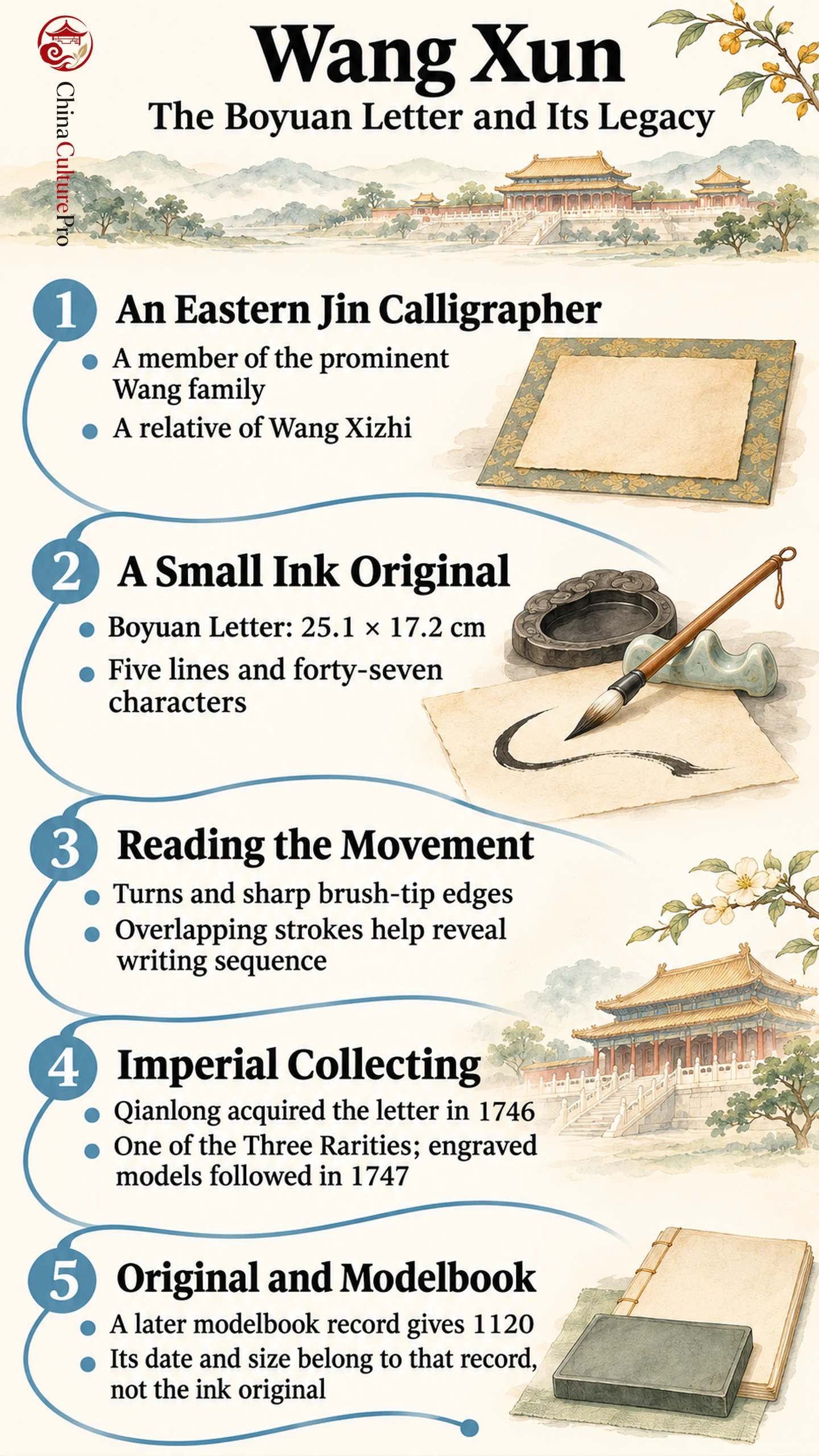
Wang Xun (王珣, Wáng Xún) was an Eastern Jin official and calligrapher from the prominent Wang family, related to Wang Xizhi. His fame rests especially on the Boyuan Letter (伯远帖, Bóyuǎn Tiè), a rare surviving ink original. [2]
- The object: An ink-on-paper letter measuring 25.1 × 17.2 cm, with five lines and forty-seven characters. [1]
- Artistic interest: Natural turns and overlapping brush strokes preserve evidence of movement. [2]
- Later history: Imperial collecting and engraved versions extended the letter’s reputation. [1][3]
The original ink sheet and later modelbook versions should be identified separately.
Wang Xun’s place in Chinese calligraphy can be explored through a single small letter. Its writing, mounting and reproductions offer different kinds of evidence: marks of the hand, responses by collectors, and models used by later students.
An Eastern Jin Official from the Wang Family
Wang’s family came from Langye, associated with present-day Linyi in Shandong. His courtesy name was Yuanlin and his childhood name Fahu. He became Marquis of Dongting and held senior offices, including Director of the Department of State Affairs. [2]
He belonged to the extended family of Wang Xizhi, whose members cultivated calligraphy across generations. His career belongs to the Eastern Jin dynasty, while most of the collection history visible around his letter is much later. [2]
The Boyuan Letter: A Small Sheet with a Long Afterlife
The letter is written in running script (行书, xíngshū). Its text praises Boyuan and mentions ill health, wishes for leisure and separation across mountainous country. [1]
Later inscriptions, seals and paintings belong to the mounted work’s history, rather than to Wang Xun’s five-line letter. [1]
What to Notice in the Brushwork
Look at the changes of direction and the sharp edges left by the brush tip. Where a later stroke crosses an earlier one, the overlapping ink can help reveal the writing sequence. This direct record of handling is part of the letter’s importance as a rare surviving ink work. [2]
Begin by following one character through its turns, then compare the spacing around its neighbors. Following the relationships between marks also helps when reading Chinese calligraphy in other early letters.
Imperial Collecting and the Three Rarities
In 1746 the Qianlong emperor acquired the letter and placed it among the Three Rarities (三希, sān xī), with works associated with Wang Xizhi and Wang Xianzhi. The Hall of Three Rarities (三希堂, Sānxī Táng) was in the Hall of Mental Cultivation within the Forbidden City. [1]
An imperial engraved collection followed in 1747. Boyuan later left the palace and was purchased back from Hong Kong in 1951 for the Palace Museum. [1]
The Ink Original and Later Modelbook Versions
Calligraphic modelbooks (法帖, fǎtiè) circulated admired writing in reproduced form. A National Palace Museum record for the Boyuan model in the Secret Chamber collection gives a date of 1120 and a paper size of 26.5 × 13.8 cm. Those fields belong to the modelbook record, rather than the original ink sheet. [3]
A separate Three Rarities Hall modelbook version reproduces later inscriptions, including Dong Qichang’s dated 1598 and Wang Kentang’s dated 1605, as well as Qianlong’s comments. Reproduction could preserve a work’s growing history of appreciation alongside its central text. [4]
Interprétation inscriptions and seals therefore involves asking whose voice is present and when it entered the object’s history. A reproduced collector’s comment should not be mistaken for the original writer’s words.
FAQs About Wang Xun
What dates are used for Wang Xun’s life?
The cited Shanghai Museum record uses 349–400; the Palace Museum uses 350–401. [1][2]
Is every Boyuan Letter reproduction the original?
No. Later modelbook versions are separate objects. Check the collection, medium and catalogue date rather than relying on the work’s title alone. [3][4]
Is it the only surviving Jin calligraphy?
That claim is too broad. The Palace Museum also identifies Lu Ji’s Pingfu Letter as a surviving Jin manuscript. [1]
Sources
[1] Palace Museum. Wang Xun’s Boyuan Letter in Running Script
[2] Shanghai Museum. Boyuan Letter: Wang Xun and His Brushwork
[3] National Palace Museum. Calligraphic Modelbooks from the Secret Chamber, Volume Five: Boyuan
[4] National Palace Museum. Modelbooks of the Three Rarities Hall, Volume Two: Boyuan