


Quick Answer: What Is Turnip Cake?
Lo bak go(萝卜糕,luóbo gāo)is a savory Cantonese cake made from white radish and rice flour. “Lo bak go” is a Cantonese menu name; the pinyin luóbo gāo gives its Mandarin reading.[1]
- Base: Shredded daikon radish is bound into a tender rice-flour cake.
- Additions: Sausage, dried seafood or mushrooms may contribute savory pieces.
- Serving: The cake is steamed to set, then often sliced and pan-fried.
Despite the English words “turnip” and “cake,” the familiar Cantonese dish uses white radish and is not a sweet baked dessert. Its filling and serving style vary.
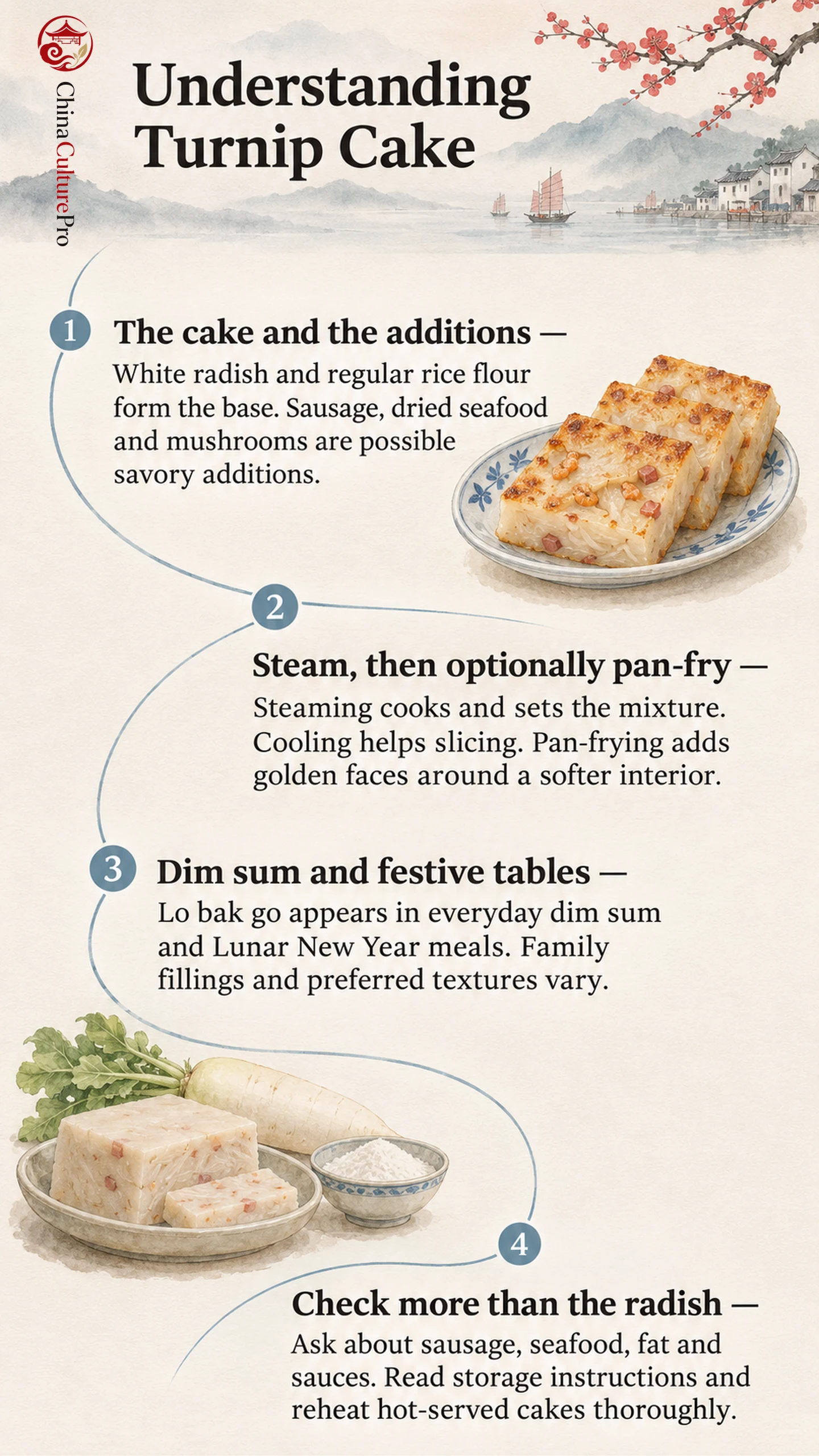
Golden edges give way to a pale, soft center when a slice of turnip cake is lifted from a dim sum plate. Fine strands of radish and small savory pieces may show through the surface. This guide explains what forms the cake, what flavors it, and why steaming and pan-frying create different parts of the experience.
Daikon, Rice Flour and Savory Additions
The vegetable is a long white radish, commonly sold as daikon or mooli. “Turnip cake” is the established English dish name, but an ordinary round turnip is not the standard vegetable behind it. Regular rice flour forms the familiar base; glutinous rice flour behaves differently and is not a direct equivalent.[1]
These ingredients have separate roles. Radish contributes moisture, vegetable flavor and visible shreds. Rice flour binds the mixture into something that can hold a slice. Some recipes also include another starch, so two cakes with similar-looking ingredients may have different firmness or smoothness.[2]
Small pieces supply concentrated savory flavor. Common examples include Chinese sausage, dried shrimp and shiitake mushrooms; dried scallop is another possible addition. Their quantities and combinations differ by household or restaurant.[2] A portion may have abundant savory pieces or a simpler filling.
Plant-based versions can use mushrooms and vegetables in place of meat and seafood. A documented example includes shiitake, scallions and bell pepper, showing that the radish-and-rice-flour structure does not depend on sausage.[3] The whole recipe, including its seasoning, determines whether it is vegan.
Steaming Sets the Cake; Pan-Frying Browns It
The preparation has two distinct stages. First, the radish, rice-flour mixture and chosen additions are brought together and steamed in a mold. This produces the cooked cake. Resting and cooling let it become firmer and easier to cut into intact pieces.[3]
Pan-frying is a later finishing option. It gives the broad faces of a slice a browned crust while the interior stays softer. A steamed serving can therefore be smooth and tender without having a golden exterior; a pan-fried serving adds a crisp-to-soft contrast.[3] Both belong to the dish’s familiar range.
This distinction also helps when reading a package. An already steamed block may need reheating or browning, whereas an uncooked mixture needs its full cooking process. A photograph of browned slices does not tell you the product’s processing state. Follow the label rather than applying one method to every refrigerated or frozen cake.
Dim Sum and Lunar New Year Traditions
Turnip cake is a familiar part of Cantonese cuisine and dim sum. Small portions suit a shared table, where the radish cake provides a different texture from dumpling wrappers or soft buns. It can be ordered as part of an ordinary meal, not only during a holiday.[2]
It also has a place among Chinese New Year foods. A firsthand family account describes serving it for the holiday, and Hong Kong’s food-safety authority includes turnip pudding among the festive steamed cakes it monitors.[2][4] Here, “pudding” is another English rendering for the savory cake, not a promise of custard or sweetness.
One household may favor pronounced radish strands, another a smoother slice. Festive use does not impose a single filling, required shape or national serving ritual. The same food can carry a family’s seasonal memories and still appear on a year-round restaurant menu.
Ordering, Dietary Checks and Storage
Ask whether the portion is steamed or pan-fried, and what is mixed into the cake. “Radish” in its name does not make the dish vegetarian. Sausage and dried shrimp are dispersed throughout, so picking out visible pieces does not remove their contribution. For vegetarian Chinese food, confirm the complete filling, cooking fat and sauces.
Check seafood, soy and wheat separately. Dried shrimp introduces a crustacean ingredient; oyster sauce contains mollusc ingredients; soy sauce can introduce soy and wheat. Rice flour alone cannot establish that the complete dish is gluten-free. Labels and direct questions provide more information than the dish name.[5] Shared pans and utensils also require attention when avoiding allergens.
Dipping sauces are optional. Soy-based sauces, chili condiments or a plant-based sauce can alter the flavor considerably; a plain slice need not be spicy.[3]
For packaged cakes, check an intact container, dates and handling directions. Hong Kong’s current guidance advises refrigeration or storage according to the package, thorough reheating for cakes served hot, and avoiding prolonged room-temperature holding.[4] A crisp surface alone does not establish that the center has been heated thoroughly.
FAQs About Turnip Cake
Is turnip cake made with actual turnips?
The familiar Cantonese version uses daikon-type white radish. “Turnip cake” is its conventional English name.
Is turnip cake sweet?
Usually no. Cantonese lo bak go is savory, even if a recipe includes a little sugar as seasoning.
Is turnip cake vegetarian or vegan?
Some versions are, but many contain sausage or dried seafood. Confirm the filling, fat and dipping sauces.
Must turnip cake be pan-fried?
No. Steaming cooks and sets the cake; pan-frying adds a browned exterior to slices afterward.
Sources
[1] Bill, The Woks of Life. Turnip Cake: Chinese Lo Bak Go
[2] Maggie Zhu, Omnivore’s Cookbook. Chinese Turnip Cake
[3] Lisa Kitahara, Okonomi Kitchen. Vegan Turnip Cakes
[4] Centre for Food Safety, Hong Kong. Lunar New Year Food Guidance, January 2026
[5] Centre for Food Safety, Hong Kong. Food Allergy: Ingredient and Label Checks