


Quick Answer: What Is Six Patriarchs?
Six Patriarchs(达摩至慧能六代祖师像,Dámó zhì Huìnéng liùdài zǔshī xiàng)is a Ming-dynasty handscroll traditionally attributed to Dai Jin(戴进,Dài Jìn)and held by the Liaoning Provincial Museum. It represents six successive ancestral teachers of Chan Buddhism(禅宗,Chánzōng).
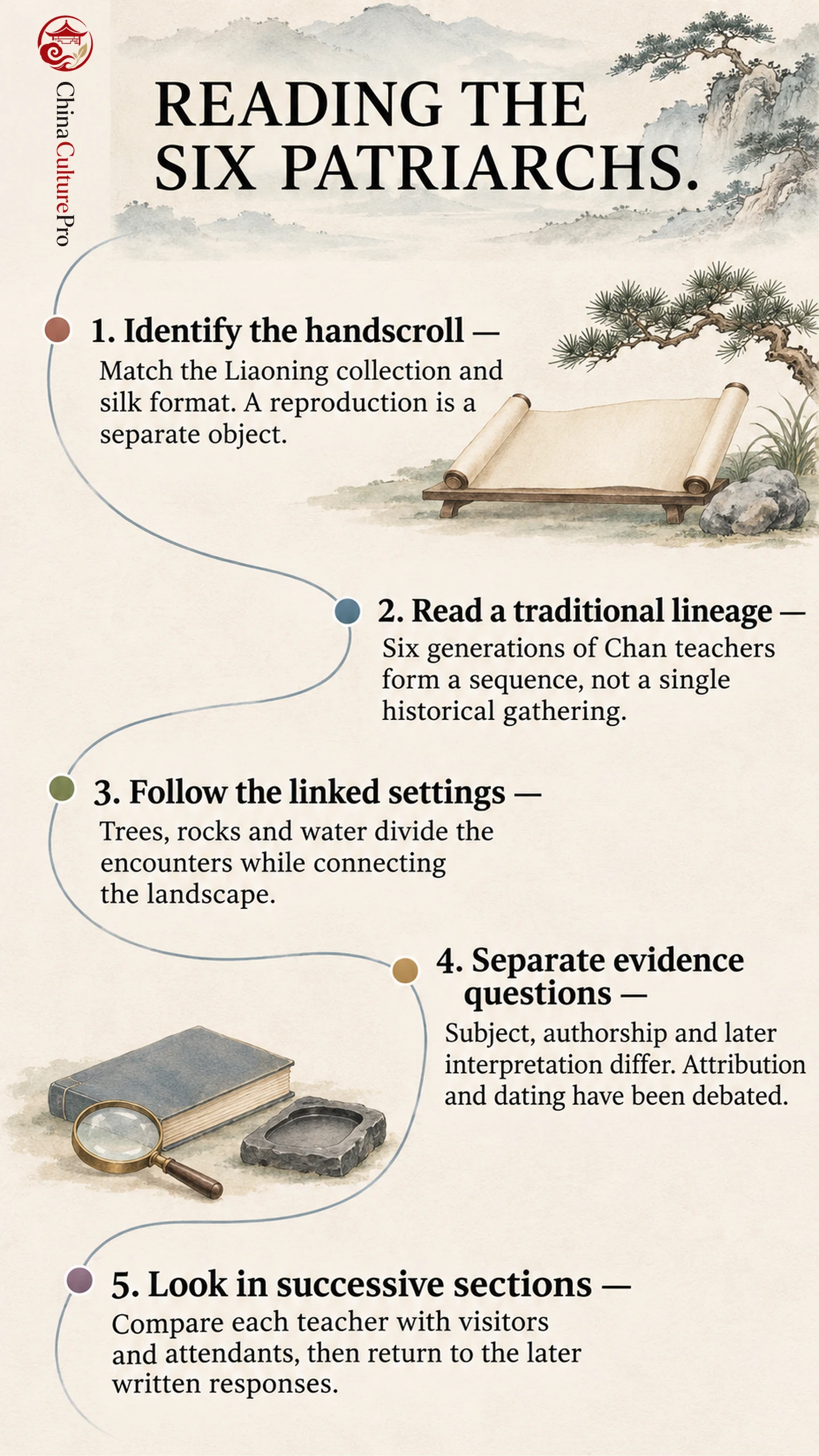
- Format: Individual encounters appear within a connected landscape.
- Subject: The figures belong to a religious lineage, rather than a gathering of six contemporaries.
- Evidence: Painting, signature and later written responses require separate attention.
The attribution and date have attracted scholarly disagreement.
A monk sits within a rocky recess, while other teachers and visitors occupy wooded places further along the scroll. Trees, rocks and water separate the encounters and connect them visually. The landscape offers continuity across a sequence that represents different generations. Reading it requires attention to both individual scenes and the religious genealogy linking them.
Identifying the Liaoning Handscroll
The work is a handscroll with ink and light color on silk. A university exhibition listing gives its painted dimensions as 33.8 by 219.5 centimeters and identifies the original collection as the Liaoning Provincial Museum.[1]
That exhibition presented high-fidelity reproductions. Its location should not be mistaken for the original painting’s collection, and a reproduction’s size or publication date should not replace the original’s identifying information.
The painting’s width, approximately 2.2 meters, allows successive encounters to occupy their own settings. The scroll-format guide explains how a handscroll can be studied section by section rather than only as a compressed panoramic strip.
Who the Six Patriarchs Are
Use the names and positions to distinguish principal teachers from visitors and attendants.[2]
| Patriarch | Place in the traditional sequence |
|---|---|
| Bodhidharma(达摩,Dámó) | First patriarch in the Chinese lineage |
| Huike(慧可,Huìkě) | Second patriarch |
| Sengcan(僧璨,Sēngcàn) | Third patriarch |
| Daoxin(道信,Dàoxìn) | Fourth patriarch |
| Hongren(弘忍,Hóngrěn) | Fifth patriarch |
| Huineng(慧能,Huìnéng) | Sixth patriarch |
This genealogy expresses religious authority and transmission. Its stories developed within Chan tradition and should not be treated as an unproblematic modern documentary history.[3] The painting represents that tradition; it does not independently verify every narrated meeting.
The Chan Buddhism introduction supplies broader context. In this title, “six patriarchs” means the sequence as a whole. “The Sixth Patriarch,” in the singular, refers specifically to Huineng.
Separate Encounters within a Continuous Landscape
At the right-hand beginning, the rocky enclosure gives one seated figure a distinct space. Moving left, the terrain opens into tree-shaded settings where visitors approach other teachers. The changes in setting keep one encounter from merging completely with the next.
Look at the trees between the figures. Their trunks and spreading branches form substantial visual divisions, but the ground continues around them. Water and distant slopes provide further connections across the scroll.
The principal seated figures also differ in posture and placement. Some occupy stone surfaces; others sit on more elaborate, irregularly shaped seats. Standing visitors and smaller attendants create changes of height around them. Compare the groups without counting every person as another patriarch.
A visitor is not automatically the next holder of the lineage. The scenes include encounters beyond a simple repeated teacher-to-successor formula.[2] Avoid assigning every attendant a name merely to make the sequence perfectly regular.
The figure-painting guide offers context for gesture and grouping, while the landscape-painting introduction helps with the intervening terrain. Here, figure and setting work together to organize religious storytelling.
Authorship, Dating and Later Colophons
Scholars have questioned the attribution by comparing brushwork, signature and later inscriptions. A 2023 study defends Dai Jin’s authorship and places the work in a mature phase of his career through pictorial and stylistic comparisons. That is an argued dating, not a year written on the painting.[2]
Later responses include colophons by Zhu Yunming(祝允明,Zhù Yǔnmíng)and Tang Yin(唐寅,Táng Yín). Their historical texts engage the religious subject and its owner. They are later contributions, not statements spoken by the pictured patriarchs.
Tang’s response also brings Buddhist, Daoist and Confucian concerns into conversation. This records a later reader’s intellectual engagement with the work. It should not be projected backward as the literal content of every painted encounter.
Distinguish three questions: what the painting represents, who made it and how later readers interpreted it. Evidence that helps with one does not automatically settle the others. An identifiable religious subject can remain meaningful even when authorship is debated.
Viewing the Scroll as Religious Storytelling
Start with a complete image to locate the major groups, then examine successive sections from right to left. Compare a teacher’s seated form with the standing visitor, and then follow the landscape into the next encounter.
Return to the names after looking at the figures. The lineage provides historical order, while the painting gives that order a spatial form. Continuity of scenery does not make the generations contemporaries.
Finally, consider the later writing as another stage of reception. A viewer can study the image’s religious significance without treating it as a prescribed exercise in meditation. The Chinese Buddhism guide places this particular Chan subject within a wider religious culture.
FAQs About Six Patriarchs
Does Six Patriarchs show six Buddhas?
It depicts ancestral teachers in a Chan lineage, rather than six representations of the historical Buddha.
Did the six patriarchs meet together?
The scroll joins different generations through separate encounters in one continuous landscape.
Is the attribution to Dai Jin undisputed?
No. Scholarship includes both challenges to the attribution and arguments defending it.
Is this the same as a portrait of the Sixth Patriarch?
No. This work presents six patriarchs; a singular Sixth Patriarch subject focuses on Huineng.
Sources
[1] Tsinghua University Art Library. High-fidelity masterpieces exhibition, item 21: Six Patriarchs
[2] Wang Zhongxu, Palace Museum Journal. Authorship and dating of Dai Jin’s Six Patriarchs handscroll, 2023, pages 110–127
[3] Peter D. Hershock, Stanford Encyclopedia of Philosophy. Chan Buddhism, historical narratives and transmission