


Quick Answer: What Is Scholar Playing the Guqin?
Scholar Playing the Guqin(琴士图,Qínshì tú)is a Ming-dynasty handscroll by Tang Yin(唐寅,Táng Yín)in the National Palace Museum, Taipei. It portrays a musician with a guqin(古琴,gǔqín), the Chinese seven-stringed zither.
- Subject: A named contemporary musician appears within an idealized scholarly setting.
- Composition: Figure, attendants, pine trees, rocks and water share the scene.
- Viewing: The painted image and later written responses belong to different layers of the scroll.
The work is undated. Its landscape and costume help support interpretation, but neither supplies an exact creation year or identifies a piece of music.
A musician sits at the water’s edge while attendants and small objects gather around him. The scene is quiet without being empty: pine branches turn overhead, rock faces break into angular strokes, and pale water opens away from the group. Looking closely reveals a portrait shaped as much by its setting as by the sitter’s face.
Identifying the Portrait and Its Collection Record
The sitter is Yang Jijing(杨季静,Yáng Jìjìng), also named Yang Ling, a musician connected with Tang Yin’s circle. The collection record identifies the work as a handscroll on paper; the painted section measures 29.2 by 197.5 centimeters. Those dimensions describe the image, not every part of its mounting.[1]
The catalog’s English title is The Lutanist. Together with the Chinese title, artist and collection identifier 故畫001037N000000000, that name helps distinguish this object from other paintings of musicians.
No creation year appears in the artist’s inscription. A late-career placement is a stylistic assessment, based partly on the relatively free handling of the rocks. Keep that assessment separate from dates attached to later writing on the scroll.
Reading the Figure, Pines and Water
Start with the seated figure in the main scene. His light robe creates a comparatively clear shape against the darker, busier landscape. The instrument lies across his lap. Rather than leaning forward into an emphatic performance, his head turns outward and his posture remains composed.
Then compare him with the attendants. Their smaller scale and active gestures bring practical work into the setting: someone must carry, prepare or arrange the objects that make this apparently effortless leisure possible. The contrast gives the portrait social texture without turning it into a crowded public gathering.
The pines are not a neutral frame. Their bent branches and textured trunks introduce a different rhythm from the smooth clothing lines. Nearby rocks use short, broken marks and broad pale surfaces, while the water is comparatively open. Moving between those densities makes the figure’s stillness more noticeable.
Finally, follow the water behind the group. Its descent can be read as a counterpart to the qin’s imagined sound. It remains a reading of a silent painting: the marks cannot tell us a melody, tuning or audible tempo. The landscape-painting guide explains how such changes of surface and space organize a scene.
Music, Objects and the Ideal Scholar
The instrument is a zither, despite the older English “lutanist” label. A guqin has seven strings and no movable bridges of the kind associated with the larger guzheng. Its left-hand stopping and sliding work differs from the right hand’s plucking.[2] The guqin introduction and guqin–guzheng comparison clarify the distinction without treating the painting as a playing manual.
A curatorial interpretation connects the sitter’s headcloth, white robe and relaxed bearing with Tao Yuanming(陶渊明,Táo Yuānmíng), the poet associated with withdrawal from official life. The portrayal gives Yang an exemplary identity rather than depicting Tao himself.[3] Read Tao Yuanming’s cultural legacy for that allusive background.
Books, writing implements, antique vessels and tea-related objects extend this identity beyond music. They suggest the cultivated environment of a scholar’s study carried outdoors. The apparent retreat is therefore furnished with signs of learning and sociability, not simply isolation.
A 2024 museum exhibition placed the painting alongside historical instruments and incense utensils to explore that material setting.[4] Such comparisons explain types of objects; they do not prove that a particular surviving vessel is the exact one painted here.
Inscriptions, Seals and Later Readers
The artist’s short inscription states that Tang Yin made the work for Jijing. Later colophons add other voices. For example, Lu Zhi’s appraisal praises the sitter’s plain clothing and distance from worldly ambition, while Peng Nian’s longer response considers the musician’s character and recognition.[1] These are historical responses to the portrait, not quotations spoken by its painted figure.
Red seals introduce another kind of mark. Their placement can intersect with the image, but their function differs from brushwork representing a tree or a sleeve. Read an individual seal through the collection documentation before assigning it to the artist, a collector or an imperial owner.
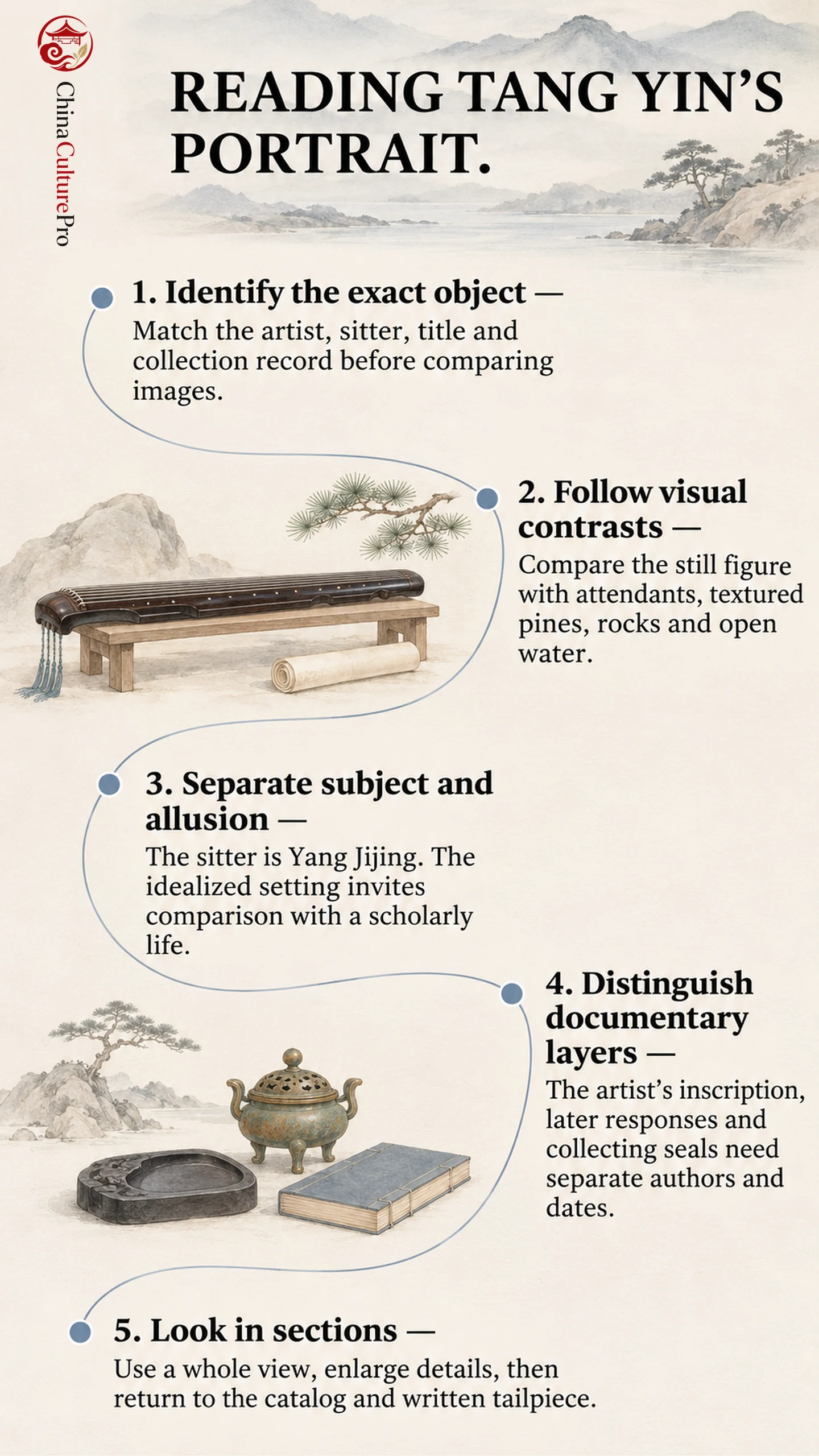
Distinguish the image, artist’s inscription, later commentary and collecting marks instead of assigning the whole mounted scroll to one moment.
Viewing the Handscroll in Sections
Handscrolls were traditionally encountered in successive sections from right to left, rather than as a complete wall-sized picture. Written additions could follow the image, recording responses across generations.[5] A digital view can recover something of that sequence without requiring access to the fragile original.
- Check the whole object: Identify the painted section, surrounding mounting and written tailpiece. A narrow overview helps you locate them before enlarging details.
- Inspect the principal group: Enlarge the sitter, instrument and attendants. Compare their gestures before attaching a symbolic meaning.
- Follow the setting: Move through pines, rocks, falling water and open water, noticing where marks become dense or sparse.
- Return to the written layers: Consult the catalog’s transcriptions and seal records, keeping each author and date separate from the painting’s creation.
The scroll-format guide expands this approach. Collection ownership does not mean continuous display: the documented southern-branch exhibition ran from November 2024 to February 2025.[4] Use the collection’s digital record for study and check a current exhibition listing before planning a visit.
FAQs About Scholar Playing the Guqin
Who is the man in Scholar Playing the Guqin?
He is identified as the musician Yang Jijing, also named Yang Ling, rather than an anonymous hermit.
Is the instrument a European lute?
No. The subject holds a guqin, a Chinese zither; the catalog’s older English title should not override that identification.
Does the painting carry an exact creation date?
No. Its late-career placement is an assessment; dates on later colophons do not automatically date the picture.
Is the scroll always on display in Taipei?
No continuous-display claim follows from the collection record. Check current exhibitions separately.
Sources
[1] National Palace Museum, Taipei. Tang Yin: The Lutanist, collection record
[2] Tse Chun-yan, Hong Kong Music Office. A Rendezvous with the Guqin
[3] National Palace Museum, Southern Branch. The ideal life of a lofty scholar: Qinshi tu
[4] National Palace Museum. An exhibition of literati qin culture, November 5, 2024
[5] Dawn Delbanco, Metropolitan Museum of Art. Chinese Handscrolls, 2008