
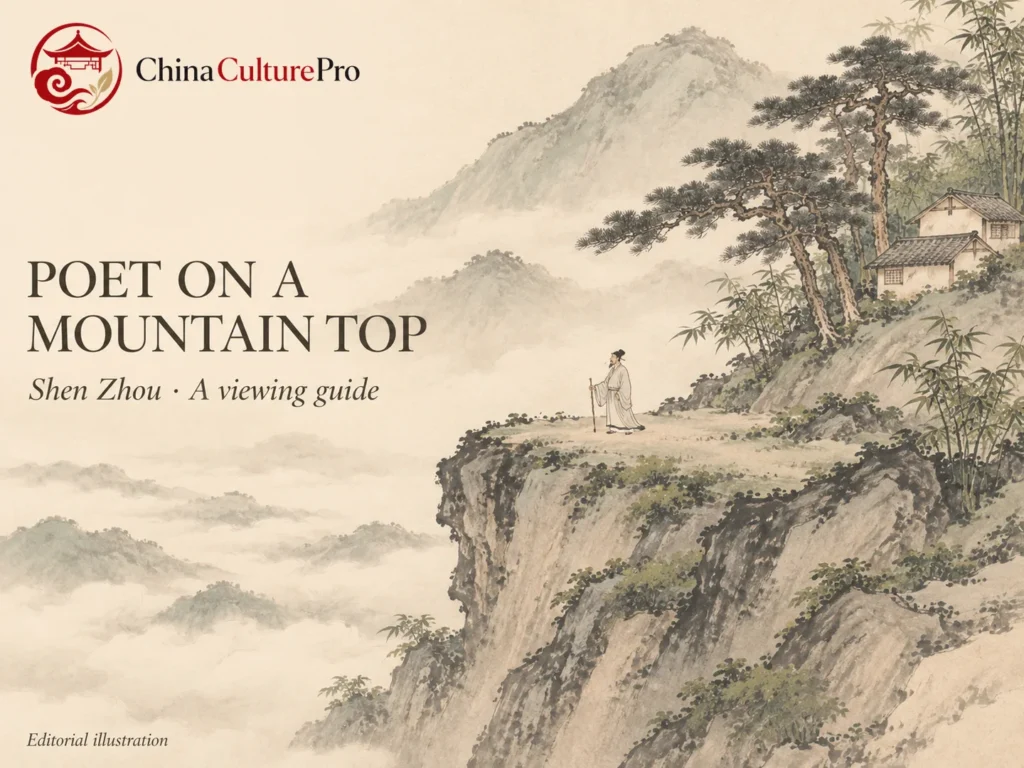

Quick Answer: What Is Poet on a Mountain Top?
Poet on a Mountain Top (杖藜远眺, Zhànglí Yuǎntiào) is a late-fifteenth-century landscape by Shen Zhou (沈周, Shěn Zhōu), held by the Nelson-Atkins Museum of Art in Kansas City. It is the second leaf in a six-picture landscape album now mounted as a handscroll. A small, staff-bearing figure stands on a rocky height, while an inscribed poem adds clouds, a distant path and the imagined sound of a flute to the view.[1][3]

The figure is easy to miss, but once you find him, the rock beneath his feet becomes a towering lookout. Across the pale space at the left, a poem occupies the upper air. Looking between person, cliff and writing reveals a landscape built for both seeing and imagining.
The Nelson-Atkins Album Leaf at a Glance
| Champ | Identification |
|---|---|
| Artist of this leaf | Shen Zhou |
| Date | Late fifteenth century |
| Original format | Album leaf, second in a group of six |
| Support | Paper |
| Approximate leaf dimensions | 38.7 cm high × 60.2 cm wide |
| Present collection | Nelson-Atkins Museum of Art, Kansas City, Missouri |
| Album identifier and position | 46-51/1–6; second leaf |
The album combines five leaves by Shen Zhou and one by Wen Zhengming. Its present handscroll mounting brings those separate pictures into a longer object; dimensions for that whole mounting should not be mistaken for this leaf’s image size.[1][2] The guide to Chinese scroll painting formats explains this difference between an individual picture and its later presentation.
A Small Figure Gives the Cliff Its Scale
Find the figure near the top of the projecting cliff, left of center. His pale robe stands out with very few marks. There is little need for elaborate facial detail: the upright body and staff establish a human presence against the broad rock surface below.
Then follow the cliff downward. Broken contours, vertical lines and dark patches of vegetation interrupt its face. The drop occupies far more of the picture than the figure, making the lookout feel high even within a comparatively small sheet of paper. Scale emerges from the relationship between those forms.
The right half is busier. Trees, bamboo-like foliage and buildings cluster against the slope, while a paler peak rises behind them. The left opens into clouds and a deep interval between rock masses. This unequal distribution gives the figure somewhere to look: his view extends across a space that the painter has largely left light.
The contrast between dense brushwork and pale distance is central to the viewing experience. Chinese landscape painting provides broader context for how ink, unpainted areas and overlapping landforms create a sense of space.
The Four-Line Poem Adds Sound to the View
The inscription contains four lines of seven characters each. Here is their plain English sense, preserving the original order rather than trying to reproduce the rhyme.[3]
| Original line | Plain English sense |
|---|---|
| 白雲如帶束山腰 | White clouds bind the mountains’ waists like a sash. |
| 石磴飛空細路遙 | Stone steps seem to fly into space; a narrow path stretches far away. |
| 獨倚杖藜舒眺望 | Alone, leaning on a staff, I gaze out at ease. |
| 欲因鳴澗答吹簫 | I wish to answer the sounding stream by playing the flute. |
The first two lines turn the landscape into movement. Clouds wrap, steps seem airborne, and the path carries the mind beyond the immediate ledge. The third line introduces a person whose stillness contrasts with that imagined motion.
The ending adds a different sense. A painted image cannot make a stream audible, but the poem asks you to imagine its sound and a musical response. The flute belongs to that wish. It does not require a flute to be visibly placed in the standing figure’s hands. For the literary setting of a four-line poem, see Chinese poetry forms.
The phrase for playing the flute should also be distinguished from whistling. The original refers to a musical instrument, a distinction that affects how the final line is imagined.[3]
The Poem and Painted Landscape Answer Each Other
The writing sits across the open space from the figure. You can read his position as turning toward the poem as well as toward the landscape. This is an effect of the composition, rather than proof that the pictured person is literally reading words suspended in the sky.
Try following the sequence in both directions. Starting with the painting, the sheer cliff and pale clouds make the first two poetic lines more tangible. Starting with the poem, the mention of a narrow, distant path encourages you to search the painted slopes for a possible route. The verse supplies movement and sound that the sparse figure alone does not explain.
The painting therefore offers more than an illustration of four sentences. Its crowded right side, open left side and small lookout figure control where you pause and how you move across the paper. The words add another route through the same space. A guide to Chinese calligraphy and painting explores how written marks and painted forms can share a surface, while Shen Zhou’s work places this leaf within his broader practice.
How to Follow the Figure, Clouds and Inscription
- Locate the figure: Use his height to judge the scale of the cliff below.
- Trace the open space: Compare the pale clouds at the left with the trees and buildings at the right.
- Read one poetic line: Look back at the landscape for the movement or space that the words suggest.
- Return to the whole leaf: Notice how figure, painted forms and writing share one horizontal field.
FAQs About Poet on a Mountain Top by Shen Zhou
Is the figure playing a flute?
He is shown with a staff. The poem expresses a wish to answer the stream by playing a flute; that imagined action should be distinguished from what is visibly depicted.[3]
Was the painting made as a hanging scroll?
It is an album leaf, now part of a group mounted as a handscroll. The individual picture has the wide proportions of a leaf rather than a tall hanging scroll.[1]
When did Shen Zhou paint this work?
The museum dates the album to the late fifteenth century. The collection record does not specify an exact year for this leaf.[1]
Sources
[1] Nelson-Atkins Museum of Art. Landscape Album: Five Leaves by Shen Zhou, One Leaf by Wen Zhengming
[2] Penn State University, Art History Visual Resource Collection. Poet on a Mountain Top: Work Identification and Dimensions
[3] Conal Boyce. Metric Montage in Chinese Poetry, Appendix A: Shen Zhou’s Painting and Inscribed Poem