


Quick Answer: Who Was Li Gonglin?
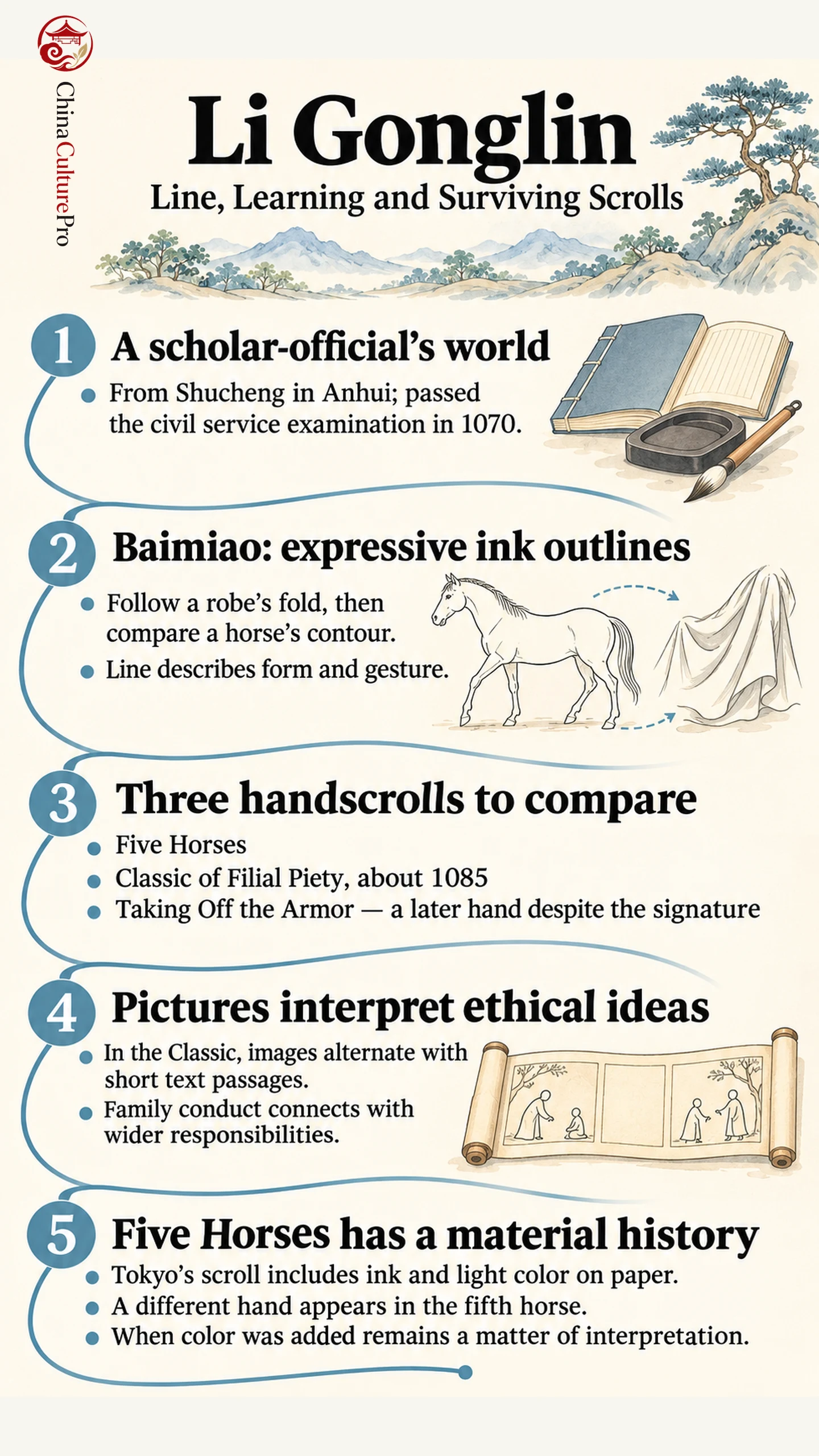
Li Gonglin (李公麟, Lǐ Gōnglín) was a Northern Song painter celebrated for horses and figures. His learned approach connected careful observation with historical models and the expressive possibilities of brushwork.[1][2]
- He worked as a scholar-official (士大夫, shìdàfū), bringing learned concerns into painting.[1]
- He is known for baimiao (白描, báimiáo), or ink-outline painting.[1]
- Five Horses survives in Tokyo and includes light color, complicating a purely monochrome image of his art.[3][4]
- His pictures could explore filial piety (孝, xiào), relating family conduct to wider responsibilities.[2]
A style label does not settle an individual scroll’s materials, attribution or history of alteration.
A line can describe a horse’s weight, the fall of a robe or a person’s bearing. Li Gonglin’s work makes these small decisions carry expressive force. To understand that legacy, compare the line itself with the text, materials and later additions surrounding it.
A Scholar-Official Who Painted
Li came from Shucheng in present-day Anhui and passed the civil service examinations in 1070.[1] His career belongs to the world of Chinese scholar-officials, where studying old texts and objects could inform artistic judgment.
His importance within literati painting involves ethical concerns, references to earlier art and brushwork capable of personal expression.[2] These qualities give a figure or narrative scene a purpose beyond attractive description.
Baimiao and the Expressive Work of Line
Baimiao emphasizes forms articulated through ink lines. In figure painting, changes in a contour’s movement can suggest a robe’s weight or a gesture’s direction without requiring a richly colored surface.[5]
Try following one continuous clothing fold before looking at the entire group. Then compare its rhythm with a horse’s neck or legs. This way of looking connects the physical action of the brush with the represented body, an important question throughout Chinese figure painting.
The label is useful for discussing a visual method; it should not make the actual color on a surviving scroll disappear from the account.
Three Handscrolls to Study
| Scroll | Material and date | Collection and qualification |
|---|---|---|
| Five Horses | Ink and light color on paper; cataloged as eleventh-century Northern Song. | Tokyo National Museum; its present composition has a history of later alteration.[3][4] |
| Classic of Filial Piety (孝经, Xiàojīng) | Cataloged as ink and color on silk; about 1085. | Metropolitan Museum of Art; pictures alternate with transcribed text.[2] |
| Taking Off the Armor | Paper handscroll using ink-outline painting. | National Palace Museum, Taipei; interpreted as a later hand despite its Li Gonglin signature.[5] |
Read these as three different kinds of evidence: a celebrated horse scroll with a complex physical history, an ethical picture-and-text sequence, and a later work associated with his manner.
Text, Pictures and Moral Meaning
The Classic of Filial Piety connects family conduct with wider social and political responsibilities. In Li’s scroll, transcriptions of short passages alternate with images that interpret their ethical significance rather than merely repeat the words.[2]
This relationship matters for how a handscroll unfolds. Reading a passage and then a scene invites the viewer to compare conduct, posture and social relationships. For the cultural idea behind the work, the guide to filial piety provides further context.
The paintings’ restraint and historically inflected calligraphy support a serious moral reading.[2] That does not mean all of Li’s subjects can be reduced to a single lesson.
Five Horses and the Problem of Color
The first four horse-and-handler pairs offer a place to compare the animals’ bodies with the lines of human clothing.[1]
For decades, Five Horses was widely known through monochrome reproductions while the original was out of public sight. Its display in Tokyo in 2019 made close examination of the actual color especially consequential.[4]
The surviving work is not simply five untouched monochrome drawings. Research identifies a different hand in the fifth horse, while another analysis argues that the present color was added later.[4][6] The timing of individual changes requires scholarly interpretation; the presence of color is a material fact.
Its material history matters for style: the visible color and a later replacement cannot simply be treated as one unchanged artistic decision.
FAQs About Li Gonglin
Does baimiao mean every Li Gonglin painting lacks color?
No. Five Horses is cataloged with light color, and its changing physical history requires a more specific account than the general style label.[3][4]
Where is Five Horses now?
It belongs to the Tokyo National Museum. Collection ownership does not mean the fragile scroll is continuously displayed.[3]
Does a Li Gonglin signature guarantee his authorship?
No. Taking Off the Armor bears his name, but its style is interpreted as that of a later painter.[5]
Sources
[1] National Palace Museum. An Assembly for the Ages: Five Horses
[2] Metropolitan Museum of Art. The Classic of Filial Piety
[3] Tokyo National Museum. Five Horses, ColBase TA-694
[4] Itakura Masaaki, University of Tokyo. Li Gonglin’s Five Horses
[5] National Palace Museum. Taking Off the Armor
[6] Wang Lianqi, Palace Museum. 关于李公麟《五马图》的问题