


Quick Answer: What Defines Juran’s Painting?
Juran (巨然, Jù Rán), active in the later tenth century, was a Buddhist monk and landscape painter associated with Dong Yuan’s tradition.[1]
- Texture: Long strokes and rounded summit rocks help identify the visual vocabulary associated with him.[2]
- Composition: Misty southern effects can appear within a towering mountain landscape.[1]
- Legacy: Later painters used his name to identify an older artistic model.[4]
Style is useful evidence, but it does not settle the authorship of every painting attributed to Juran.
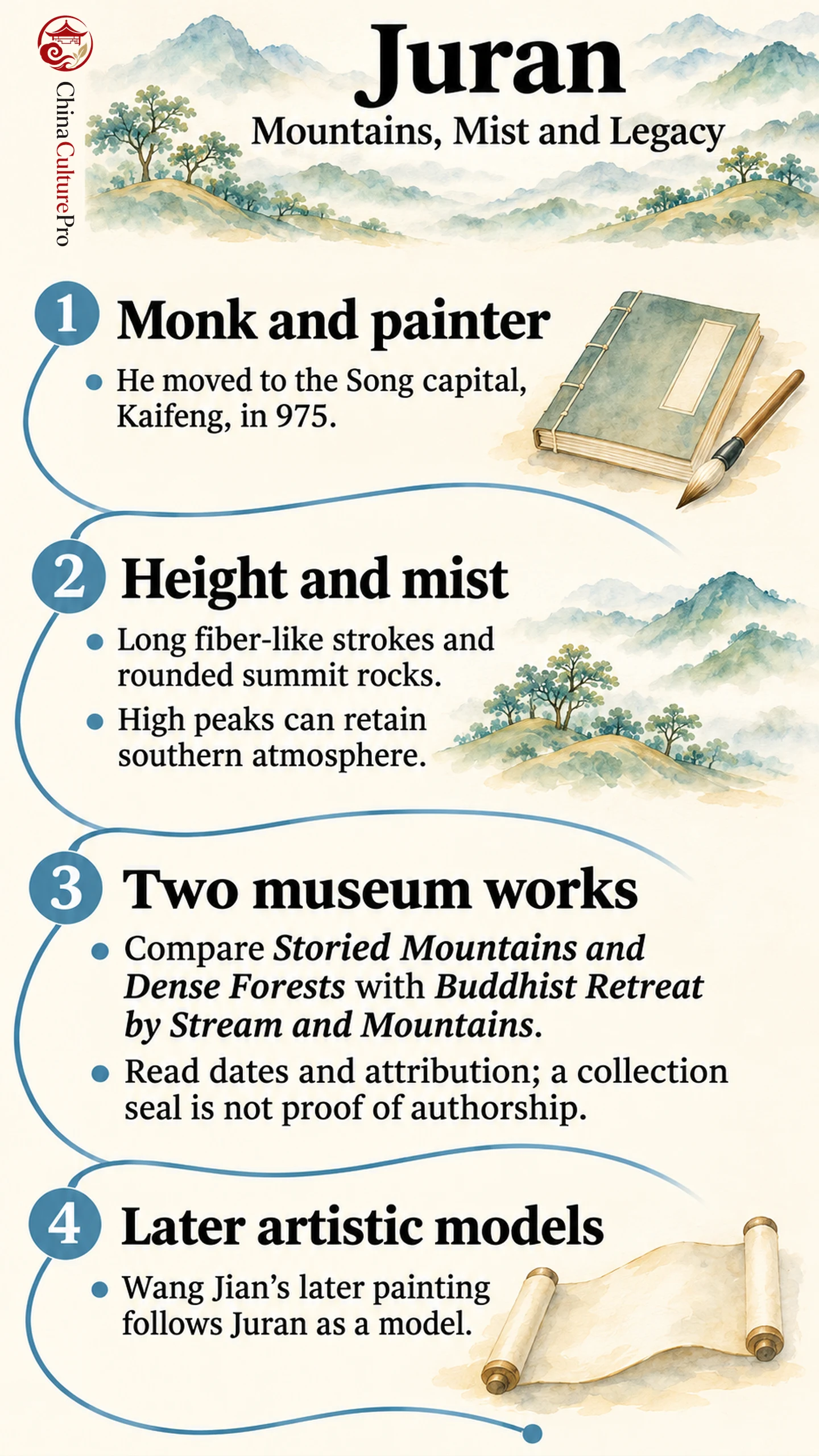
A Juran landscape can feel both immense and intimate: mountains rise above a small retreat, while damp-looking surfaces and wooded paths draw attention back into the terrain. His career also helps explain why southern and northern features can coexist.
A Monk-Painter between Southern Tang and Song
Juran worked in the Southern Tang cultural world centered on Nanjing and learned from Dong Yuan. When the Southern Tang fell, he moved north to Kaifeng, the Song capital.[1] The move is conventionally placed in 975.[2]
His monastic identity belongs to the history of Chinese Buddhism, but identifying him as a monk does not by itself explain every painted mountain or building as a doctrinal symbol.
Height, Mist and the Texture of Hills
Buddhist Retreat by Stream and Mountains combines a commanding central mountain with features associated with southern painting, including wet dots and rounded summit stones.[1] Monumental height and a moist atmosphere need not be opposing choices.
- Hemp-fiber texture strokes (披麻皴, pī má cūn): Long, fiber-like strokes used to texture hills and rocks.[2]
- Alum heads (矾头, fán tóu): Clusters of rounded rocks on mountain summits.[2][3]
Light washes also help establish mist and dampness between wooded slopes.[2] Look at the relationship between textured surfaces and pale spaces, rather than judging the landscape by its outer mountain silhouette alone.
Two Early Works and Their Evidence
The dimensions below describe the painted surfaces, not the complete mountings.
| Work | Collection | Format and size | Attribution or dating note |
|---|---|---|---|
| Storied Mountains and Dense Forests | National Palace Museum, Taipei | Hanging scroll, ink on silk; 144.1 × 55.4 cm | Traditionally associated with Juran; authorship remains debated.[2][3] |
| Buddhist Retreat by Stream and Mountains | Cleveland Museum of Art | Hanging scroll, ink on silk; 184.5 × 56.1 cm | Catalogued as Juran, 960–985; the interpretation suggests after 976.[1] |
For Storied Mountains and Dense Forests, an official seal used in the early twelfth century contributes evidence about the work’s history. It does not by itself identify the painter as Juran.[3]
The catalogue gives a range, 960–985. A suggested date after 976 is a narrower proposal within that range, not a recorded exact year.[1]
Juran’s Legacy in Later Painting
A later Landscape in the Style of Juran is by Wang Jian (1598–1677), and is dated between 1620 and 1677. Its ink and watercolor on paper belong to that later artist’s work, not to Juran’s tenth-century output.[4]
Compare the later painting with the earlier scrolls by following its contours, textured passages and reserved paper. Those choices offer a way to examine how a later artist developed a received vocabulary.
For the larger history of composition and technique, the Chinese landscape painting overview supplies a broader comparison.
FAQs About Juran
Was Juran a Buddhist monk?
Yes. His monastic identity is part of the recorded context of his landscape-painting career.[1]
Did he paint only gentle, low hills?
No. The towering mountain in Buddhist Retreat demonstrates how monumental structure can coexist with a southern textural vocabulary.[1]
Are all paintings attributed to Juran undisputed?
No. Storied Mountains and Dense Forests remains a debated attribution; evidence about its collection history does not automatically establish its painter.[3]
Sources
[1] Cleveland Museum of Art. Buddhist Retreat by Stream and Mountains
[2] National Palace Museum. Storied Mountains and Dense Forests: selection essay
[3] National Palace Museum. Storied Mountains and Dense Forests: collection record and attribution discussion
[4] Detroit Institute of Arts. Wang Jian, Landscape in the Style of Juran