

Quick Answer: What Is Investiture of the Gods?
Investiture of the Gods, or Fengshen Yanyi (封神演义, Fēngshén Yǎnyì), is a Chinese novel that turns the fall of the Shang and rise of the Zhou into a war involving rulers, warriors, spirits and immortals. Its title points toward the assignment of divine offices after the conflict.[1]
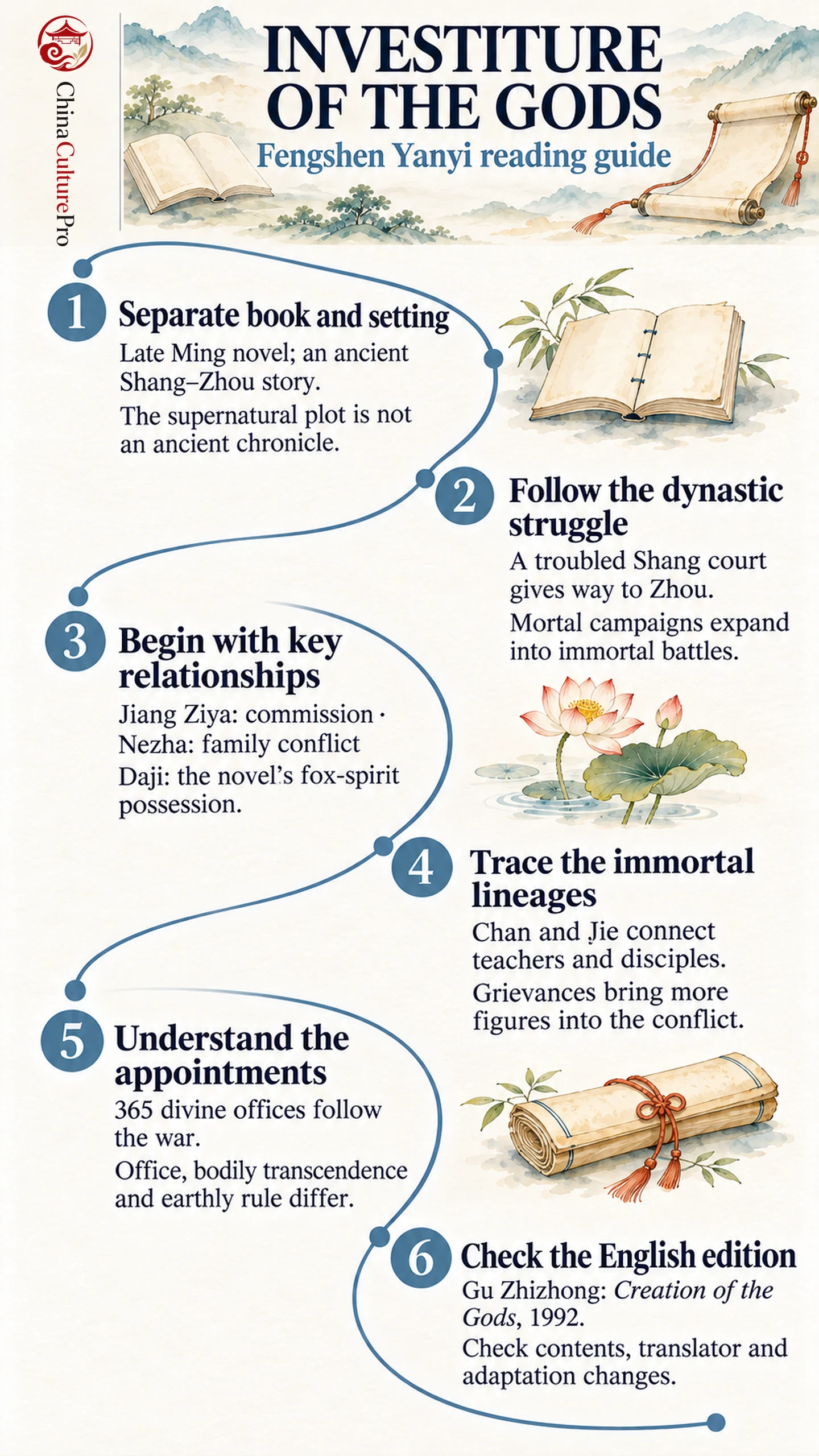
- The book: A late-imperial work, not an account written at the time of the ancient events it depicts.
- The story: Political disorder and dynastic change become intertwined with supernatural battles.
- The characters: Family relationships, teachers, disciples and competing loyalties connect a large cast.
- The ending: Divine appointment and earthly victory are related but different outcomes.
Begin with the story’s relationships. A screen adaptation or a familiar deity’s temple image may preserve only part of the novel’s characterization.
A child with a lotus body, a strategist charged with appointing gods, and a court disrupted by a fox spirit all belong to the same sprawling story. The easiest way into it is to follow two connected questions: who will rule on earth, and what positions the dead will receive in the divine order. This introduction includes broad plot and ending spoilers.
What the Novel Is and When Its Story Takes Place
The novel belongs to the late Ming literary world. Its authorship remains disputed: Xu Zhonglin (许仲琳, Xǔ Zhònglín) and Lu Xixing (陆西星, Lù Xīxīng) are among the names associated with it. Giving one name without qualification hides that uncertainty.[1]
Its standard chapter sequence runs to 100. It is commonly discussed as shenmo (神魔, shénmó), or gods-and-demons fiction: supernatural beings and their interventions shape the narrative rather than appearing only as passing decoration. The Chinese literature guide places it among the broader forms of classical writing.[14]
The story’s ancient setting is much earlier than the book. Its backdrop is the Shang–Zhou transition in the eleventh century BCE, transformed by later religious and storytelling traditions. Use the Shang dynasty and Zhou dynasty guides for historical orientation; do not derive an ancient religious system or a precise battle chronology from a magical scene.[2]
That time gap is part of the work’s interest. Readers encounter an ancient dynastic struggle through a much later imaginative world, with divine powers, ritual associations and recognizable religious figures. The Chinese mythology overview provides context for those connected traditions.
The Story: From a Troubled Court to a New Dynasty
King Zhou (纣王, Zhòu Wáng), the last Shang ruler in the story, presides over a deteriorating court. Daji (妲己, Dájǐ) becomes central to its supernatural corruption. Chapter 4 makes an important distinction: the human Daji dies, and a fox spirit takes her body. The character’s subsequent actions belong to that fictional possession narrative.[5]
Jiang Ziya (姜子牙, Jiāng Zǐyá), also called Jiang Shang, receives a different task. His teacher sends him down from the immortal world to assist the coming political order and carry out the investiture. His role joins worldly service to a divine commission.[7]
King Wu (武王, Wǔ Wáng) becomes the ruler associated with the Zhou victory. Around that transition, the story develops through several connected movements:[13]
- Disorder at the Shang court creates the moral and political case for opposition.
- The future Zhou coalition gathers leaders, warriors and extraordinary allies.
- Mortal campaigns expand into battles involving immortal lineages, magical objects and formations.
- The overthrow of the Shang leads toward both divine appointments and the allocation of earthly rule.
One name can cause needless confusion: King Zhou and the Zhou dynasty are different. The king’s epithet uses 纣, Zhòu, while the dynasty is 周, Zhōu. In English spelling they look alike; in the story they occupy opposing sides of the dynastic transition.
The Mandate of Heaven is a useful background concept for reading claims about a ruler’s legitimacy. Within the novel, however, political judgment works together with supernatural necessity. A reader should notice both what characters choose and what the narrative presents as already destined.
Major Characters and the Relationships to Follow
The cast is large enough that a relationship map is more useful than a list of powers. These nine figures provide a practical starting point.
| Personnage | Relationship or role worth following |
|---|---|
| Jiang Ziya | Strategist and divine appointee who connects the Zhou campaign with the investiture.[7] |
| King Zhou | Shang ruler whose conduct drives the novel’s condemnation of his court.[5] |
| Daji | The court figure whose human identity is overtaken by a fox spirit.[5] |
| King Wen (文王, Wén Wáng) | Father of King Wu; his recruitment of Jiang Ziya links recognition of talent to political change.[8] |
| King Wu | The Zhou leader whose victory and later enfeoffments give the earthly story its new order.[13] |
| Nezha (哪吒, Nézhā) | Warrior whose new lotus body and conflict with his father complicate simple ideas of family obedience.[6] |
| Yang Jian (杨戬, Yáng Jiǎn) | Resourceful Zhou ally who uses transformations and other means to counter supernatural opponents.[11] |
| Shen Gongbao (申公豹, Shēn Gōngbào) | Jiang Ziya’s opponent, whose persuasion brings further resistance into the struggle.[9] |
| Wen Zhong (闻仲, Wén Zhòng) | Loyal Shang commander whose later thunder office shows that fighting against Zhou does not prevent divine appointment.[12] |
Nezha’s Chapter 14 is a particularly useful episode to read closely. His teacher creates a body from lotus materials after the destruction of his shrine, and the renewed body does not immediately resolve his anger toward his father. The conflict concerns bodily origins, authority and obligations as well as martial ability.[6]
Yang Jian belongs to the wider Erlang Shen tradition, but details should still be attached to the work in which you encounter them. A later film’s design or biography is not automatically evidence for a scene in this novel.
For Daji, the Chinese fox-spirit guide offers wider literary context. Her particular role should not become a rule that every fox spirit in Chinese stories has the same motives, character or relationship to humans.
Why the Immortals Fight
Two major teaching lineages help organize the supernatural conflict. They are groups within the novel, with masters, disciples and obligations; they should not be treated as a direct map of present-day religious institutions.[7][10]
Yuanshi Tianzun (元始天尊, Yuánshǐ Tiānzūn) gives Jiang Ziya his commission. Tongtian Jiaozhu (通天教主, Tōngtiān Jiàozhǔ) heads the other lineage.[7][10]
| Teaching lineage | Definition within this story |
|---|---|
| Chan teaching (阐教, Chǎnjiào) | The immortal lineage headed by Yuanshi Tianzun in the novel. |
| Jie teaching (截教, Jiéjiào) | The immortal lineage headed by Tongtian Jiaozhu in the novel. |
The important reading task is to trace who has taught whom and why an injury or death brings another figure into the struggle.
A duel can therefore expand through obligation. A defeated disciple’s teacher or companions may take up the grievance. Chapter 72 connects the death of a disciple, the handling of a magical object and renewed conflict among lineage members.[10] A powerful object changes the immediate danger, while another figure’s knowledge or intervention changes how it can be answered. The succession of battles is also a succession of relationships being activated.
Shen Gongbao gives persuasion a destructive role. In Chapter 37, he tries to turn Jiang Ziya away from his commission and toward the Shang court. His opposition is not confined to one exchange of blows; recruiting further participants helps enlarge the conflict.[9]
Religious context gives these patterns additional depth. Mark R. E. Meulenbeld’s research connects the novel with older Daoist martial and exorcist ritual structures, temple communities and performance. That is a reason to read the supernatural organization as more than a collection of fantasy weapons, while keeping scholarship about cultural practice distinct from the novel’s imagined events. The guides to religious Daoism and Chinese folk religion offer broader introductions.[3]
What the Investiture of the Gods Actually Means
Fengshen Bang (封神榜, Fēngshén Bǎng), the investiture register, names the divine appointments toward which the conflict moves. Chapter 99 presents Jiang Ziya’s ceremony, with 365 positions and named responsibilities within the celestial order.[12]
An appointment gives a spirit an office; it is not simply a declaration that the person was on the winning side. Wen Zhong, who served Shang, receives authority over the thunder department. The ending gathers antagonists into an ordered divine administration rather than making the human coalition’s victory the only measure of their future status.[12]
Nor does every prominent figure reach the same outcome. The final chapter distinguishes seven figures, including Nezha and Yang Jian, who achieve transcendence in bodily form, from the dead who receive appointments. Jiang Ziya also participates in the earthly settlement. A list of familiar gods is therefore not a simple list of everyone killed or everyone rewarded in the same way.[13]
For wider traditions of divine figures, consult the Chinese gods and goddesses guide. The novel has close connections with religious culture, but it does not supply the single origin story or universal hierarchy of every Chinese deity.
Reading the Novel in English and Recognizing Adaptations
English titles vary. Investiture of the Gods, Creation of the Gods and Romance of Canonizations can refer to this work. Check the original title, translator and contents before assuming that two English titles describe different novels.[1]
One identifiable edition is Gu Zhizhong’s Creation of the Gods, published by New World Press in 1992 in two volumes. Use the translator’s credit, publisher, year and volume count to identify that edition, then check the contents of the copy you plan to read.[4]
Before choosing a copy, check four things:
- Coverage: A full chapter sequence, a selection, a retelling or one volume of a larger set.
- Translator: The actual credit on the edition, kept separate from the author attribution.
- Names: Whether the edition uses pinyin, older spellings or translated titles for the same figures.
- Notes: Enough explanation of teacher relationships, divine titles and unfamiliar objects to support your reading.
Keep a small cast list as you read, adding teacher, family, allegiance and current outcome beside each name. When a new immortal appears, locating the relationship often explains the intervention before a detailed account of the weapon becomes necessary. The Chinese classic books guide gives more general help with editions.
Readers coming from Chinese animation or mythology-based games should identify the particular adaptation. A retelling may reorganize the plot or make one figure its center. The presence of a familiar name does not make every new relationship part of the old novel.
The same caution helps when comparing it with Journey to the West. Shared supernatural figures and religious materials do not make the two books a single continuous plot. Their shared materials can be compared, but their supernatural worlds differ. Follow each work’s own mission, cast relationships and narrative rules.[15]
FAQs About Investiture of the Gods
Is Investiture of the Gods the same work as Fengshen Yanyi?
Yes. Fengshen Yanyi is the Chinese title. Creation of the Gods and Romance of Canonizations are other English renderings, although a specific edition may be abridged or retold.
Is the novel a reliable history of the Shang and Zhou?
It uses the dynastic transition as a story framework, but its supernatural battles and character episodes belong to a much later work of fiction. Historical claims need separate evidence.
Does every major character become a god through the final list?
No. The story distinguishes posthumous appointments, bodily transcendence and earthly political rewards. A familiar divine figure need not have entered the list in the same way as a fallen warrior.
Is Nezha’s story identical in the novel and modern films?
No. Modern adaptations can change origins, relationships and plot emphasis. The novel’s lotus-body episode is a useful reference point when comparing a particular retelling.
Sources
[1] University of California San Diego, David K. Jordan. Romance of Canonizations: Introduction
[2] Keio University, Kazuo Yamashita. Religious Beliefs and Mass Entertainment in the Sinosphere
[3] University of Hawai‘i Press. Demonic Warfare: Daoism, Territorial Networks, and the History of a Ming Novel
[4] National Institute of Informatics, CiNii Books. Creation of the gods, translated by Gu Zhizhong
[5] Fengshen Yanyi, Chinese primary text via Wikisource. Chapter 4
[6] Fengshen Yanyi, Chinese primary text via Wikisource. Chapter 14
[7] Fengshen Yanyi, Chinese primary text via Wikisource. Chapter 15
[8] Fengshen Yanyi, Chinese primary text via Wikisource. Chapter 24
[9] Fengshen Yanyi, Chinese primary text via Wikisource. Chapter 37
[10] Fengshen Yanyi, Chinese primary text via Wikisource. Chapter 72
[11] Fengshen Yanyi, Chinese primary text via Wikisource. Chapter 92
[12] Fengshen Yanyi, Chinese primary text via Wikisource. Chapter 99
[13] Fengshen Yanyi, Chinese primary text via Wikisource. Chapter 100
[14] Zhange Ni. Xiuzhen (Immortality Cultivation) Fantasy: Science, Religion, and the Novels of Magic/Superstition in Contemporary China
[15] Grand Valley State University, Yan Liang. The Freedom of Gods and Demons: A Comparative Study of Xiyou ji and Fengshen yanyi