


Quick Answer: What Was the Mandate of Heaven?
The Mandate of Heaven (天命, Tiānmìng) was the idea that Heaven (天, tiān) authorized a ruler to govern and could withdraw that authority. It became prominent when the Zhou dynasty (周朝, Zhōu cháo) explained its conquest of the Shang dynasty (商朝, Shāng cháo) in the eleventh century BCE.[1][2]
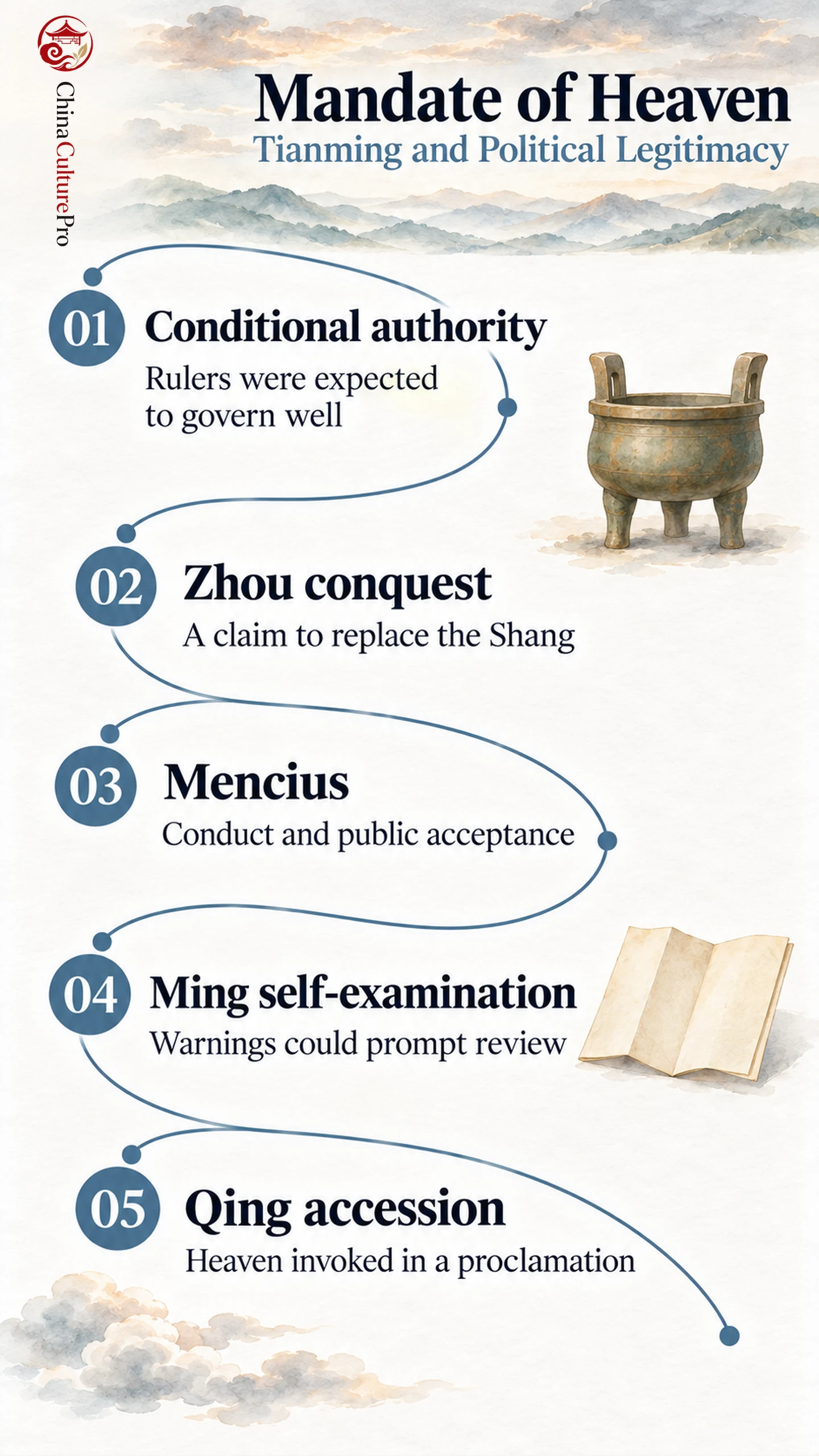
- Legitimacy: The mandate gave a ruler a claim to govern, together with a responsibility to rule well.[1][2]
- Succession: Early Zhou accounts explained how a once legitimate dynasty could lose its authority and be replaced.[2][3]
- The people: Mencius (孟子, Mèngzǐ) treated public acceptance and the conduct of government as evidence of Heaven’s approval.[4]
Courts could invoke the mandate to defend a new reign, while unusual events could also prompt a reigning emperor to examine his conduct.[1][6][7]
An early Zhou king had a lesson for an official named Yu. He contrasted the conduct of his own dynasty’s founders with the excesses he blamed for the fall of their predecessors. The speech survives inside a bronze vessel. It offers a starting point for seeing how arguments about legitimacy took shape in Chinese history, in words spoken to officials and in objects made to preserve those words.[3]
What Tianming Meant in Politics
In this expression, tian is Heaven, while ming can mean a command (命, mìng). The political meaning concerns a charge to rule. In early accounts, Heaven is described as able to judge conduct and favor rulers who care for the people. That made a ruler’s behavior relevant to the strength of his claim.[1][2]
Heaven could also refer to the sky and its patterns, and ming could refer to fate in other settings. These meanings became topics of debate in Chinese philosophy. A political claim about a king’s right to govern uses a specific sense of the term. The title Son of Heaven (天子, Tiānzǐ), associated with Chinese rulers, places the sovereign in a relationship to Heaven.[1][4]
How the Zhou Explained the Fall of the Shang
When the Zhou dynasty took power, it faced a question of how to justify replacing the Shang dynasty. The transmitted Book of Documents (尚书, Shàngshū) preserves a speech attributed to the Duke of Shao. It treats the Shang as having once held Heaven’s authority and warns the Zhou ruler to act with care to preserve his own mandate. The same idea that justified the conquest therefore set a standard for the new rulers.[1][2]
The Da Yu ding (大盂鼎, Dà Yú Dǐng) gives an early material example. Its inscription records King Kang appointing Yu and holding up the Zhou founders as examples. The king blames Shang officials’ drinking and excess for the downfall of their state. This is a message delivered in the course of giving an official duties. The account turns the earlier dynasty’s fall into a lesson about how Yu should carry out his new duties.[3]
How Mencius Connected Heaven and the People
In Mencius 5A5, a student asks whether the exemplary ruler Yao simply gave his throne to Shun. Mencius says Yao could put Shun forward. Acceptance had to become visible through his conduct and the way he administered affairs. When the people could live securely under his administration, their acceptance became part of the story of Heaven’s approval.[4]
Another passage, 1B8, asks whether King Wu was right to kill the last Shang ruler. Mencius answers by describing the tyrant as a man who had forfeited the moral standing of a sovereign. The answer makes the title depend on conduct. It supplies a defense of removing a tyrant in that example, while leaving open how a political community would establish that judgment in practice.[5]
How Later Courts Used the Mandate
The language could be used while a dynasty remained in power. In the Ming dynasty, emperors sometimes reviewed their own conduct in response to disasters or unusual celestial events. Li Yuan’s study describes how self-examination could lead to a formal edict of self-blame. Such a response acknowledged duties and left the ruler in office. A celestial event could prompt a political interpretation as well as a record in the history of Chinese astronomy.[6]
The mandate could also support a claim to replace a dynasty. In the early Qing dynasty, the Shunzhi Emperor’s accession proclamation invoked Heaven’s mandate to justify Qing entry into the Central Plains and invited former Ming subjects to submit. This is evidence of how the new court presented its rule during a contested transition.[7]
What the Mandate Can Explain About Dynastic Change
The bronze inscription, the philosophical dialogue and the accession proclamation address different audiences. The inscription reminds an official how the king expects him to serve. The dialogue considers what makes a ruler worthy. The accession proclamation calls on subjects of the former dynasty to accept a new sovereign. Reading them together shows how an idea about Heaven could shape the presentation of politics across centuries. To explain a particular transition, historians also examine the struggles and institutions that affected who could actually rule.[3][4][5][7]
FAQs About the Mandate of Heaven
Was the Mandate of Heaven hereditary?
Power often passed within a ruling family. The mandate was conditional, allowing a rival house to claim that Heaven had transferred its authority.
Did a natural disaster mean the mandate was lost?
A disaster could be read as a warning about a ruler’s conduct. Ming emperors sometimes responded with policy review or self-reproach while remaining on the throne.
Did the Mandate of Heaven give people a right to rebel?
Mencius defended the removal of the last Shang ruler on moral grounds. The passage offers a justification in that case and leaves open who could make or enforce such a judgment in other cases.
Sources
[1] Stanford Encyclopedia of Philosophy. Metaphysics in Chinese Philosophy
[2] Book of Documents, translated by James Legge. The Announcement of the Duke of Shao
[3] National Museum of China. Yu Bronze Ding
[4] Mencius, translated by James Legge. Wan Zhang I
[5] Mencius, translated by James Legge. Liang Hui Wang II
[6] Li Yuan. The Ming Emperors’ Practice of Self-Examination and Self-Blame
[7] Academia Sinica. Discovering How Qing Dynasty Emperors Thought Through Their Edicts