

Quick Answer: Where Should You Start?
Chinese children’s stories include traditional tales retold for young readers, adaptations of long classics, modern Chinese books in translation and new English-language fiction inspired by Chinese culture. Start with the kind of reading experience you want, then check the specific edition.
- For short traditional tales: Choose an illustrated anthology with clear reteller and source information.
- For a familiar classic character: Try a children’s Monkey King adaptation, checking which adventures it includes.
- For modern lives and feelings: Look at translated picture books and longer children’s novels.
- For two-language reading: Check the actual pages and audio rather than assuming that “bilingual” means beginner level.
A story’s cultural background, reading difficulty and emotional intensity are separate questions. A picture book can contain grief; a book with Chinese themes can have been written originally in English.
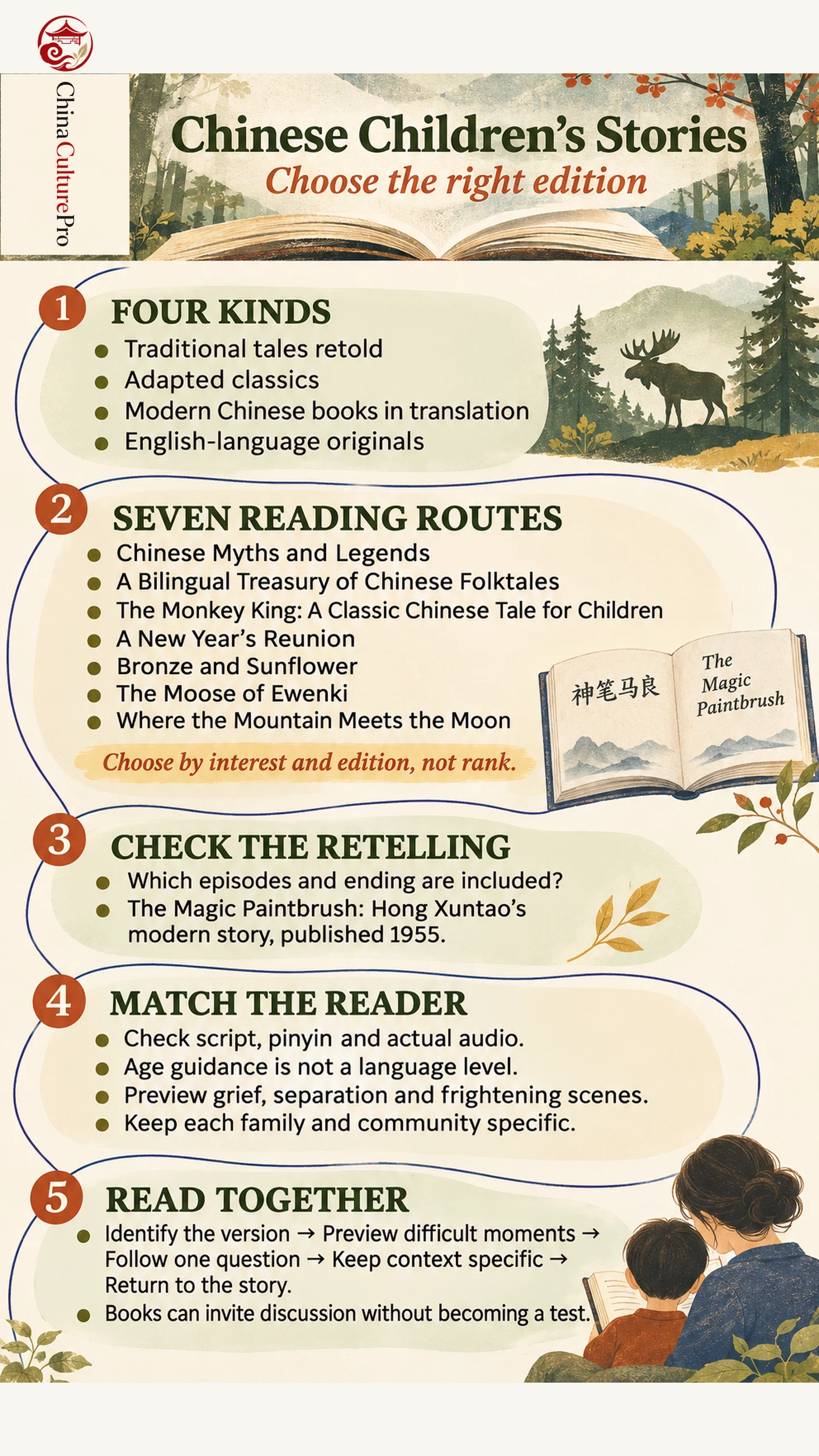
Chinese children’s stories offer more than a shelf of ancient legends. Some invite listeners into imaginary worlds; others follow a family reunion, a rural childhood or a relationship with an animal. Begin with the child’s interest: a brief adventure to hear aloud, a family story to share, or a longer novel to read independently.
This guide offers seven reading routes rather than a ranking. The descriptions draw on the named editions’ catalog information, not a claim that every book suits every child. For the wider literary setting, explore Chinese literature.
Four Kinds of Chinese Children’s Stories
These categories help explain where a book comes from. They can overlap: a contemporary author may reshape a traditional tale, and a bilingual edition may present either an old story or a new one.
- Traditional tales retold: Folk tales and Chinese myths appear in new arrangements, translations and illustrations. A reteller’s version is one telling, not a single definitive original.
- Adaptations of classics: A picture book may select one character or episode from a long work. Its length and ending can differ substantially from the source novel.
- Modern Chinese originals in translation: These have identifiable authors and publication histories. Their subjects include everyday life as well as fantastic events, within the broader world of modern Chinese literature.
- English-language originals: A new story can draw on Chinese cultural traditions without being translated from a Chinese book. Its language of composition matters when choosing it for language learning.
Short Chinese fables offer another possible route, but their original arguments were not necessarily addressed to children. Choose a retelling on its own merits rather than treating “traditional” as an age recommendation.
Seven Books and Reading Routes
The page counts below identify the cited editions, not the length of every edition carrying that title. Creator and translator credits help distinguish an original work from an adaptation or translation.
| Book and creators | What this edition offers | Reading choice and preview |
|---|---|---|
| Chinese Myths and Legends, retold by Shelley Fu; illustrated by Patrick Yee | Seven tales in a 128-page English collection, with a pronunciation guide and further reading | Creation stories and supernatural encounters, with background material to read alongside the tales. Treat the narratives as mythology rather than documentary history.[1] |
| A Bilingual Treasury of Chinese Folktales, by Vivian Ling and Wang Peng; illustrated by Yang Xi | Ten stories across 64 pages, with parallel Chinese and English and online audio in both languages | Useful for comparing two tellings of the same passage. Inspect the text and recording before choosing it for a learner; parallel languages alone do not establish difficulty.[2] |
| The Monkey King: A Classic Chinese Tale for Children, retold by David Seow; illustrated by Lak-Khee Tay-Audouard | A 32-page illustrated adaptation introducing the beginnings of the quest and the gathering of companions | A short entry into a much longer adventure. Check its coverage before expecting the whole journey or every famous episode.[3] |
| A New Year’s Reunion (团圆, Tuányuán), written by Yu Li-Qiong (余丽琼, Yú Lìqióng); illustrated by Zhu Cheng-Liang (朱成梁, Zhū Chéngliáng) | A 40-page picture book about a child whose father returns home for New Year | The cited edition gives ages 3–7. Its warmth sits alongside separation: this is one family’s experience, not a description of all families.[4][10] |
| Bronze and Sunflower (青铜葵花, Qīngtóng Kuíhuā), by Cao Wenxuan (曹文轩, Cáo Wénxuān); translated by Helen Wang; illustrated by Meilo So | A 400-page novel in which a bereaved girl becomes part of a poor rural family | The cited edition gives ages 9–12. Preview the father’s drowning, hardship and loss, and consider whether sustained independent reading or shared reading fits better.[5][11] |
| The Moose of Ewenki (鄂温克的驼鹿, Èwēnkè de Tuólù), by Gerelchimeg Blackcrane (黑鹤, Hēihè); illustrated by Jiu Er (九儿, Jiǔ’ér) | A 68-page picture book about an Ewenki (鄂温克, Èwēnkè) hunter and an orphaned moose calf in northern China’s forests | A community-specific story of care and attachment. The mother moose’s death begins the relationship; illustrated format does not mean an absence of difficult events.[6][8] |
| Where the Mountain Meets the Moon, by Grace Lin | A 288-page English-original fantasy following Minli’s quest, with stories woven through the adventure | The author lists ages 8–12 and grades 3–6. Choose it for an extended fantasy inspired by Chinese folklore, rather than as a translated collection of traditional tales.[7] |
For a festival reading session, pair the reunion picture book with a simple explanation of Chinese New Year traditions. Let the book’s particular family remain particular: an explanation of a custom should not turn a character into a representative of every household.
The moose story offers a different setting and community from the rural family novel or the festival picture book. Reading them alongside each other helps keep place, livelihood and personal experience visible instead of reducing the selection to one generalized image of China.
What Changes in a Children’s Retelling
A children’s version can change the plot, narrative voice, pictures and ending. For an adaptation of Journey to the West (西游记, Xī Yóu Jì), first ask whether it covers the Monkey King’s beginnings, a single trial or a condensed pilgrimage. The full novel’s story provides a different reading experience from a short picture book.
A book centered on Sun Wukong (孙悟空, Sūn Wùkōng), the Monkey King, may give the other travelers little space. If children want to know who joins him and why, a guide to Journey to the West characters is a useful next step. The reteller’s selection determines which episodes a reader encounters.
Authorship is another important distinction. The Magic Paintbrush (神笔马良, Shén Bǐ Mǎ Liáng) is associated with Hong Xuntao (洪汛涛, Hóng Xùntāo), whose story was published in 1955. Although it draws on folk-story traditions, it is a modern authored literary tale, not simply an anonymous ancient story. A later version should be identified by its own reteller or adapter, with attention to what that person changed.[9]
When comparing versions, choose one concrete feature: who receives help, what the central character wants, or how the conflict ends. That produces a more useful conversation than deciding that every difference is a mistake. A retelling can be inventive while still needing an honest description of its relationship to the source.
Match Language and Reading Readiness
A publisher’s age band is a guide to the edition’s intended audience, not a test of Chinese proficiency. An English-speaking nine-year-old may read a translated novel independently while needing considerable support with a much shorter Chinese text. Shared reading also changes the task: an adult can carry the written language while the child follows the pictures and plot.
For a Chinese or bilingual edition, check three separate features:
- Writing system: Look at whether the pages use simplified or traditional characters. A familiar story does not remove the challenge of an unfamiliar script.
- Pronunciation support: Check whether pinyin (拼音, pīnyīn), the romanization system, appears, and whether a recording accompanies the complete text. A pronunciation guide and line-by-line reading support are different features.
- Spoken language: Listen to the actual recording. The label “Chinese” alone does not tell you everything about the language variety or the support a particular learner needs.
Try a sample spread or short passage before committing to the whole book. Can the child follow the action, with help if needed? Are the pictures providing useful clues, or does the written vocabulary carry almost everything? An introduction to Chinese characters can support a separate language lesson without making the story session into a vocabulary test.
Emotional readiness deserves the same attention as sentence length. In the selection above, a novel includes bereavement and poverty, and an animal picture book begins with a death. Preview those scenes and offer a different book if the child would rather read something else. These are selection choices, not diagnoses or promises about how reading will affect a child.
How to Read a Story Together
Use these steps flexibly. A child absorbed in an adventure need not stop at every page for a cultural explanation.
- Identify the version: Find the author or reteller, illustrator, translator if named, and the language of this edition.
- Preview the difficult moments: Look for death, injury, separation or frightening pictures before choosing how to share the story.
- Follow one question: Ask what the character wants and which choice changes the situation.
- Keep the context specific: Name the family, community or imagined world shown without making it stand for everyone.
- Return to the story: Invite a different interpretation or compare one changed scene in another version.
If a festival or custom raises a question, answer the part needed to follow the scene, then continue reading. For a longer activity afterward, Chinese New Year ideas for children can extend a seasonal story without requiring every reading session to become a lesson.
FAQs About Chinese Children’s Stories
Are Chinese children’s stories all ancient folk tales?
No. They also include adaptations of classics, modern Chinese picture books and novels in translation, and English-original writing inspired by Chinese cultural traditions. Check the creator and edition credits before describing a book’s origin.
Is a bilingual storybook suitable for a beginning Chinese learner?
Sometimes, but the two-language format does not establish a beginner level. Inspect a sample for vocabulary, character forms, pronunciation support and the recording’s language, then decide whether independent or shared reading is realistic.
Do children’s books avoid death and sadness?
No. Picture books and novels can include bereavement, separation, poverty or frightening events. Preview the specific edition rather than using page count or illustration style as a measure of emotional intensity.
Can two books tell the same traditional story differently?
Yes. Retellers can select different episodes, alter dialogue and reshape endings. Identify the source tradition and the particular adapter, then compare specific changes rather than assuming one short version contains the entire original work.
Sources
[1] Tuttle Publishing. Chinese Myths and Legends
[2] Tuttle Publishing. A Bilingual Treasury of Chinese Folktales
[3] Tuttle Publishing. The Monkey King: A Classic Chinese Tale for Children
[4] Candlewick Press. A New Year’s Reunion
[5] Candlewick Press. Bronze and Sunflower
[6] Greystone Books. The Moose of Ewenki
[7] Grace Lin. Where the Mountain Meets the Moon
[8] China Writers Association, book presentation. The Moose of Ewenki: Chinese edition
[9] Hong Huaqian, China Writers Association. Thoughts on The Magic Paintbrush
[10] China Writers Association. Original Picture Books: Where Are the Artistic Bottlenecks?
[11] Cao Wenxuan, China Writers Association. Cao Wenxuan: Author and Works