
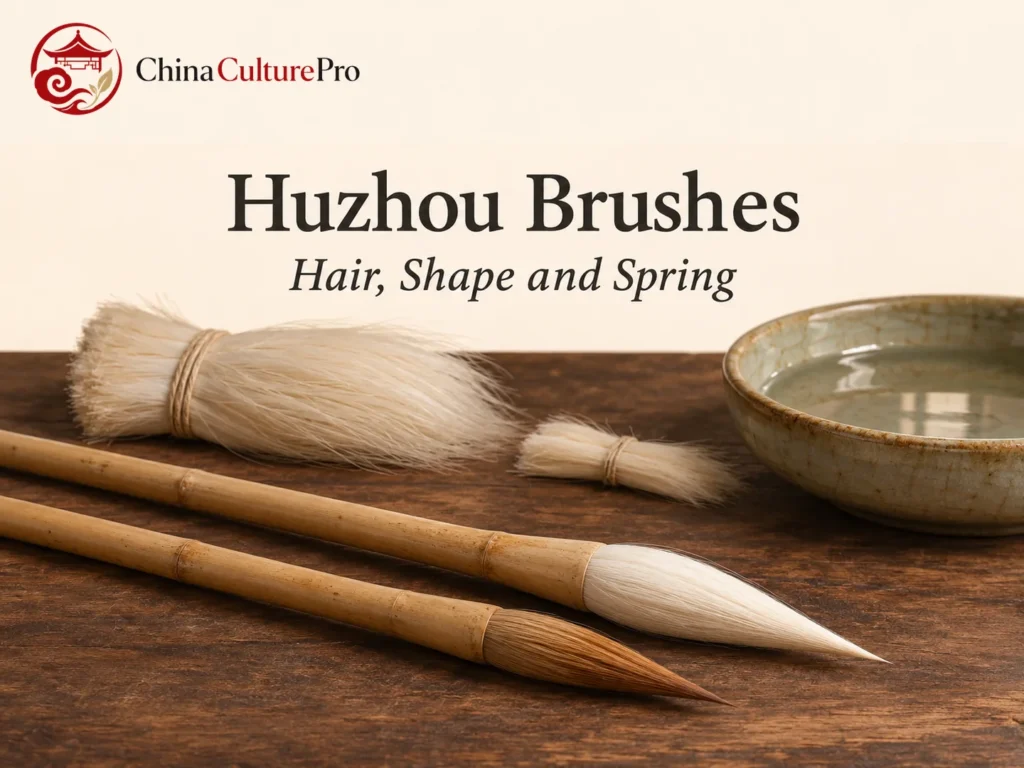

Quick Answer: What Are Huzhou Brushes?
A Huzhou brush (湖笔, Húbǐ) is a Chinese writing or painting brush from a tradition centered in Shanlian, in Huzhou’s Nanxun District, Zhejiang. The brush maker selects and aligns animal hairs, forms the head in water, and fits the bound root into a handle. [1][2][3]
- Hair: Goat, hare, weasel and mixtures give different handling qualities.
- Water basin: Wet combing and sorting shape the bundle before mounting.
- Final inspection: The worker refines the mounted head for a point, even ends, a round body and spring. [1][2][3]
The head material and the way the hairs are arranged both affect how the brush feels on paper.
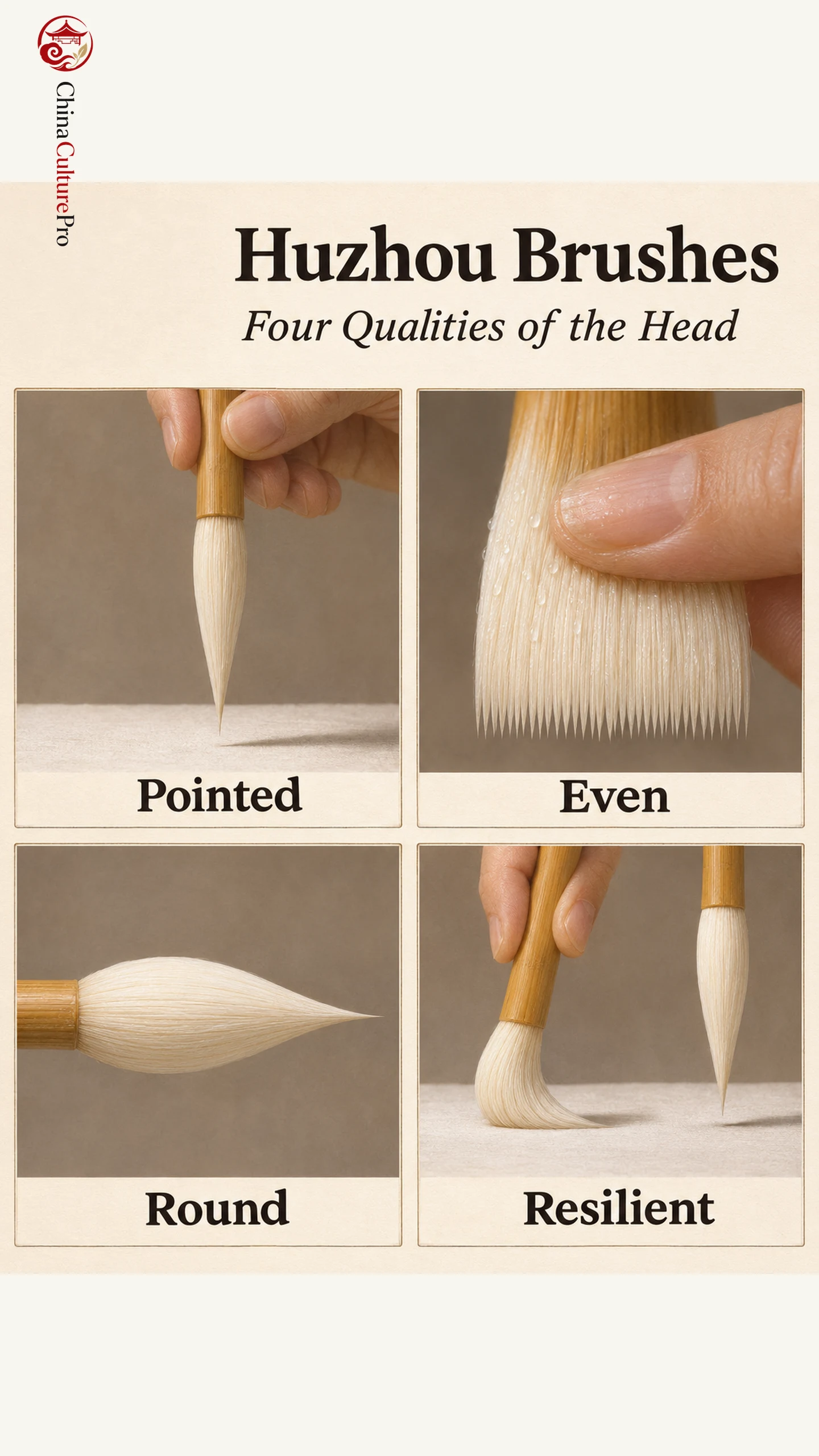
Look at a wet writing brush upright and the hair gathers into a point. Press it lightly and the hairs spread. Lift it and they gather again. Making that small movement possible starts with choosing individual hairs long before the brush reaches a writing desk.
Which Hairs Go into the Brush?
In traditional brush terminology, yángháo (羊毫) is goat hair. A soft goat-hair head can carry plenty of ink. Zǐháo (紫毫) refers to dark hare hair, and lángháo (狼毫) is made with weasel tail hair. Makers sort the raw hair by length, thickness, color and the condition of the tip. [2][3]
A mixed-hair brush, jiānháo (兼毫), combines softer and firmer hairs. The combination lets the maker vary how firmly the head responds to pressure. The label gives the material category. The length and profile of the bundle also affect how it bends. [2][3]
From Water Basin to Handle
At the water basin, or shuǐpén (水盆), the worker combs, aligns and shapes wet hair while removing fine underfur, broken strands and hair without usable tips. A 2025 Shanlian factory report shows Wang Xiaohua working in cold water under a light. The carefully aligned hair becomes an unfinished brush head. [2][3][4]
The maker dries and binds the root of the shaped bundle, then fits it into a hollow in a matched handle, often bamboo. After mounting, the worker fans out the head and removes stray strands or hairs without a proper tip. This final refinement, zébǐ (择笔), is where the worker adjusts the shape of the assembled brush and checks the tip. [2][3][4]
The Four Qualities of a Finished Brush
The Huzhou standard describes four ways to assess the head. Each refers to something visible when the brush gathers, spreads or recovers. [1][3]
| Qualité | Ce que le nom décrit |
|---|---|
| Pointed (jiān, 尖) | Moistened hairs gather into a fine point when the brush is upright. |
| Even (qí, 齐) | The ends line up evenly when the hair is spread. |
| Round (yuán, 圆) | The gathered body is full and centered on the shaft. |
| Resilient (jiàn, 健) | The damp head returns to shape after being pressed. |
A writer can lay down a narrow line from the point, broaden the stroke by pressing and lift to bring the hairs together again. The brush joins paper, ink and inkstone as one of the four treasures of the study. [1][3]
Learning the Craft in Shanlian
Qiu Changming joined the Shanlian brush factory in 1966 and learned to refine high-grade goat-hair brushes. A 2025 report follows him holding a mounted head toward the light to inspect individual tips. A stray hair with a blunt end is easier to spot when the dry bundle is spread under the light. [4][5]
Yao Yulin, who returned to her family’s brush business after university, trained with Qiu for three years, according to a 2025 report. In the same report, Wang Xiaohua shows visiting children how to hold the refinement tool at the factory. The workshop passes on both the movements and the judgment involved in inspecting the head. [6]
FAQs About Huzhou Brushes
Is wolf hair in a Huzhou brush really from a wolf?
The usual material is weasel tail hair. “Wolf hair” is the literal translation of the traditional name lángháo. [2][3]
What is fengying in Huzhou brush making?
Fengying (锋颖, fēngyǐng) is the fine, somewhat translucent part near the tip of suitable brush hairs. For a goat-hair brush, workers look for intact tips when sorting the hair and again when refining the mounted head. [2][3][4]
When was Huzhou brush making nationally listed?
Huzhou brush making was included in China’s first national intangible cultural heritage list in 2006. [1]
Sources
[1] China Intangible Cultural Heritage Network. Huzhou Brush Making
[2] China Intangible Cultural Heritage Network (Réseau chinois du patrimoine culturel immatériel). The Life of a Huzhou Brush
[3] Huzhou Administration for Market Regulation. Shanlian Huzhou Brush Making Standard DB3305/T 331–2024
[4] Dou Hanyang, People’s Daily. The Craft Behind the Four Treasures
[5] China Intangible Cultural Heritage Network (Réseau chinois du patrimoine culturel immatériel). Qiu Changming, Huzhou Brush Making
[6] Dou Hanyang, People’s Daily via Beijing Daily. Huzhou Brushes and Spring Couplets in Shanlian