
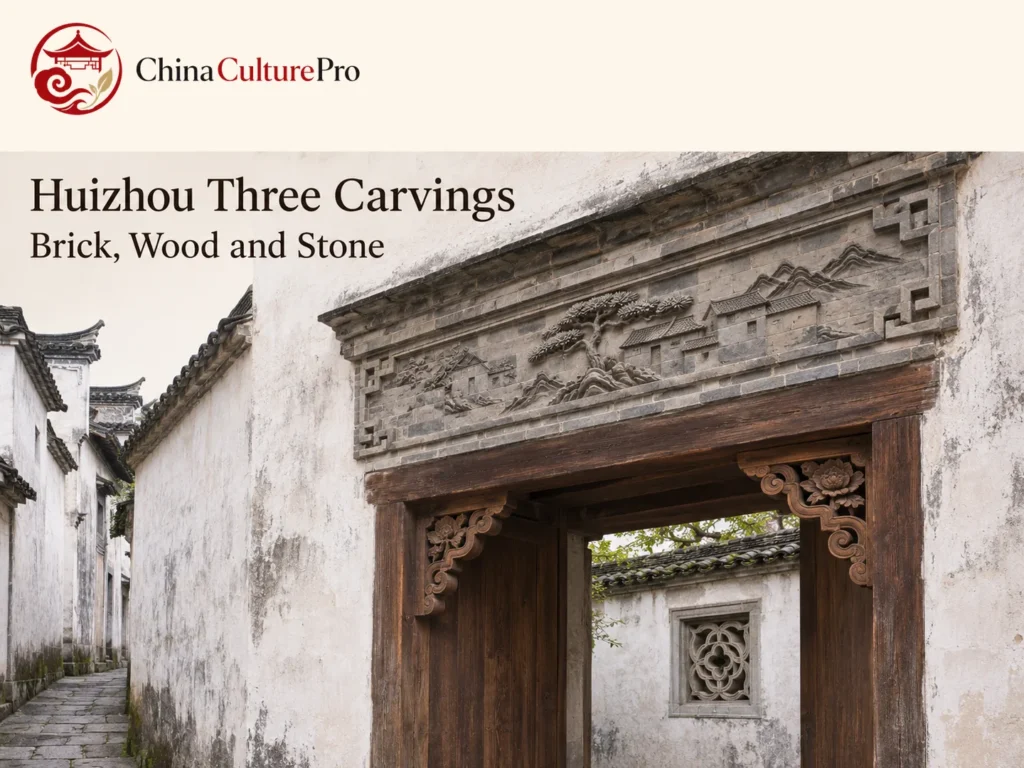

Quick Answer: What Are the Huizhou Three Carvings?
The Huizhou Three Carvings (徽州三雕, Huīzhōu sāndiāo) are the regional arts of decorating buildings in brick, wood and stone. Their best-known settings include the houses, ancestral halls and ceremonial gateways of historic Huizhou, a region that included areas now in southern Anhui and Wuyuan in Jiangxi. [1][4]
- Brick: Look above the entrance or on the masonry door hood.
- Wood: Look at interior beams, brackets and dividing screens.
- Stone: Look at bases, balustrades, pierced windows and ceremonial archways. [1]
The position offers a first clue. Look for wood grain, masonry joints or the cut edges of a stone slab.
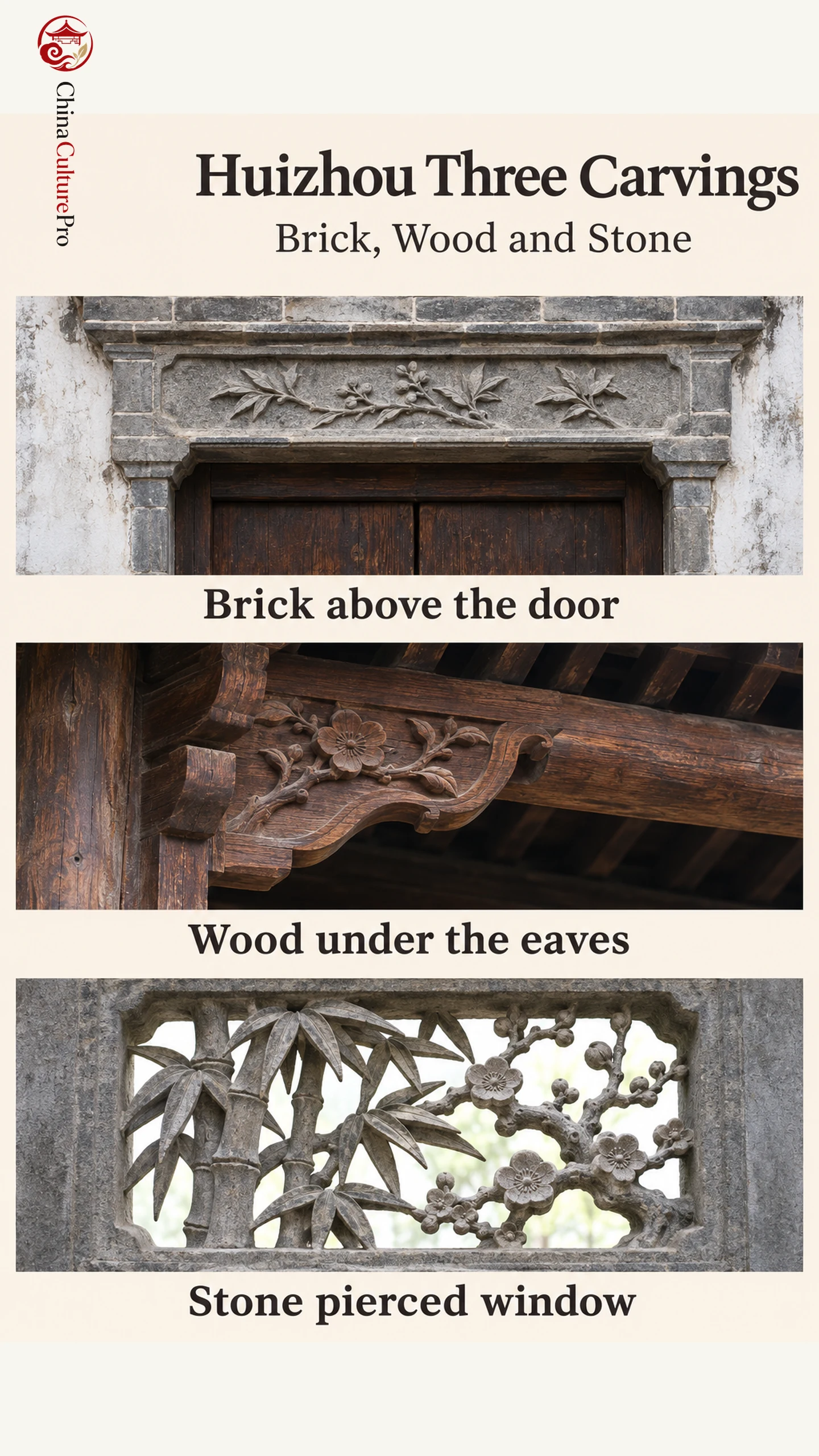
From the lane, an ornamental scene may sit above a household doorway. Step under the eaves and the next scene might be carved into a timber beam. In a nearby courtyard, daylight can pass through a patterned window cut from a slab. All three details belong to the same building tradition, but each calls for different work at the bench.
Three Materials in One Building Tradition
Huizhou merchants and officials invested in residences and community buildings. At Xidi and Hongcun in Yi County, carved details survive in buildings whose layout and decoration UNESCO describes as evidence of a trading economy and a society organized around families and clans. [1][3]
| Matériau | Typical location | Ce qu’il faut remarquer |
|---|---|---|
| Brick | Door towers and masonry hoods | Fine relief above an entrance and joints between masonry units |
| Bois | Beams, brackets, screens and furniture | Grain along the cut and undercut detail in sheltered places |
| Stone | Bases, balustrades, openwork windows and archways | Thick edges, cut-through openings or relief on exposed surfaces |
Furniture could carry the same scrolls or scenes as the beams around it. Carvers could adapt a motif to different materials, taking into account the depth of the blank and the angle from which people would see it. [1][2]
What the Carver Does Differently
Brick carvers dress the face of the brick and lay out the design before cutting the main forms. Chisels and small finishing tools refine the shapes. In Wuyuan, the heritage inventory specifies locally made, smooth gray brick for this work. A finished doorway can carry a design across several separate units. [1][4]
Wood carvers select and mark a piece, then work from the rough form to finer cuts with chisels and knives. A screen can have openings cut all the way through it, while a beam can carry a scene in raised relief. Sanding, oiling or lacquering can follow the carving, depending on the piece. [1][2][4]
Stone carvers dress the blank, mark the outline and use hammers and chisels to establish the main forms. For a pierced window, they also remove material from the spaces between the forms. The open spaces become part of the design when viewed against the light. [1][2]
What Surviving Carvings Show
At Hongcun’s Chengzhi Hall, a carved wooden beam depicts children celebrating the Lantern Festival. The figures turn the underside of the beam into a narrative surface visible from the room. In Xidi, two pierced stone windows pair designs of pine and rock with bamboo and plum. The motifs fill matching openings but form two different compositions. [2][3]
Stories, birds, flowers and other auspicious images appear across the materials. Relief shapes cast shadows on the backing. In openwork, the carver cuts through the backing so that light passes between the forms. [1][2]
Restoring Carved Wood in Wuyuan
Yu Youhong learned Huizhou wood carving in Xiuning before opening a workshop and teaching center in his native Wuyuan. The national heritage profile records restoration work in Tunxi Old Street and at Xichongyuan in Wuyuan. Xinhua’s 2024 photographs show him examining a house carving in Wangkou and using design patterns in the workshop. [5][6]
Repairing an older panel calls for reading the existing pattern and seeing how the carving fits into the timber. The same training supports new work: Xinhua photographed Yu carving a scene from the Three Kingdoms tradition on a new piece. His teaching connects the preservation of buildings with the skills behind Chinese traditional crafts. [5][6]
FAQs About the Huizhou Three Carvings
Is Wuyuan carving part of the Huizhou Three Carvings?
Yes. Wuyuan was historically part of Huizhou and is now in Jiangxi. The national register names Wuyuan Three Carvings as a local branch of the Huizhou tradition. [1][4]
Is every Huizhou carved window made of wood?
Both wood and stone were used in decorative windows. Look for the grain of wood or the thicker cut edges of a pierced stone slab. Xidi preserves two well-known stone examples. [1][2]
When were the Huizhou Three Carvings nationally listed?
The Huangshan and Wuyuan entries were both included in the first national intangible cultural heritage list in 2006. [1][4]
Sources
[1] China Intangible Cultural Heritage Network. Huizhou Three Carvings, Huangshan
[2] China Intangible Cultural Heritage Network (Réseau chinois du patrimoine culturel immatériel). Huizhou Three Carvings: Techniques and Examples
[3] UNESCO World Heritage Centre. Ancient Villages in Southern Anhui – Xidi and Hongcun
[4] China Intangible Cultural Heritage Network. Huizhou Three Carvings, Wuyuan
[5] China Intangible Cultural Heritage Network (Réseau chinois du patrimoine culturel immatériel). Yu Youhong, Wuyuan Three Carvings
[6] Wan Xiang, Xinhua. Wuyuan Three Carvings in the Workshop and Village