
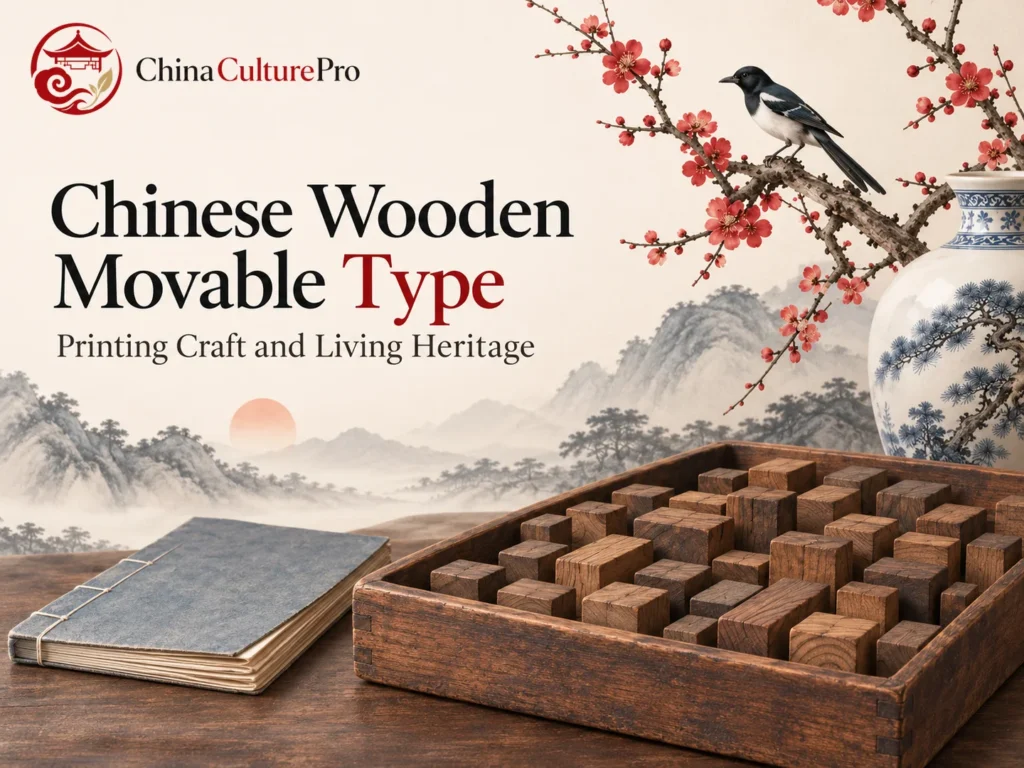

Quick Answer: What Is Wooden Movable-Type Printing?
In wooden movable-type printing (木活字印刷, mù huózì yìnshuā), a raised character sits on each small wooden block. Printers select blocks to assemble a page, ink the raised faces and transfer the text to paper. In Rui’an (瑞安, Ruì’ān), Zhejiang, the technique is documented in the making of family records.[1][2][3]
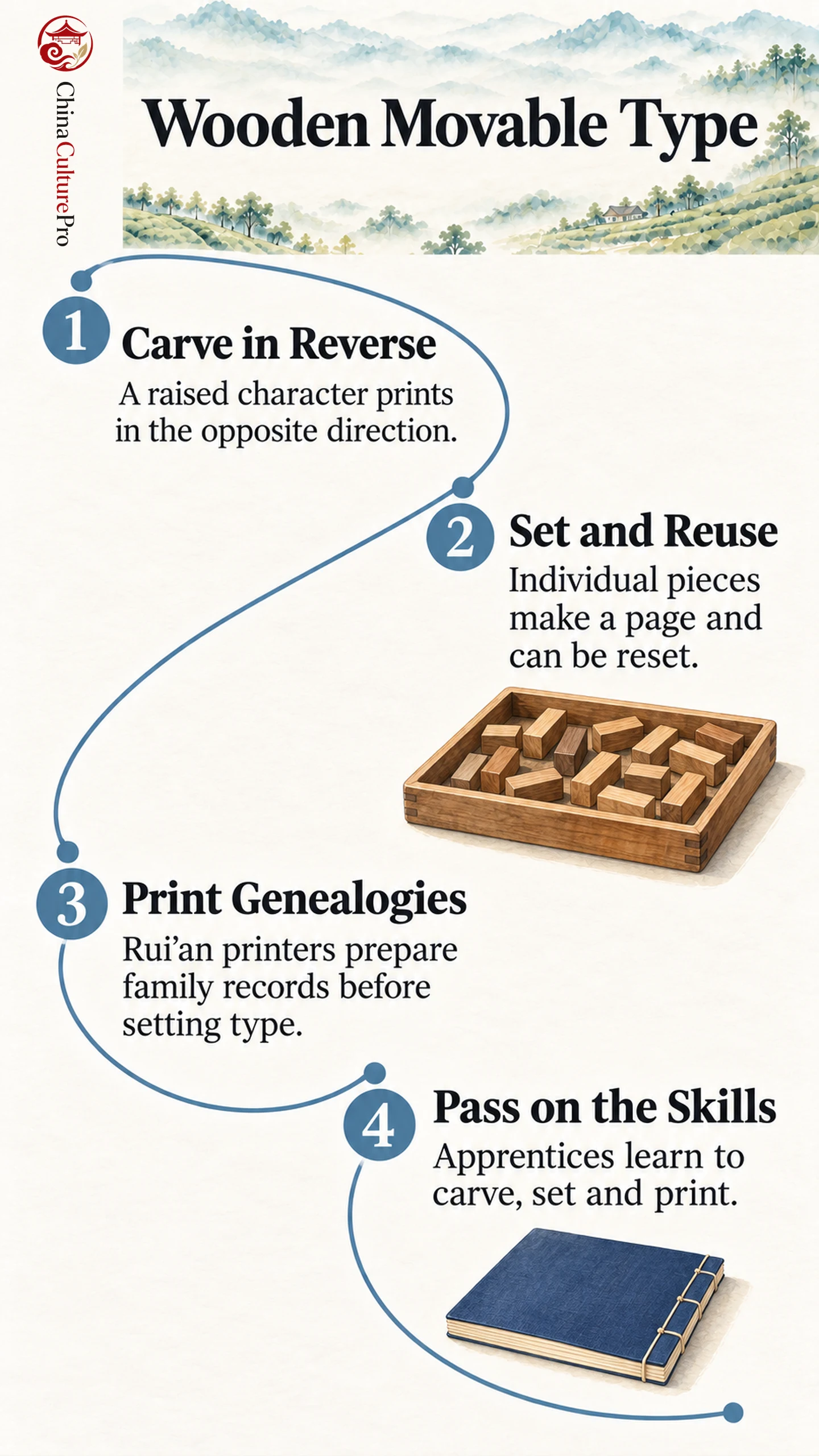
- Carve: A character is made in reverse so it will read correctly on paper.
- Set: Individual pieces fit together to form columns.
- Reuse: The printer separates the blocks after a run and can set them into another page.
The reusable unit is a character. The assembled page is temporary.
Look closely at a page of wooden type and you can see where each piece ends. Those seams explain how printers can use the same collection of carved characters to print different pages, or replace a single piece during proofing.
From a Wooden Blank to a Reusable Character
The Rui’an workflow describes using a fine-grained local pear wood for small, evenly shaped blanks. On the printing face, a reversed character is carved in relief. The strokes stay raised, and the lower areas are cleared. Ink on the raised strokes reaches the paper. The impression reverses the printing face and makes the text readable.[1][2]
A printer maintains a stock of reusable characters. The printer can carve a replacement for worn type or make a piece for a character missing from stock. The local account describes larger type for personal names and smaller type for details below them, such as dates and other biographical information. Both sizes are designed to fit the same setting frame.[1]
How a Page Is Set, Checked and Printed
The printer picks characters from the stock and fits them into a frame in the order the page requires. Proofing can expose a wrong character or a mistake in placement before a run. The printer inks the raised faces and takes the impression on paper by hand. The finished setting can then be taken apart and the type returned to stock.[1][2][3]
In Chinese woodblock printing a page or design can instead be cut on the face of a larger block. Both techniques transfer ink from raised surfaces. A page block preserves the arrangement for another impression of the same design. A setting of movable type can be redistributed to make a different page.[3][4]
Wood is one material in the wider history of Chinese printing. The nomination file distinguishes early movable type made of fired clay from later wooden type and from the specific Rui’an practice.[6]
Why Rui’an Printers Make Clan Genealogies
A clan genealogy (宗谱, zōngpǔ) records lines of descent and other family information. The Rui’an account describes work before typesetting begins. Printers and compilers check an earlier genealogy, collect information for new entries and establish how branches and generations should appear. The guide to Chinese family genealogy explains why the arrangement carries meaning.[1][2]
The UNESCO account describes craftspeople taking type and printing tools to ancestral halls in local communities. After printing, the sheets can be marked, folded, sorted and sewn. Printing puts text on the sheet. The techniques covered in Chinese traditional bookbinding turn the sheets into volumes.[2][3]
Safeguarding the Whole Craft
UNESCO inscribed wooden movable-type printing of China on the List of Intangible Cultural Heritage in Need of Urgent Safeguarding in 2010. Its 2023 review noted measures including support for apprenticeships, new facilities and education, and efforts to involve communities in safeguarding. The inscription concerns the living practice and the conditions that support it.[3][5]
Keeping a set of type is useful, but a working print run also takes people who can prepare the text, set the type and assemble the printed book. An exhibition can show the tools. The continued use of those tools is a separate part of safeguarding living heritage.[2][5]
FAQs About Chinese Wooden Movable Type
How is wooden movable type different from woodblock printing?
Movable type uses separately carved pieces arranged into a page. In engraved block printing, the design is carved together on a block.
Why are the characters carved backward?
The inked printing face makes a reversed impression on the sheet. A mirrored character on the wood therefore reads correctly in the print.
Can the same wooden characters be used again?
Yes. Once a page has been printed, the pieces can be separated and returned to stock for a new setting.
Is the Rui’an practice the same as Bi Sheng’s invention?
Bi Sheng is associated with early movable type made from clay. The living practice documented in Rui’an uses wood for printing genealogies.
Sources
[1] China Intangible Cultural Heritage Digital Museum. Rui’an Wooden Movable-Type Printing: Workflow
[2] China Intangible Cultural Heritage Digital Museum. Chinese Movable-Type Printing Resource Survey: Overview
[3] UNESCO. Wooden Movable-Type Printing of China
[4] UNESCO. China Engraved Block Printing Technique
[5] UNESCO Intergovernmental Committee. Decision 18.COM 7.a.13: Wooden Movable-Type Printing of China
[6] UNESCO Nomination File 00322. Nomination for the Urgent Safeguarding List