
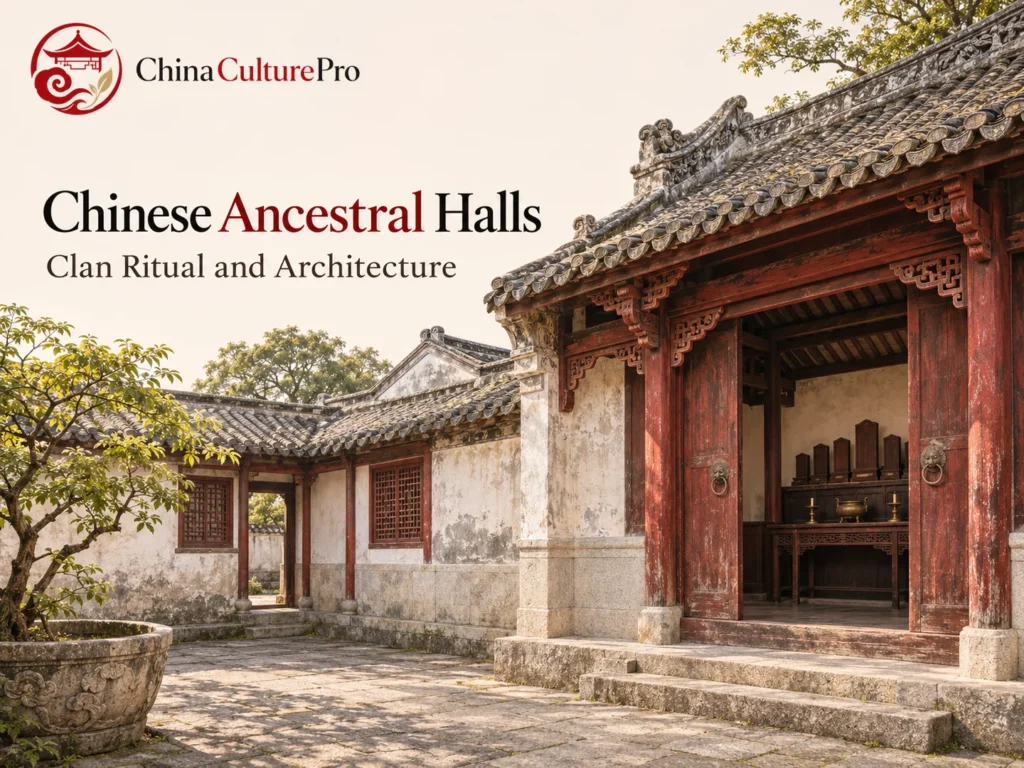

Quick Answer: What Is a Chinese Ancestral Hall?
A Chinese ancestral hall (祠堂, cítáng) is a building where members of a lineage honor common ancestors. The hall can also host clan meetings, celebrations or schooling. At some sites, halls and courtyards lead to an altar for the lineage. [1][2][3]
- An ancestral tablet (牌位, páiwèi) identifies someone honored in the hall. Tablets may stand on an altar in the rear chamber. [1][3]
- The spaces have different jobs. Courts link buildings and give people room to gather, while the innermost hall can house the tablets. [1][3]
- Community use can change. The same compound may support family ceremonies and institutions such as a school at different points in its history. [1][2]
Shared roofs and courtyard plans can make temples and ancestral halls look similar. The dedication and history tell you who built and used each place. [1][4]

At the Tang Ancestral Hall (邓氏宗祠, Dèngshì Zōngcí) in Ping Shan, two courtyards separate three halls. At the far end, a rear altar holds the Tang lineage’s tablets. The route through the building leads to a record of whom the hall was built to honor.
What an Ancestral Hall Was Built For
The hall in Ping Shan serves the local Tang lineage. A lineage is a group whose members trace descent to shared ancestors. A lineage hall can serve people in several settlements. In Ping Shan, the hall stands between two villages and serves a clan with roots across the area. [1]
An ancestral altar makes the dedication visible. At Ping Shan the tablets stand in the rear hall. At Jing’ai Hall (敬爱堂, Jìng’ài Táng) in Xidi (西递, Xīdì), the innermost structure houses the tablets of the Hu lineage. Where records survive, clan genealogies can help explain which ancestor a hall was built to honor and how people traced their connection to that person. [1][3][5]
Gates, Courtyards and the Rear Altar
The Ping Shan building has three successive halls and two internal courtyards. Each hall occupies a different position in the approach. From the main entrance, the route crosses the courts before reaching the tablets. Drum platforms flank the front, while carved beams and dougong brackets (斗拱, dǒugǒng) sit beneath the roofs. [1]
Liu Man Shek Tong (廖万石堂, Liào Wànshí Táng) in Sheung Shui also has three halls and two courtyards. Each hall is three bays wide. A bay is a space between columns or other structural divisions. Bays describe the width here, while successive halls describe the depth. Both are useful when reading a drawing of traditional Chinese architecture. [2]
In Huizhou (徽州, Huīzhōu), the layout of Jing’ai Hall includes a ritual space separated by an open court and flanked by side galleries. An inner doorway leads to the structure that houses the ancestral tablets. The arrangement is one example of Huizhou architecture, where the openings between buildings can matter as much as the rooms themselves. [3]
Clan Ritual, Schooling and Shared Resources
At a documented reenactment at Jing’ai Hall, participants assembled for a declaration and then presented offerings. The building gave people room to gather before approaching the ancestral altar. The site’s ritual history also reflects local Confucian traditions. The exact sequence depended on the lineage and occasion. [3][6]
The Liu hall provides a separate example of shared use. It hosted sacrificial rites and discussions of village affairs. From 1932, Fung Kai Primary School also used the hall to educate young clan members. The school moved to its own campus in 1974. The school’s stay shows how a standing clan building could accommodate a newer institution. [2]
In Tangyue, a study of the Bao lineage links the building of ancestral halls to the management of land held for the lineage. Genealogies helped define who held rights in those arrangements. In this case, the buildings were places of worship and part of an institution that held property across generations. [5]
How an Ancestral Hall Differs From a Temple
In Yau Ma Tei, the temple dedicated to Tin Hau (天后, Tiānhòu in Mandarin) also has a court between halls. The wider compound served worship, study and arbitration. Both sites combined worship with other uses. The Ping Shan altar honors ancestors of the lineage, while the Yau Ma Tei temple centers on a local deity. [1][4]
To compare the compounds, look at who is named in the dedication and who is represented at the main altar. Records can show how the buildings were funded and which people used the spaces. These details also help explain shared forms in Chinese temple architecture. [1][4][5]
Reading an Ancestral Hall in Its Village
A dedicated hall can make a lineage’s presence visible beyond any one home. Jing’ai Hall was an important shared building of Xidi. In Ping Shan, the Tang hall was built to serve a clan associated with a cluster of settlements. Read a hall alongside paths, study halls and traditional Chinese houses to understand where a particular community gathered. [1][3]
Records of recent use help explain what remains active. The Tang hall is still used for clan occasions. The documented event at Jing’ai Hall shows how heritage programs can also bring attention to historic practices. The records distinguish a continuing use at Ping Shan from a particular heritage event at Xidi. [1][6]
FAQs About Chinese Ancestral Halls
What is kept inside a Chinese ancestral hall?
A hall can hold ancestral tablets, an altar and inscribed boards. At the Tang Ancestral Hall in Ping Shan, the tablets are on the altar in the rear hall. [1][2]
Are Chinese ancestral halls still in use?
Some continue to host clan rites, meetings and festivals. Ping Shan’s Tang Ancestral Hall is one documented example. Check the history of the specific building to understand its current role. [1]
Did every ancestral hall have the same layout?
Plans varied. Both the Tang and Liu halls have three halls and two courtyards. Jing’ai Hall in Xidi has galleries around its ritual space and a separate inner structure for the Hu lineage’s tablets. [1][2][3]
Sources
[1] Hong Kong Antiquities and Monuments Office. Tang Ancestral Hall
[2] Hong Kong Antiquities and Monuments Office. Liu Man Shek Tong Ancestral Hall
[3] China Intangible Cultural Heritage Network. Huizhou Culture in Architecture
[4] Hong Kong Antiquities and Monuments Office. Tin Hau Temple and the Adjoining Buildings
[5] Kam Chau Kwok. The Development of Lineage and the Management of Charitable Land in Huizhou from Ming to Qing Dynasty
[6] Huangshan Municipal Government. Huizhou Ancestral Hall Rituals