


Quick Answer: What Is a Chinese Ting Pavilion?
A ting (亭, tíng) is a Chinese pavilion often built as a roof on posts with open sides. In a garden, it provides shelter and gives people a place to sit or look out. Some pavilions stand alone and others attach to a wall or corridor. [1][2]
- A pavilion can frame a view and appear in it. Its position changes what people see from the path and from the shelter. [2][3][4]
- The shape responds to the setting. A garden pavilion can be square, hexagonal, octagonal or shaped to fit a curved bank. [2]
- Pavilions also serve routes. Roadside shelters could provide places to rest or say farewell, while tower-like roofs shelter parts of some bridges. [5][6]
In English, “pavilion” can describe several kinds of Chinese building. Look at the original name, plan and use to understand the structure. [1][2][7]
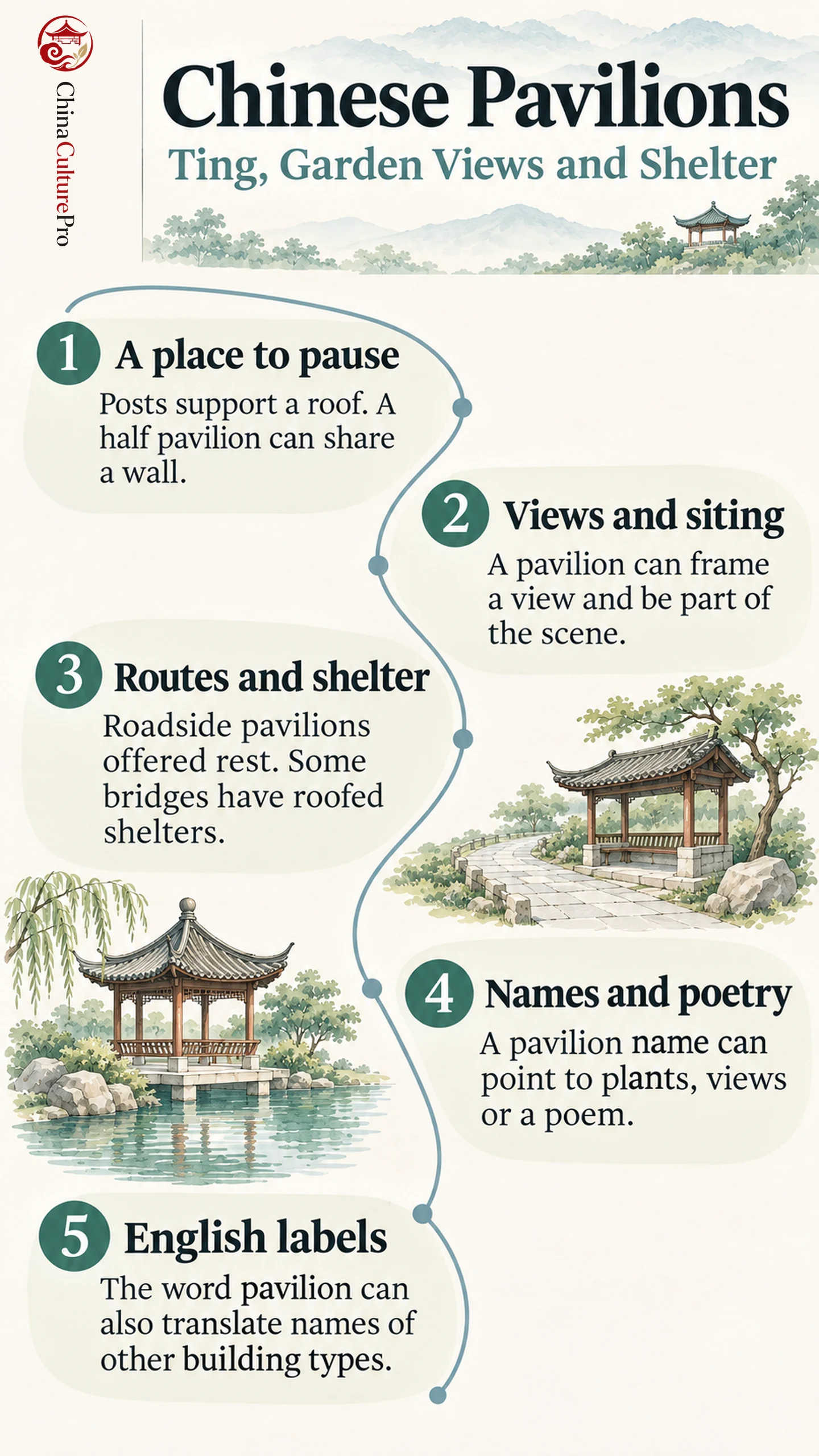
From a path, a small roof beside a pond can be part of the view. From under that roof, its posts frame a different scene. This double role explains why a pavilion’s position matters as much as its roof shape.
The Ting as a Roofed Place to Pause
In the familiar garden form, posts hold up a roof and leave openings between them. The openings allow views and air to pass through. A platform or low railing can mark the edge while leaving a view between the posts. The roof protects a place to stop, and different Chinese roof forms change its outline in the garden. [1][2]
A half pavilion (半亭, bàntíng) can sit against a wall or connect to a covered walk. It creates a sheltered pause along the walk and directs the view away from the wall. The Suzhou garden guide describes examples set against walls at the Humble Administrator’s Garden. It also records freestanding forms adapted to hills, pond edges and plantings. [2]
How a Pavilion Directs a Garden View
In the Humble Administrator’s Garden, the Lotus Breeze Pavilion (荷风四面亭, Héfēng Sìmiàn Tíng) has a hexagonal plan. It stands within a pond where lotuses surround it in summer. The shelter is also an object to look toward from elsewhere in the garden. In Chinese garden design, a pavilion can link a view seen from inside with a landmark seen along a path. [2][3]
At Beijing’s Summer Palace, the Heralding Spring Pavilion (知春亭, Zhīchūn Tíng) stands on a small island east of Kunming Lake. The sightlines cross Kunming Lake toward Longevity Hill and reach hills outside the garden. This is a case where the position helps bring borrowed scenery into view. A person under the roof can take in the lake, the palace grounds and a distant ridgeline in the same view. [4]
Pavilions on Roads and Bridges
Roadside pavilions could be places to rest, wait or bid farewell. Nanjing’s Laolao Pavilion (劳劳亭, Láoláo Tíng) is associated with parting in poems, including one by the Tang poet Li Bai. The poems attach a moment of departure to a particular point on the road. [5]
Pavilion forms also appear above crossings. Chengyang Bridge in Guangxi has covered walkways and taller roofed structures above its main supports. The roofs shelter pedestrians, while projecting timber beams below support the crossing. These components are easiest to understand when you look at both the roofed spaces and the supports of traditional Chinese bridges. [6]
Names, Poetry and What to Look For
The name of a pavilion can refer to a view, a plant or an older text. At the Lotus Breeze Pavilion, the name and inscribed couplet refer to lotuses, willows and water. Those references give people details to look for around the shelter. Related garden names and couplets can connect a building to a view or the season. [3]
Beijing’s Taoran Pavilion (陶然亭, Táorán Tíng) dates to 1695. Its name draws on a poem by Bai Juyi, evoking a feeling of contentment. The pavilion later gave its name to the surrounding park. The name of a small building thus became the name of a much larger landscape. [8]
Why Pavilion Has a Broader Meaning in English
Some buildings described as pavilions in translation differ from a small garden ting. The Tower of the Fragrance of the Buddha (佛香阁, Fóxiāng Gé) at the Summer Palace is a tall building with a religious history and a view over the lake. Its original name ends in ge (阁, gé). An English catalogue of an archival plan calls it a pavilion, while Beijing’s English description calls it a tower. The different labels illustrate why the Chinese name, size and use matter when comparing structures in imperial and scholar gardens or in traditional Chinese architecture more broadly. [1][2][7][9]
FAQs About Chinese Pavilions
Does every ting have open sides?
An open-sided roof on posts is common. A half pavilion can be attached to a wall or corridor, so it may open in fewer directions. [1][2]
What shapes do Chinese garden pavilions have?
Documented plans include square, rectangular, hexagonal, octagonal, round and fan-shaped examples. The plan can respond to its site, such as the curve of a pond edge. [2]
Is a ting the same as a pagoda?
A ting usually offers a place to stop or look out. Many Chinese pagodas are Buddhist towers with origins in the tradition of housing sacred relics. Their role differs from that of a small garden shelter. [1][10]
Sources
[1] Getty Research Institute. Tíng
[2] Suzhou Bureau of Gardens and Landscaping. Architecture in Suzhou Gardens
[3] Suzhou Bureau of Gardens and Landscaping. Lotus Breeze Pavilion
[4] Beijing Municipal Government. Summer Palace
[5] Yuhuatai District Government, Nanjing. Laolao Pavilion
[6] Ronald G. Knapp, Terry E. Miller and Jie Liu. China’s Corridor Bridges: Heritage Buildings Over Water
[7] Beijing Municipal Government. Tower of the Fragrance of the Buddha
[8] Beijing Bureau of Forestry and Parks. Taoranting Park
[9] Library of Congress. Site Plan of Paiyun Dian and Foxiangge of the Summer Palace
[10] Asian Art Museum. Great Wild Goose Pagoda