

Quick Answer: What Types of Traditional Chinese Bridges Are There?
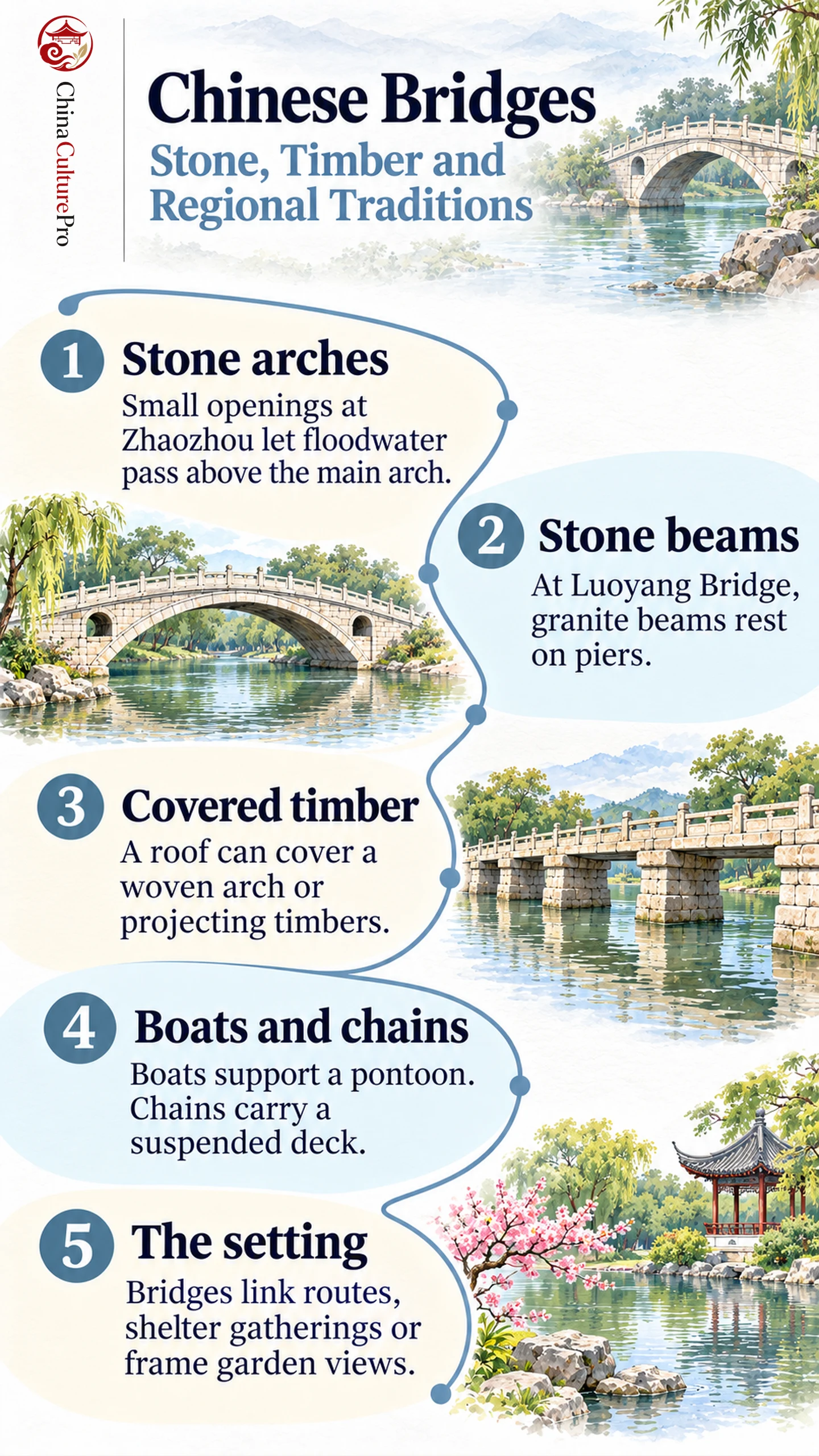
Traditional Chinese bridges use arches, beams, cantilevers, boats or chains to support a crossing. Stone and timber can appear together, as when stone piers carry a wooden span. A corridor bridge (廊桥, lángqiáo) has a roofed passage, which describes the space above the deck. The structure beneath it can take several forms. [1][2][3][4][5]
- Stone arches curve between supports. At Zhaozhou Bridge (赵州桥, Zhàozhōu Qiáo), small openings in the shoulders flank the main arch. [1]
- Beams span from support to support. At Luoyang Bridge (洛阳桥, Luòyáng Qiáo) in Quanzhou, long granite slabs rest on piers across a tidal river mouth. [2]
- Covered timber bridges can have different structures. In some, interwoven timbers form an arch. In others, horizontal timbers project from the supports. [3][6]
- A deck can float or hang. Boats support a floating span. Anchored chains support a suspended span. [4][5]
To identify a bridge, read the underside as well as the roof. Then look at what the crossing connects and how people use the deck. [2][3]
From the bank, a bridge can look quite different from the way it does on the deck. On Zhaozhou Bridge, the side view reveals openings above the stone arch. At Chengyang Bridge (程阳桥, Chéngyáng Qiáo), the roof is visible from both angles, but only the side view shows the timbers that project from the piers.
Stone Arches: Zhaozhou Bridge in Hebei
The Sui dynasty’s Zhaozhou Bridge crosses the Jiao River in Hebei. Its broad main arch forms a shallow arc. The shape gives the crossing a relatively low rise across a wide opening. An arch carries weight through the curve and presses against the supports at each end. The supports that receive that force are called abutments. [1]
Look above the outer parts of the main arch. Smaller arches open through the masonry between the curve and the deck, in areas known as the spandrels. These openings replace some solid masonry and let water pass through above the main arch when the river rises. [1]
Stone Beams: Luoyang Bridge in Quanzhou
Luoyang Bridge crosses an estuary north of Quanzhou in Fujian, far from the city of Luoyang in Henan. The original bridge was completed in 1059 during the Northern Song. It connected the port region with routes to northern Fujian and farther inland. [2]
Its long granite beams rest across a series of stone piers. The piers have pointed ends that divide the current, known as cutwaters. The builders also used the tide to move heavy slabs into place. Boats floated the slabs into position at higher water, and the falling tide allowed them to settle onto the supports. Granite appears among many traditional building materials, and Luoyang Bridge shows how local waterways shaped its use. [2]
Timber and the Covered Corridor
In parts of Fujian and Zhejiang, carpenters weave sets of timber beams into a load-bearing arch. The technique of weaving the beams is one of the defining practices behind Chinese wooden arch bridges. UNESCO transferred this living tradition to the Representative List of the Intangible Cultural Heritage of Humanity in 2024. The listing concerns the craft and its transmission. [6][7]
The wind-and-rain bridge (风雨桥, fēngyǔqiáo) tradition of Dong communities in places such as Guangxi uses a covered crossing for passage and gatherings. At Chengyang Bridge in Sanjiang, layers of fir logs project from stone piers and the banks. The projecting layers support the ends of the deck beams closer to the middle of the span. The roofs and tower-like Chinese pavilions sit above a structure that differs from a woven arch. [3]
A roof can turn a crossing into a sheltered place to rest, meet or take part in communal life. Whether the bridge has a roof and how it carries its load are separate questions. [3][6]
Floating Decks and Suspended Decks
At Guangji Bridge (广济桥, Guǎngjì Qiáo) in Chaozhou, the outer sections stand on fixed piers. A row of connected boats supports part of the walkway in the middle of the Han River. That part can be moved aside to leave a channel for vessels. The fixed sections and the floating center meet the needs of crossing the river and traveling along it. [4][8]
Luding Bridge (泸定桥, Lúdìng Qiáo) crosses the Dadu River in Sichuan. Iron chains anchored at either bank carry the walkway. A pontoon deck transfers its weight to floats below it. [5]
What a Bridge’s Setting Can Tell You
The purpose of a crossing changes with what it connects. The Luoyang Bridge linked a port’s inland routes. A village corridor bridge gives neighbors room to stop and gather on the deck. A garden crossing works on a smaller scale, connecting paths and directing views across a pond. [2][3][9]
In Suzhou’s Humble Administrator’s Garden (拙政园, Zhuōzhèng Yuán), the Small Flying Rainbow Bridge (小飞虹, Xiǎofēihóng) crosses a narrow stretch of water and helps divide views across it. In Chinese gardens, a crossing can help shape the scene as well as connect paths. Look at the support below the deck, the spaces above it and what lies on either bank to see how bridges fit within traditional Chinese architecture. [9]
FAQs About Traditional Chinese Bridges
Are all Chinese covered bridges wooden arch bridges?
No. A covered bridge has a roof over the passage. The deck can sit above an arch, beams or projecting cantilevers. Chengyang Bridge is a covered crossing built with timber cantilevers. [3][6]
Why are there smaller openings in Zhaozhou Bridge?
The smaller arches open through the shoulders beside the main span. They reduce the amount of solid masonry and give floodwater another way through when the river rises. [1]
Where is the Luoyang Bridge described here?
It crosses the mouth of the Luoyang River near Quanzhou, in Fujian. The Northern Song bridge is also known by its earlier name, Wan’an Bridge. [2]
Sources
[1] American Society of Civil Engineers. Zhaozhou Bridge
[2] Quanzhou Municipal Government. Luoyang Bridge
[3] Ronald G. Knapp, Terry E. Miller and Jie Liu. China’s Corridor Bridges: Heritage Buildings Over Water
[4] MTR High Speed Rail. Attractions Guide: Chaozhou
[5] State Council Information Office. Various New and Old Bridges Built Along Sichuan–Tibet Highway
[6] UNESCO Intangible Cultural Heritage. Traditional Design and Practices for Building Chinese Wooden Arch Bridges
[7] UNESCO Intangible Cultural Heritage. Decision 19.COM 7.c.3
[8] MTR High Speed Rail. Chaoshan History and Delicacy
[9] Suzhou Bureau of Gardens and Landscaping. Arranging Water in Suzhou Gardens