


Quick Answer: What Is a Chinese Pagoda?
A Chinese pagoda (塔, tǎ) is a monument often built in a Buddhist setting to enshrine relics or other sacred objects. Builders adapted the South Asian stupa tradition to local materials and building forms. The resulting structures range from timber towers with distinct levels to masonry forms with closely spaced eaves. [1][2][3]
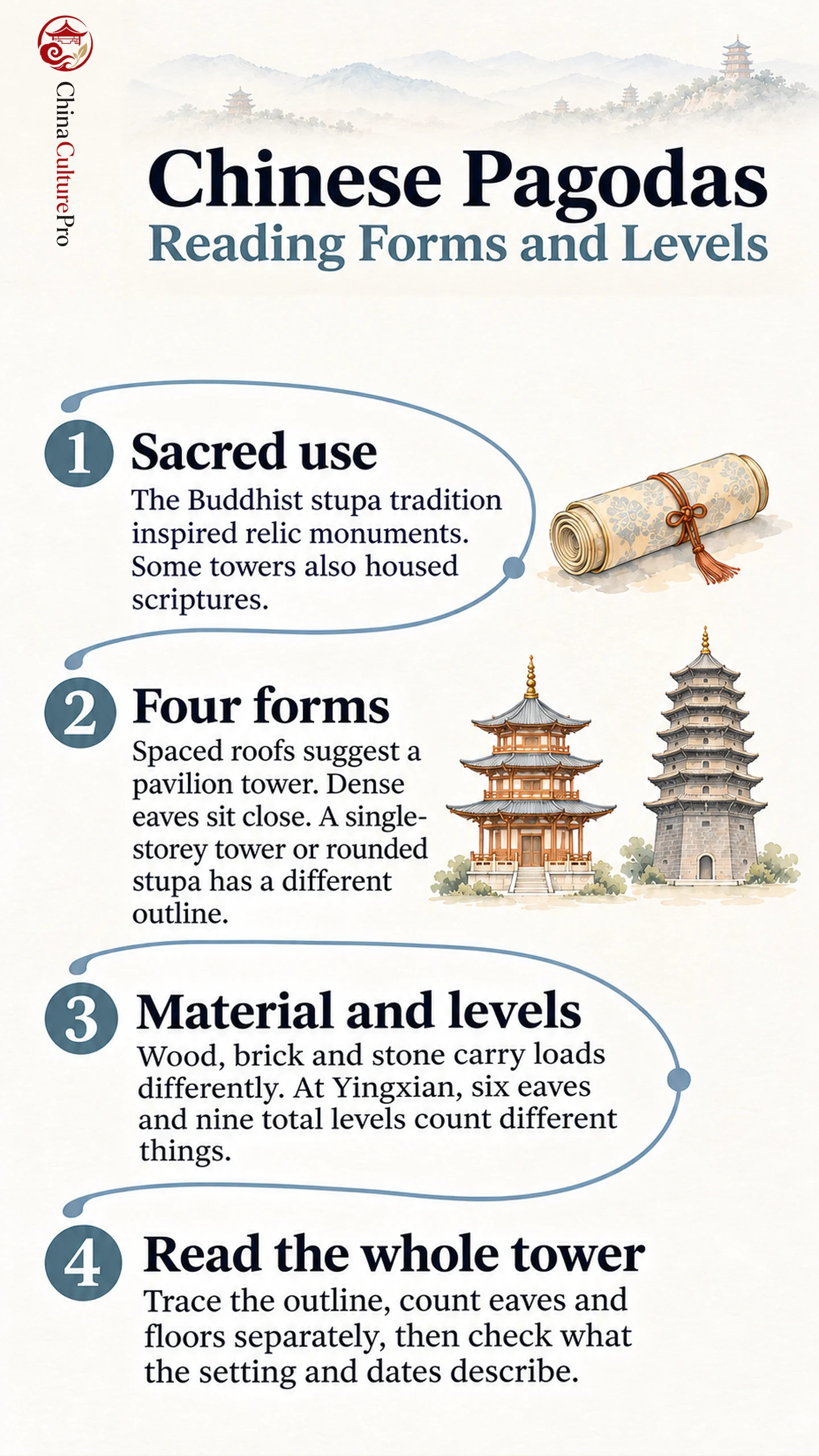
- Start with the profile. Widely separated roofs can make levels look like pavilions. Closely spaced eaves can form a continuous taper above a taller lower body. [3][4]
- Check the material. A brick tower may imitate timber features. A glazed surface can conceal the masonry underneath. [2][3][5]
- Separate eaves from floors. Repeated lines on the outside tell you how the exterior is divided. The internal levels may follow a different pattern. [6][4]
Treat the outline as the first clue. Use records of the plan, interior and repairs to establish details that the outside cannot show.
A date on a pagoda’s label might identify the founding of a tower, the construction of the surviving walls or the deposit of a sacred object. Look closely at what the date describes. The tower’s shape, interior and contents can preserve different moments in its history.
Why Buddhist Pagodas Were Built
The South Asian stupa offered a form for housing relics and a focus for devotion. Walking around a sacred monument was one way people paid respect. As Buddhism spread in China, builders explored ways to give relic monuments height and a recognizable place in a religious compound. Chinese builders drew on familiar multilevel timber towers as well as masonry techniques. Early examples in brick and stone show several different approaches to giving the monument form. [1][2]
A tower could enshrine relics or hold scriptures. The Great Wild Goose Pagoda (大雁塔, Dàyàn Tǎ) in present-day Xi’an was first built in 652. Its founding is associated with the monk Xuanzang (玄奘, Xuánzàng), who returned from a journey through Central and South Asia with Buddhist scriptures. Later repairs and alterations mean the first construction date does not describe every part visible today. [1]
Early pagodas could occupy a central place in a monastery. Other compounds gave the main image hall prominence or placed a pagoda elsewhere. Look at the relationship between the tower and the rest of the temple architecture to see what visitors approach and where worship can take place. [1][2]
Four Forms You Can Recognize
These four forms are starting points for reading a building within traditional Chinese architecture. The labels describe general forms. Stone and brick can reproduce the profile of a building framed in wood, and towers of different forms can use the same materials. [2][3]
| Forme | Éléments à observer | Exemple |
|---|---|---|
| Pavilion-style pagoda (楼阁式塔, lóugéshì tǎ) | Distinct stacked levels with substantial space between roofs. | Yingxian Wooden Pagoda (应县木塔, Yìngxiàn Mùtǎ), built in 1056. [6] |
| Dense-eaved pagoda (密檐式塔, mìyánshì tǎ) | A relatively tall lower body and a succession of closely spaced eaves above. | Songyue Pagoda (嵩岳寺塔, Sōngyuèsì Tǎ), a Northern Wei brick tower with a twelve-sided body. [2][4] |
| Single-storey pagoda (单层塔, dāncéng tǎ) | One main body above the platform, with a roof or cap over it. | Four-Gate Pagoda (四门塔, Sìmén Tǎ) in Shandong, a granite example with entrances on four sides. [2] |
| Tibetan-style stupa (藏式佛塔, zàngshì fótǎ) | A rounded body above a base, with an upper spire and no stack of pavilion roofs. | The Yuan-era White Dagoba (白塔, Báitǎ) at Miaoying Temple in Beijing. [7] |
An opening under an eave may be a recess that imitates a window. Look for an interior description before treating a repeated facade feature as evidence of a room.
What Materials Reveal About the Structure
At Yingxian, two rings of columns support an octagonal timber tower. Joinery connects the framework. Sets of dougong (斗拱, dǒugǒng) brackets help carry loads between roof members and supports. The tower has six visible eaves and five main storeys. Inside, four concealed intermediate levels bring the total to nine. The three counts describe different parts of the same building. [6]
Builders could use masonry to evoke similar forms. Brick projections could suggest rafters or a bracket line even when the wall itself carried the weight. Kaifeng’s Iron Pagoda (铁塔, Tiětǎ), built in 1049, takes its name from the appearance of its glazed exterior. The dark glaze gives the tower its name and shows how ceramic finishes could change the appearance of traditional building materials. [2][3][5]
Material also affects what survives. Some early brick and stone towers remain after timber buildings from the same periods have disappeared. A survey of surviving monuments gives a view of preservation as well as a view of the choices made by earlier builders. [2]
Reading Eaves, Levels and the Setting
Use the outside to describe the tower before drawing conclusions about its interior. The result should distinguish visible features from details supported by a plan or record.
- Trace the outline. Note the base, the main body, the eaves and the top. Compare the spacing of the eaves with other Chinese roof forms.
- Count separately. Write down how many roof edges you can see. Look for a plan, section or reliable interior description before recording a number of levels.
- Check the setting and dates. Place the tower in relation to gates, halls or other monuments. Confirm whether a reported date belongs to the original construction, a restoration or an object recovered inside it.
At Songyue, two receptacles near the top contained relics dated to the Song dynasty. The Northern Wei construction of the tower and the later deposits give two dates for two events. [2]
FAQs About Chinese Pagodas
What is the difference between a pagoda and a temple?
A pagoda is one built monument. A temple is a place of worship that may occupy a whole compound with halls, courts and gates. A pagoda may be one part of a Buddhist temple compound. [1][2]
Does every eave on a Chinese pagoda mark a floor?
Closely spaced eaves often divide the exterior surface into bands. At a timber tower like Yingxian, some levels sit between the main visible stories. Use an architectural section to confirm what can be counted inside. [6][4]
Are pagodas all made of wood?
Timber, brick and stone all appear in surviving pagodas. Material and silhouette describe different things, so a masonry tower can still have a profile that recalls a wooden one. [2][3][6]
Sources
[1] Asian Art Museum. Great Wild Goose Pagoda
[2] Nancy Shatzman Steinhardt. Chinese Architecture: A History, Chapter 5
[3] Duo Mei, Lu Li, Weizhen Chen and Yue Cheng. Study on the Classification of Chinese Glazed Pagodas
[4] People’s Republic of China. Historic Monuments of Dengfeng Nomination Dossier
[5] China Culture Information Network. Iron Pagoda
[6] UNESCO World Heritage Centre. Wooden Structures of Liao Dynasty
[7] Beijing Municipal Government. Beijing Miaoying Temple