


Quick Answer: What Are Chinese Variant Characters?
Variant characters (异体字, yì tǐ zì; traditional 異體字) are different written forms linked by sound and meaning in a documented reference relationship. Some relationships cover only part of a character’s readings or meanings. [1]
- Compare: Identify the actual form and its context.
- Verify: Look for a dictionary’s documented relationship.
- Distinguish: A font difference is a separate display question.
- Preserve: Keep the source form when recording an inscription or name.
An unfamiliar form is not automatically an error, and visual resemblance alone does not establish equivalence.
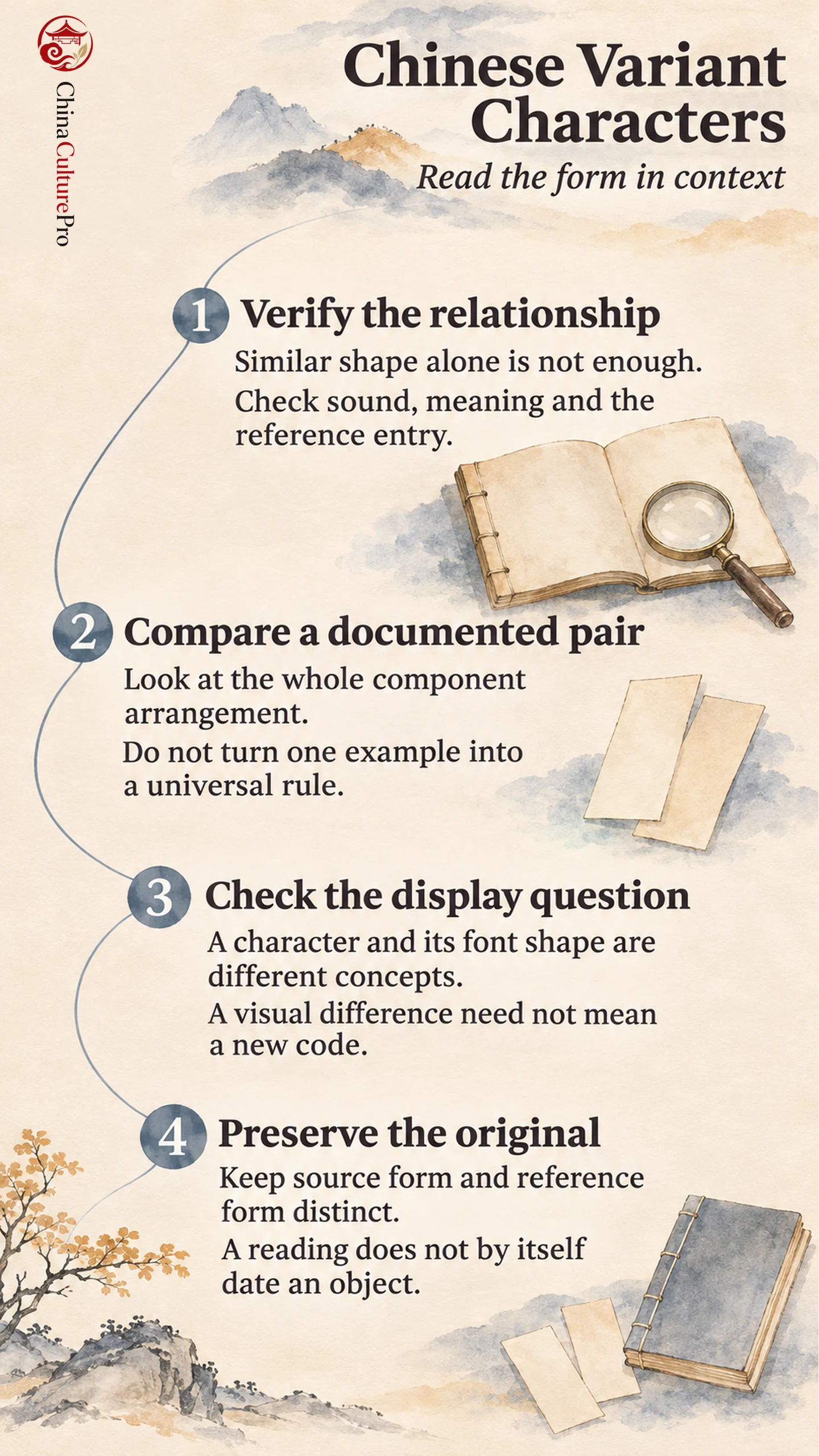
A mountain component may appear in a different position from the one you learned. A name in an older book may use a form missing from a modern learner’s list. Before correcting either, ask what kind of difference you are seeing and what evidence supports a reading.
Identify a Variant Relationship, Not Just a Similar Shape
A dictionary’s standard form (正字, zhèng zì) is defined within its editorial system. In the Taiwan reference used here, that label follows specified character lists and additions; it is not a declaration that every other historical form is meaningless. [1]
When checking an unfamiliar character, separate the visual match from the lexical claim. “These shapes look related” is an observation. “This form represents this word in this passage” requires more evidence. Record the surrounding words, the source and the dictionary entry that supports your conclusion.
The Chinese writing-system guide supplies the broader background. For a particular inscription, work from the clearest available photograph or transcription; an uncertain stroke should remain uncertain until checked.
Read the Documented Pair Feng
The pair 峰 and 峯 is a useful example. Both are read fēng and refer to a mountain peak. The variant entry links 峯 with 峰 and discusses the different arrangement of their components. [2]
In 峰, the mountain component 山 sits on the left. In 峯, it sits above the other component. Compare the whole structure, not just the total number of strokes. [2]
Once the relationship is verified, the unfamiliar arrangement need not block your reading. But do not extend this one example into a rule that moving any component produces an acceptable alternative. Each proposed pair needs its own evidence.
For a reading notebook, keep two separate fields: “form in source” and “reference form.” Add the pronunciation and the location of the entry. Those fields preserve the evidence behind your reading, including the original form.
Separate Character Forms from Font Display
A character and the particular shape drawn by a font are not identical concepts. Unicode encodes characters rather than every possible glyph. A single encoded Han character can have regionally preferred shapes, so a visible difference need not imply a different character code. [3]
Conversely, the two forms in the peak example are distinct encoded characters. Separate character codes and a documented variant relationship can coexist. The encoding question and the dictionary question answer different needs.
This helps explain why changing a font may resolve an unfamiliar display but cannot decide what an inscription means. Compare the source image before copying a shape from a different screen. The simplified and traditional Chinese comparison addresses another related distinction; do not reduce all written variation to those two labels.
Preserve the Original When Making Reading Notes
Decide what your notes are for. A searchable reading aid may need a familiar reference form. A record of an object, personal name or historical passage also needs the form actually present. Keep both when they serve different purposes.
Label any normalization openly. Do not silently replace a character in a quotation and later present the result as an exact transcription. If the source uses an image-only form you cannot type, keep a cropped reference image with its location and leave the uncertain identification visible.
The guides to characters on objects and historical naming taboos offer adjacent contexts. A dictionary relationship can help identify a form; it does not, by itself, date an object or explain why a particular writer chose it.
FAQs About Chinese Variant Characters
Is an unfamiliar character automatically a mistake?
No. Check the source and a suitable reference before correcting it. An unfamiliar form may have a documented relationship to a familiar one.
Are variant characters the same as simplified characters?
The questions overlap, but a variant relationship is broader than a choice between simplified and traditional writing. Check the specific pair and its context.
Can font changes alter how a character looks?
Yes. Glyphs can vary while the encoded character remains the same. Compare the actual text and display rather than relying on appearance alone. [3]
Sources
[1] Ministry of Education, Taiwan. Dictionary of Chinese Character Variants: System terminology
[2] Ministry of Education, Taiwan, Zhou Xiaoping. Dictionary of Chinese Character Variants: 峯
[3] Unicode Consortium. Chinese and Japanese FAQ: Han unification and glyphs