


Quick Answer: What Was Bihui?
Name avoidance (避讳, bì huì), usually called bihui in English discussion, meant avoiding the direct use of certain personal names, especially those of rulers and respected elders. [1]
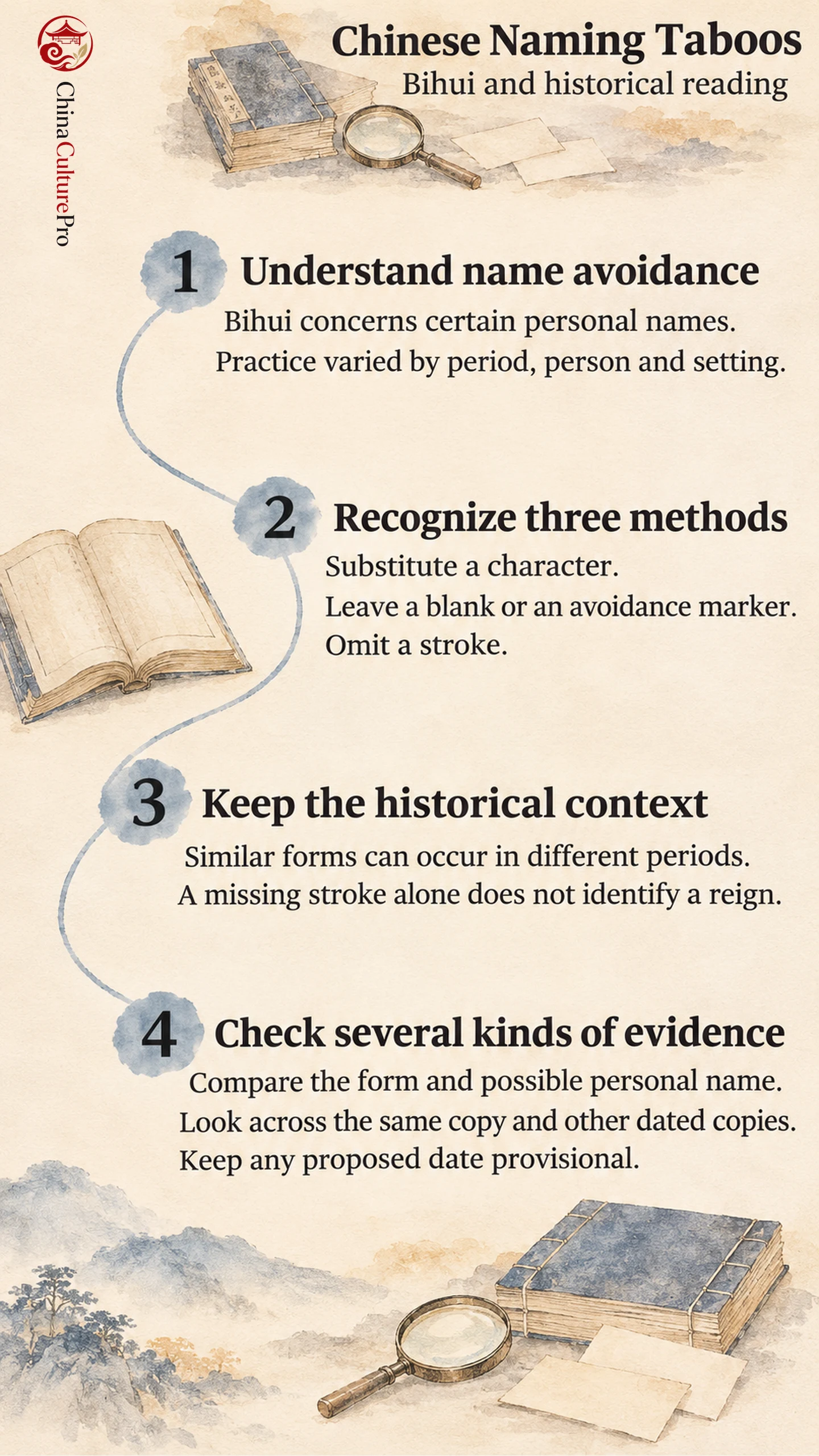
- Substitution: A different character could replace the avoided one.
- Blank space: A name or character could be left unwritten.
- Missing stroke: A character could remain recognizable but incomplete.
- Reading value: The change may help explain an unusual historical spelling.
These are historical practices, not instructions for ordinary modern handwriting. [1]
An unfamiliar character in an old Chinese book may be more than a copying error. Sometimes the writer or printer deliberately changed a familiar form because it touched a protected personal name. Recognizing that possibility helps a reader preserve meaningful evidence instead of silently “correcting” it.
What Bihui Meant in Historical Writing
The practice joined language with authority and respect. Avoidance could apply to a ruler’s name or to an elder’s name, and could affect what was said as well as what was written. Its object was the personal name; it was not simply a ban on mentioning the person in any form. [1]
Treat each case in its period and setting. A study of avoidance involving the Qing prince Yonglian found alternative characters and omitted final strokes, but the practice was neither consistent nor commonplace. An isolated example therefore does not establish an evenly enforced rule for everyone in that period. [5]
For present-day interaction, the separate guide to Chinese forms of address explains the more relevant task of choosing a suitable title.
Recognize Three Ways a Name Was Avoided
Historical texts may preserve three broad mechanisms. The actual substitute or alteration must be checked in the particular document. [2]
- Character substitution: Another character takes the avoided character’s place.
- Blanking: The space is left empty or an avoidance marker stands in for the character.
- Stroke omission (缺笔, quē bǐ): Part of the expected written form is deliberately left out.
Do not assume that the altered form has become a different vocabulary word. It may represent the original word under a writing convention. This distinction matters when comparing transcriptions, searching a digital text or consulting a character index. [2]
Read a Missing Stroke in Its Historical Context
The character 玄, xuán, provides a useful warning against instant dating. Its final stroke was omitted in some Song printed or copied texts in connection with the name Xuanlang. Qing avoidance of the Kangxi emperor’s personal name Xuanye also produced missing-stroke forms of the same character. [3]
The same base character can therefore point to different historical contexts. Consult a Chinese variant-character reference and inspect the relevant form rather than relying on a modern font approximation. [3]
Even the chronology of a method requires care. Research on stroke omission challenges the traditional starting point in Tang Gaozong’s reign by identifying possible evidence from Tang Taizong’s earlier reign. The broader Chinese history guide can orient the periods; it cannot settle an individual manuscript’s date. [4]
Check a Suspected Taboo Form Before Dating a Text
A reference on Ming and Qing taboo forms explicitly warns that a character variant alone may be insufficient for dating. Treat the form as a clue and use several kinds of evidence together. [2]
- Identify the form: Compare the unusual character with a reliable transcription or character reference.
- Find the possible name: Check whether the character belongs to a ruler’s or respected elder’s personal name.
- Compare the evidence: Look for the same treatment elsewhere in this copy and compare other dated copies.
- Keep the date provisional: Use the taboo form alongside colophons, paper, printing and provenance evidence.
Keep an image or exact transcription of the original form in your notes. Record a proposed taboo explanation separately from the observed shape. If another edition writes the character differently, retain both readings until their relationship is understood.
FAQs About Chinese Naming Taboos
Does every missing stroke show a naming taboo?
No. Missing-stroke taboo forms are documented, but a damaged, unusual or incomplete character needs contextual examination. Compare the actual shape with a reliable reference before assigning that explanation. [3]
Can a taboo character date a book exactly?
Not by itself. Some forms are ordinary variants as well as possible taboo spellings. Check the edition and supporting evidence before proposing a date. [2]
Should modern learners omit strokes to show respect?
No. This historical guide supplies no such modern handwriting rule. Learn the standard Chinese character forms for ordinary writing; preserve unusual forms when faithfully transcribing historical evidence.
Sources
[1] Palace Museum. 避讳
[2] National Library of China, Chinese Ancient Books Preservation. 明清古籍中常见的避讳字
[3] Ministry of Education, Taiwan. Dictionary of Chinese Character Variants: 玄
[4] Sun Jianqiang, Acta Orientalia. The appearance of the quebi taboo method with a reflection on using bihui to examine Chinese sources
[5] Journal of Digital Humanities, Renmin University of China. Naming taboo for Prince Yonglian, Heir Apparent Duanhui: An E-Textual Research Case Study