

Quick Answer: What Is Chinese Ramie Clothing?
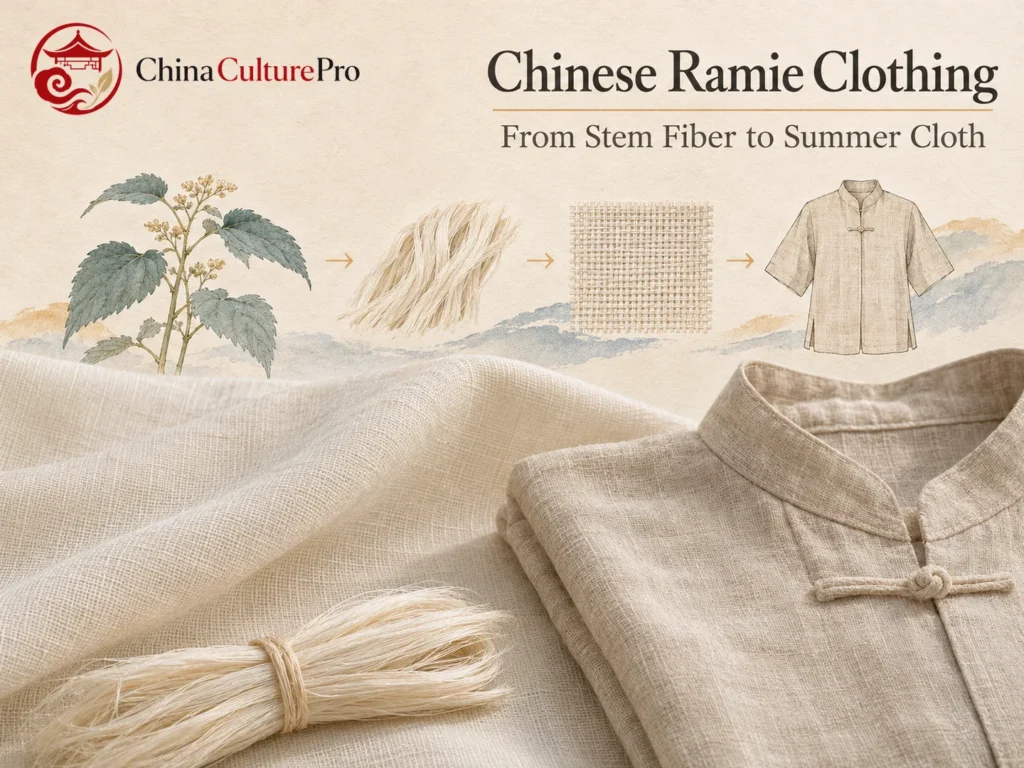
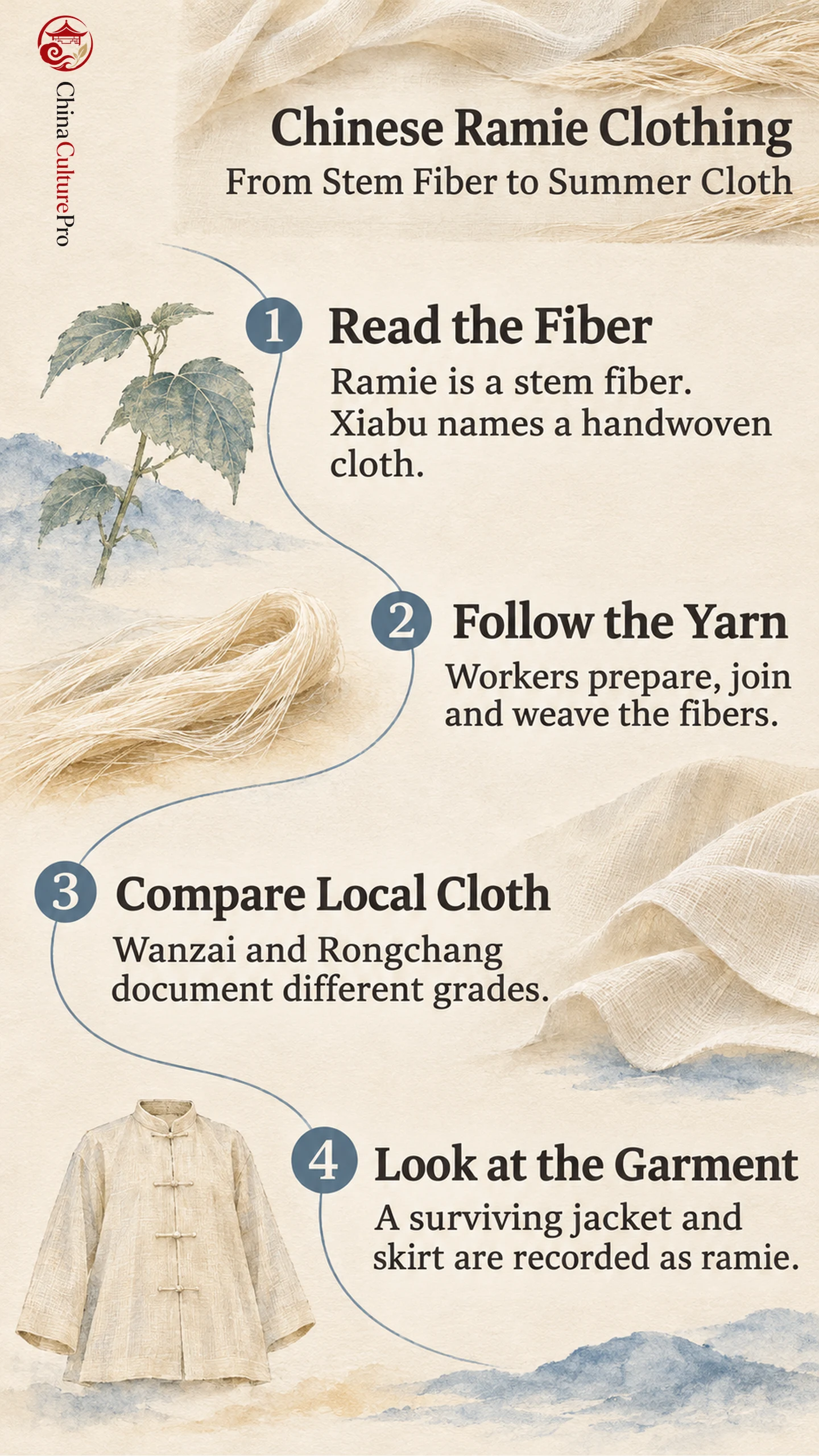
Ramie (苎麻, zhùmá) is a fiber from the inner bark of a plant stem. In China, handwoven ramie used for warm-weather clothing belongs to a tradition called xiabu (夏布, xiàbù), or summer cloth.[1][2]
- Preparation: Scraping and degumming separate the usable stem fibers and remove some of their natural gum.[2]
- Regional examples: Wanzai in Jiangxi and Rongchang in Chongqing have documented summer-cloth weaving traditions.[3]
- Dress evidence: The China National Silk Museum records a Republican-period ramie jacket and skirt.[4]
Read the material and weaving technique separately when a label calls a garment summer cloth.
A piece of Chinese summer cloth can be fine enough for a garment or sturdy enough for another use. The weave matters, and so do the decisions made before any thread reaches a loom.
Ramie Fiber and the Meaning of Xiabu
Chinese ma (麻, má) can refer to several fiber plants. Ramie and hemp come from different plants, although both can provide fibers from the stem. A label naming Chinese hemp textiles and a label naming ramie should therefore be read at the level of the fiber when that information is available.[1]
The Wuhan Botanical Garden uses xiabu for handwoven ramie cloth made on a wooden loom. The name describes a craft tradition and its association with summer use. A pale garment can look similar to other fabrics. Read the material field for ramie, cotton or silk.[1]
How Ramie Became Cloth
Qing watercolor albums held by the Science History Institute show workers scraping harvested stems, separating fibers and joining them into longer lengths. Degumming helps remove the binding material and soften the fiber. The institute’s study compares texts in which workers treat plant material, fibers or yarn at different points in the process.[2]
Workers join the ends of long fibers to build up a continuous thread. The joins become part of the yarn that goes to the loom. Research on historical summer cloth also points to preparing and sizing warp yarns before weaving. Together, fiber and yarn preparation help account for the finished fabric’s firmness and sheen.[6] The history of Chinese cotton textiles shows a different route from a plant fiber to yarn.
Wanzai and Rongchang Weaving Traditions
The national heritage listing describes Wanzai summer cloth as having round yarn and records multiple grades. Local makers also used it for curtains and craft objects. The grade and intended use tell a reader more about a piece than the name Wanzai alone.[3]
In Rongchang, the record distinguishes fine, coarse and ribbed cloth. Its account includes setting out warp yarns, passing them through the loom’s reed, brushing on sizing and washing the woven cloth. A separate Jiangxi tradition in Xinyu uses summer cloth as a ground for embroidery.[3][7]
Ramie in Surviving and Contemporary Dress
The China National Silk Museum names ramie as the material of a women’s jacket and skirt from the Republican period. The jacket and skirt have separate accession numbers, 2895 and 2896. The separate numbers let readers follow the two pieces individually in the collection.[4]
Rongchang’s craft workstation has brought weavers and design educators together to develop new uses for the fabric. Whether reading a museum label or a contemporary design note, check the named fiber and the structure of the cloth. Chinese silk gauze gives an example of how lightness can come from a very different weave.[5]
FAQs About Chinese Ramie Clothing
Is ramie the same as hemp?
Ramie and hemp are different plants. Both can yield stem fibers, which is one reason broad historical labels for ma need context.[1]
Is every ramie fabric called xiabu?
In the traditional craft sense, xiabu is handwoven ramie summer cloth. Ramie is the material name and covers more fabrics than that tradition.[1]
Does every ramie garment have a coarse feel?
Rongchang records distinguish fine and coarse cloth. Fiber preparation and the yarns used for weaving can make different grades feel and look different.[3][6]
Sources
[1] Wuhan Botanical Garden, Chinese Academy of Sciences. Bast Fibers in Historical Chinese Textiles
[2] Qinyan Wu, Science History Institute. Weaving History
[3] China Intangible Cultural Heritage. Summer Cloth Weaving Techniques
[4] China National Silk Museum. Fashion and Nature Exhibition
[5] China Intangible Cultural Heritage. Rongchang Traditional Craft Workstation
[6] Wang Yue, He You and Teng Yajuan, Donghua University Journal. Directional Characteristics of Pre-Weaving Processes for Summer Cloth
[7] China Intangible Cultural Heritage. Summer Cloth Embroidery