

Quick Answer: What Is Tibetan Pile Embroidery?
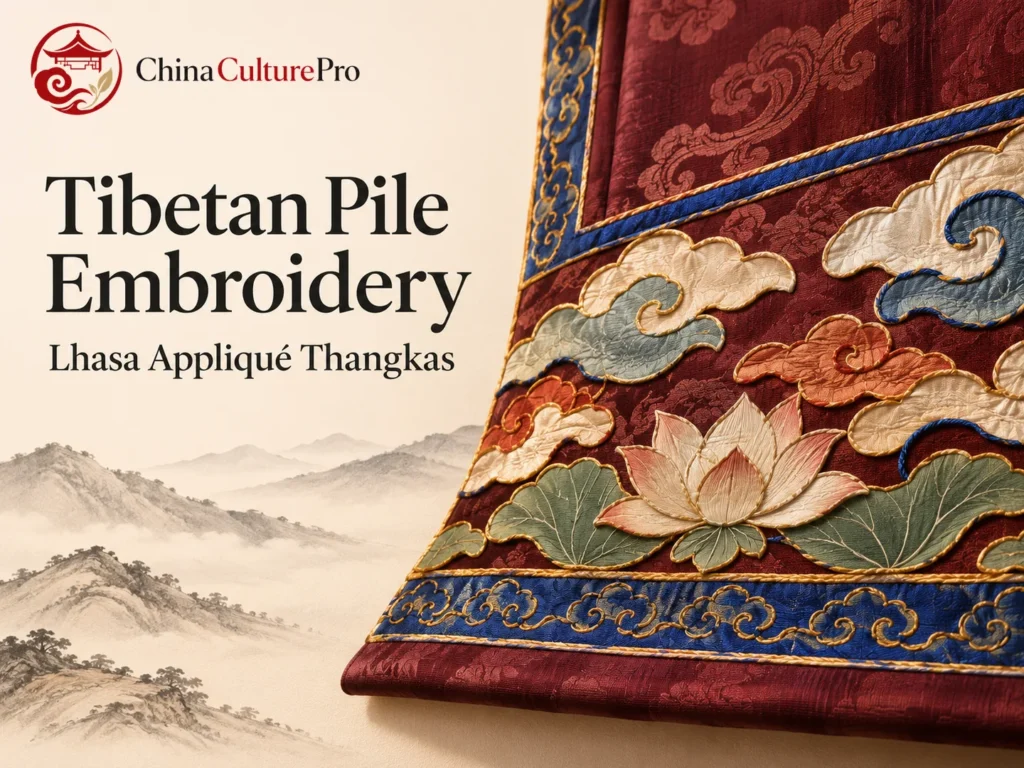
Tibetan pile embroidery refers to cut-and-layered cloth work on thangkas (唐卡, tángkǎ), Tibetan Buddhist hanging images. The Lhasa tradition of dui embroidery (堆绣, duīxiù) joins shaped pieces of cloth, with stitches defining edges and smaller details. Some traditions use wool or cotton under selected pieces for relief.[1][2]
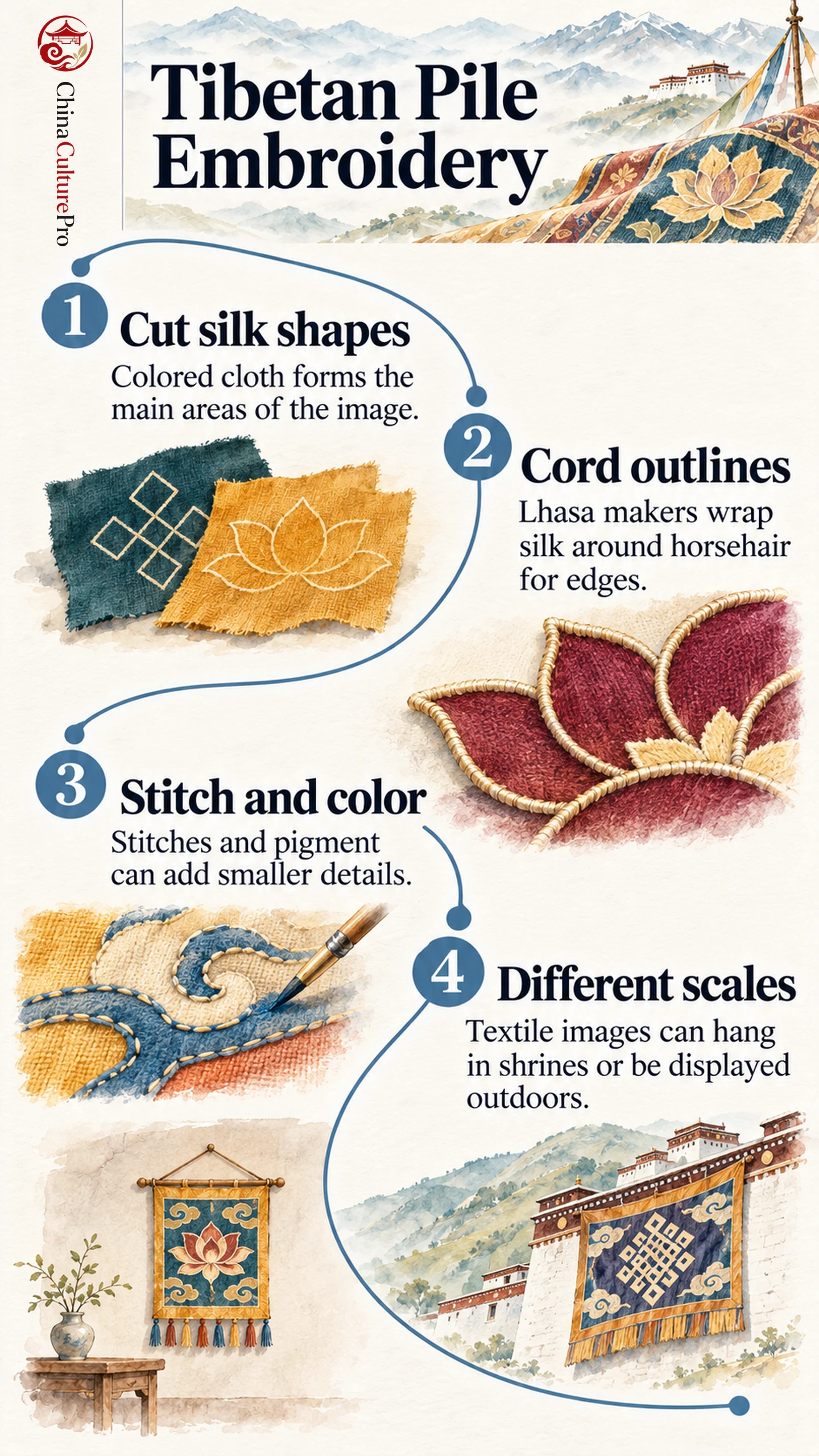
- Materials: Makers have worked with silk, satin and other fabrics. The Lhasa description also records silk-wrapped horsehair for outlines.[1][2]
- Construction: Cut pieces supply broad areas of color. Needlework and other details can complete them.[1][3]
- Use: Textile thangkas can be mounted for shrine or temple display. Monumental examples could be shown outside on special occasions.[1][4]
The term “pile” can also describe projecting yarns in other fabrics. Here the focus is on layered cloth and its outlines.[1][5]
A line at the edge of a textile figure may be thicker than the embroidered details inside it. At close range, that line can turn out to be a cord stitched down to mark the boundary between two pieces of silk.
How Lhasa Makers Assemble a Thangka
The national heritage description starts with a line drawing. A maker separates the drawing into areas of color, transfers the shapes to selected cloth and cuts them out. One recorded method transfers an outline by tapping colored powder through small holes in the design paper. Each piece already carries the color and sometimes the woven pattern needed for a part of the image. The pieces are arranged and sewn onto the ground.[1]
An outline may be made by wrapping silk around horsehair. The wrapped cord gives the outline body and a clear edge. Because it is placed along the cut shape, the cord can follow the curve of a face or a fold. Stitches can add facial details, jewelry, flames or transitions in color. Some commissions included pearls or gems. In related work, wool or cotton may be inserted beneath parts of the design to give them volume. Huangzhong dui embroidery describes a specific Qinghai practice using flat and raised pieces.[1][2]
What Two Museum Pieces Reveal
The Metropolitan Museum of Art’s nineteenth-century thangka of Kurukulla contains patterned satin, damask and brocade. Conservators found silk-wrapped horsehair secured to the textile by couching. They also documented hand-painted accents. Couching means securing a cord on the face of the cloth with separate stitches. The assembled fabrics, outlines and details are each visible in close views.[3]
The Rubin Museum’s nineteenth-century Orgyen Dorje Chang appliqué, catalogued as Tibet or Bhutan, belonged to a much larger hanging. The surviving figure is already over two meters tall. The museum describes it as one of eight manifestations that surrounded a central image of Padmasambhava. Its size shows how textile pictures could be assembled from separate figures at a monumental scale.[4]
From Workshops to Temple and Outdoor Display
According to the national heritage entry, both government and private workshops made appliqué thangkas in Lhasa by the seventeenth century. The same entry describes mounting and consecrating finished devotional works before they were placed in shrines or halls. The mounted textile has a devotional role in those settings, while a museum label usually describes it through its period, materials and construction. Lhasa dui thangkas were added as a national heritage extension in 2021.[1]
Large appliqués could be unrolled on a hillside or hung outside a monastery for communal viewing on special occasions. That display setting differs from that of a smaller image in a shrine. Both scales use fabric pieces to form the image, a principle shared with Chinese appliqué.[1][4]
FAQs About Tibetan Pile Embroidery
Does pile embroidery mean the fabric has a velvet pile?
In this context the word points to layers of cut cloth and sometimes relief. In general textile terminology, pile is a surface made from projecting loops or yarn ends, as on velvet or some carpets.[1][5]
Are all textile thangkas padded?
No. Some are assembled from cut pieces and edged with stitched or couched lines. Padding with wool or cotton is another way to raise selected shapes.[1][2][3]
Can an appliqué thangka include painted details?
Yes. The Met’s Kurukulla includes painted accents on the fabric as well as sewn patches and embroidered outlines.[3]
Sources
[1] China Intangible Cultural Heritage Digital Museum. Tibetan Thangka: Lhasa Dui Embroidery
[2] Tibet Autonomous Region Department of Culture and Tourism. Thangka Materials and Techniques
[3] The Metropolitan Museum of Art. Rescuing the Goddess: Conservation of an Appliquéd Silk Tibetan Thangka
[4] Rubin Museum of Himalayan Art. Orgyen Dorje Chang
[5] The George Washington University Museum and The Textile Museum. Textile Terms