


Quick Answer: Why Do Chinese Place Names Change?
Chinese place names (地名, dì míng) can change with political history, administrative decisions and changing conventions for writing names in other scripts. These are different processes.
- Renaming: The Chinese name itself changes.
- Romanization: Latin-letter spelling changes while the Chinese name may remain the same.
- Administration: A county, city or other unit may be reorganized.
- Historical reading: Identify the date and the geographic area meant by the source.
A familiar modern name is a useful search aid, but not a substitute for checking the historical referent.
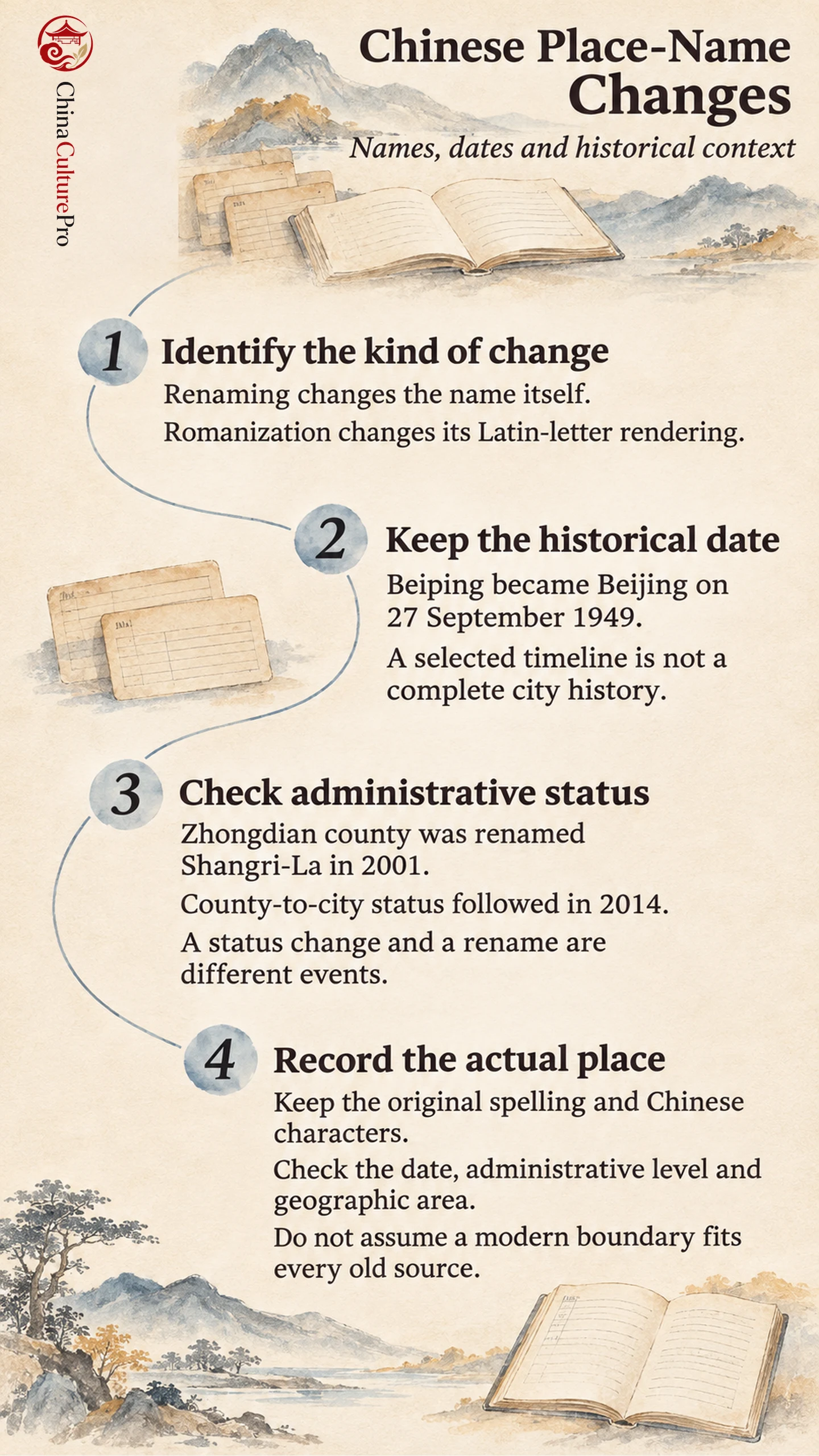
An old map and a modern atlas can use different labels for a related location. Before replacing one with the other, ask what changed: the name, the spelling, the administrative unit or its territory. A good historical note keeps those questions separate.
Separate Renaming from a Different Romanization
Peking and Beijing illustrate why an English spelling change is not necessarily a Chinese renaming. Peking is a conventional postal spelling of the city’s name; Beijing is the pinyin spelling of 北京, Běijīng. The contrast differs from an actual change between 北京 and 北平, Běipíng. [2]
Pinyin became the UN-approved romanization system for Chinese geographical names in 1977. Converting an older Latin-letter form still requires care: the official romanization report warns that one should consult the actual Chinese characters rather than mechanically convert every earlier spelling. [4]
For unfamiliar spellings, use the pinyin guide as an introduction to the system, then verify the particular name.
Read Dated Name Changes in Their Historical Setting
Beijing’s official local history provides several distinct naming events. This selected sequence identifies particular changes; it does not imply that nothing happened between its rows. [1]
| Date | Recorded change |
|---|---|
| 1368 | Dadu, 大都, Dàdū, became Beiping, 北平, Běipíng. |
| 1403 | Beiping became Beijing, 北京, Běijīng. |
| 1928 | Beijing became Beiping. |
| 27 September 1949 | Beiping became Beijing. |
Read these names alongside the dated political and administrative events. For example, the Ming naming change in 1403 and the move of the capital in 1421 are separate dated events. A name’s meaning alone does not supply the date when a city became a capital. [1]
A broader Chinese history timeline can help orient such changes, but the city’s own dated records control the individual identification.
Distinguish a New Name from a New Administrative Unit
Zhongdian, 中甸, Zhōngdiàn, offers a different example. On 17 December 2001, its county name was approved for change to Shangri-La, 香格里拉, Xiānggélǐlā. A later decision in December 2014 abolished the county and established a county-level city, using the former county’s administrative territory. Renaming and changing administrative status were therefore separate events. [3]
In English, distinguish an administrative city from its built-up centre. An administrative city need not mean only its compact built-up centre. Library cataloging guidance explicitly distinguishes administrative units from populated places of the same name; historical research needs the same attentiveness to the intended referent. [5]
Do not assume that a modern map boundary applies to every older occurrence of the name. A source may describe a settlement, a district or a wider jurisdiction.
Connect an Old Name with the Place You Mean
Start with the source’s own spelling and date. Add the Chinese characters when available, then check a local history or authoritative geographical record. In your notes, give the original label before the modern equivalent, so another reader can trace the identification.
Keep three questions beside the name: Which historical date? Which administrative level? Which geographical area? The place-name elements guide helps with components, while province abbreviations address shortened regional labels.
A historical naming explanation also needs evidence. Naming taboos can affect historical wording, but they should not become a default explanation for every changed name. Verify the particular case before assigning a motive.
FAQs About Chinese Place-Name Changes
Was Peking simply renamed Beijing?
That wording conflates different Latin-letter renderings with an actual Chinese name change. Compare the underlying characters and the period being discussed. [2][4]
Did Beijing keep one name throughout the twentieth century?
No. Its history includes changes between Beijing and Beiping. The selected dates above are examples, not a complete account of every twentieth-century change. [1]
Does a name change prove the boundary changed?
No. Names, administrative status and boundaries need separate checks. Shangri-La’s later county-to-city decision explicitly used the former county’s territory. [3]
Sources
[1] Beijing Local Chronicles Office. Administrative history of Beijing
[2] Beijing tourism authority. The Names of Beijing
[3] Shangri-La Municipal Government. General overview
[4] United Nations Group of Experts on Geographical Names. Romanization of Chinese geographical names
[5] Library of Congress. FAQ: Conventional Chinese Place Names