
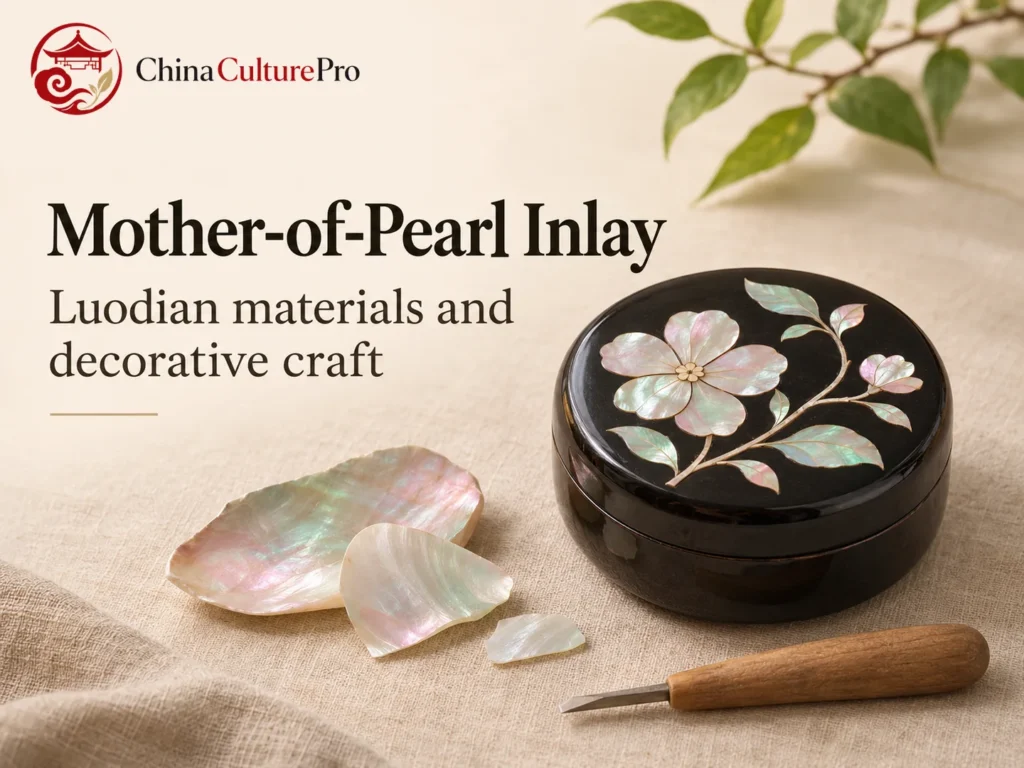

Quick Answer: What Is Chinese Mother-of-Pearl Inlay?
Chinese mother-of-pearl inlay, or luodian(螺钿,luódiàn), decorates an object with shaped shell pieces arranged into patterns. The pieces become part of the decorated surface, commonly on lacquerware or wood. [1]
- Material: Shell is selected for colour and cut into pieces suited to the design. [3]
- Technique: Thicker and thinner pieces support different approaches to inlay. [2]
- Appearance: Pale or iridescent shell can contrast with dark lacquer. [4]
- Objects: Uses range from small containers and trays to large interior furnishings. [8]
The supporting object, its coating and the inserted shell are distinct components. A shining pattern may include additional materials, so mother-of-pearl should not be assumed to explain every part of an object.
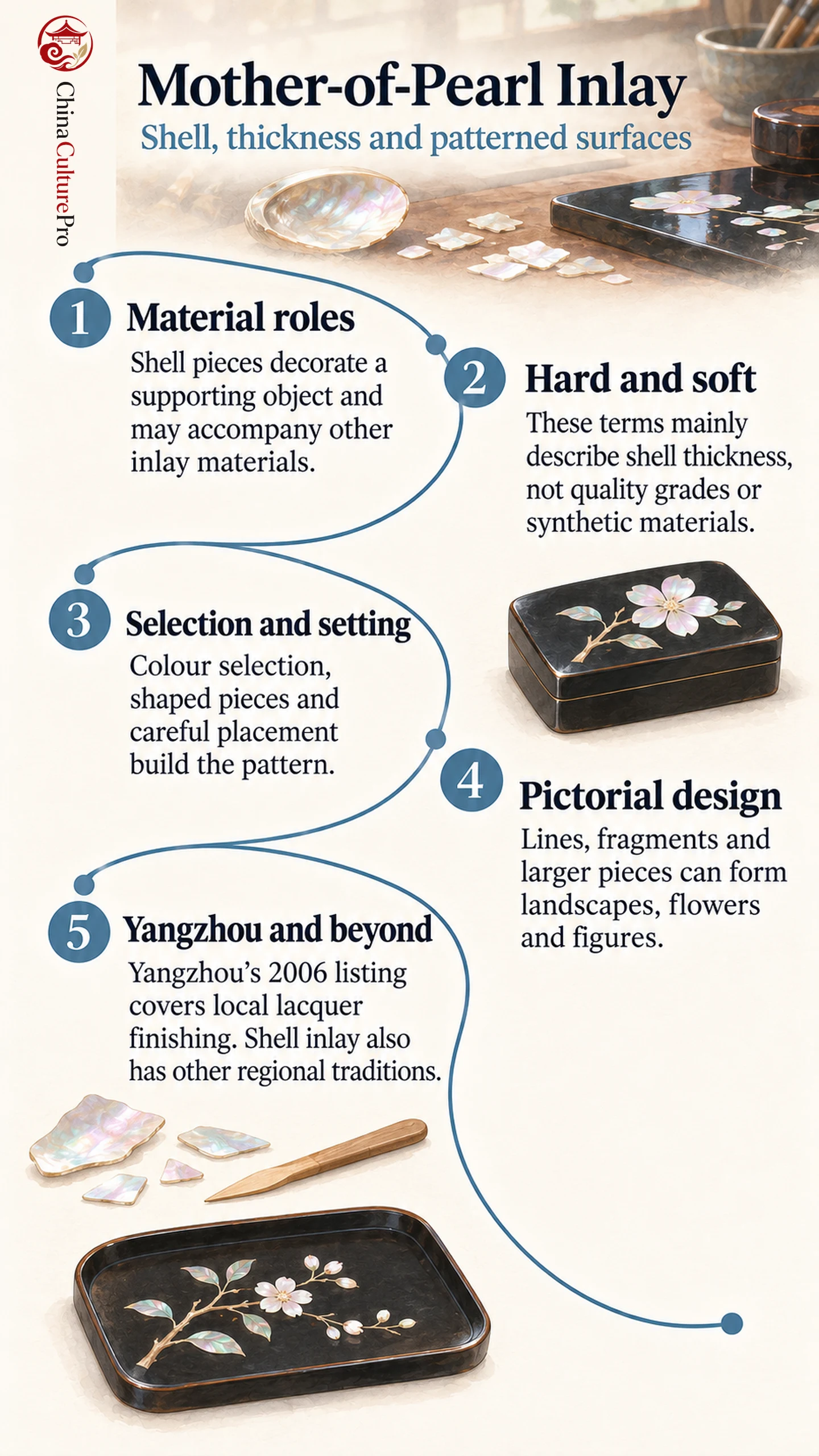
A tiny shell fragment can become a leaf, a narrow strip can describe the ground, and a larger piece can form a rock. Luodian turns those differences into a picture. Within Chinese traditional crafts, it rewards attention to both the material and its placement.
Shell Material, Lacquer and the Supporting Object
Shell supplies the visible inlay. Its colour and reflected sheen help determine which pieces suit a particular part of a composition. A craftsperson selects material before trimming it into the forms needed for the pattern. [3]
The support has a different role. A wooden box, tray or furnishing provides structure; lacquer can supply a prepared surface and a contrasting ground. Luodian is a decorating method rather than the name of the wood itself. Historical examples also show shell inlay on materials beyond wood and lacquer. [1]
A lacquered object may combine several processes. Carving, painting and inlay can coexist, but they describe different ways of working. Our guides to Chinese lacquerware and carved lacquer explain the wider material setting.
Hard and Soft Inlay: Thickness, Not Quality Grades
The familiar hard-and-soft distinction refers primarily to the shell pieces’ thickness. It should not be read as a ranking from inferior to superior workmanship.
| Catégorie | Material distinction | How to understand the name |
|---|---|---|
| Hard inlay(硬螺钿,yìng luódiàn) | Uses comparatively thick shell pieces; one curatorial account gives a typical range of about 0.5–2 mm. | “Hard” identifies this thicker-shell approach. |
| Soft inlay(软螺钿,ruǎn luódiàn) | Uses very thin shell pieces, typically below about 0.5 mm in the same account. | “Soft” does not mean plastic or painted imitation shell. |
These measurements describe a customary technical distinction, rather than a universal grading system for every workshop. Both approaches use actual shell. Thickness affects the material available to the maker, while the finished result also depends on cutting, arrangement and surface finishing. [2]
The useful comparison is therefore between the pieces and how they are handled. A more delicate-looking pattern does not, by itself, establish that an object is earlier or more valuable.
From Selected Shell to an Inlaid Pattern
The work begins with selection. Differences in colour can be assigned to different parts of a composition instead of being treated as defects to erase. Shell is then worked into fine sheets or pieces and trimmed into the required shapes. [3]
The pieces are arranged and set on the prepared object to build a motif. Individual pieces can supply petals, leaves and stems, with their contours helping define the whole flower. Lines, points and larger shapes perform different pictorial jobs, so the cut material and the intended design develop together. [3]
In lacquer traditions, the subsequent coating and finishing integrate the inlay with the surrounding surface. Yangzhou practice includes methods described as flat-polished inlay as well as more minute point-and-line work. Their shared use of shell does not make every workshop sequence identical. [5][6]
The process is different from simply painting a pearly colour onto a finished box.
Historical Examples and Pictorial Design
A fourteenth-century rectangular tray, collection 2015.500.1.56, shows how many shapes can cooperate within one picture. Against black lacquer, narrow shell lines describe the terrain, irregular pieces form a rocky outcrop, and shimmering fragments construct the trunk of a flowering plum tree. Two birds occupy the scene. [4]
This example is catalogued across the Yuan–Ming transition. Its value for understanding the craft lies in the relationship between fragment shape and depicted subject, not merely the amount of shining material. The contrast between long strips and irregular fragments gives the ground, rocks and tree different visual textures. [4]
The wider object repertoire includes containers associated with incense, cosmetics or writing supplies, alongside screens used within interiors. Small-scale detail and large compositions are both part of the tradition. The connections with traditional furniture and brush-making concern the objects and settings in which decorative craft appears. [8]
Yangzhou Dianluo and Living Craft Traditions
Dianluo(点螺,diǎnluó)is associated particularly with exceptionally small pieces, points and slender lines of prepared shell. In documented Yangzhou practice, these elements are placed individually onto a prepared lacquer surface and incorporated through finishing. The scale of the pieces permits closely detailed designs. [6]
Yangzhou lacquerware finishing entered China’s national intangible cultural heritage list in 2006. That designation covers a local group of finishing techniques, including shell-related methods alongside other lacquer practices; it is broader than luodian alone. [5]
The craft also enters present-day teaching and design discussion. On April 29, 2026, a college teaching event brought Yangzhou lacquer practitioners together with students and faculty. They discussed digital material libraries, teaching resources and new design approaches. These were areas of discussion and exploration, not evidence that software had replaced the making skills. [7]
Yangzhou lacquerware provides the local context for these techniques.
Luodian and Mixed-Material Inlay
Baibaoqian(百宝嵌,bǎibǎoqiàn)is mixed-material inlay. Mother-of-pearl can be one of its components alongside materials such as stone or jade. The categories can therefore overlap: an object may contain shell without being decorated exclusively in shell. [1]
Likewise, a lacquer surface can combine inlaid shell with other forms of decoration. Identify what each visible element is doing before treating the entire scene as one technique.
Luodian names the shell-based contribution. Baibaoqian describes the broader combination of materials.
FAQs About Chinese Mother-of-Pearl Inlay
Does Soft Inlay Use Artificial Plastic Shell?
No. The traditional hard-and-soft distinction concerns shell thickness. Soft inlay uses very thin shell pieces; the name does not identify a synthetic substitute. [2]
Is the Iridescent Pattern Simply Painted onto Lacquer?
In luodian, shaped shell pieces make the inlaid design. Selection, cutting and placement are essential to it. Painting can accompany inlay but is a separate decorative process. [3]
Is Every Mother-of-Pearl Object Chinese?
No. Lacquer-and-shell traditions also occur in Korea, Japan and other regions. Read an individual object’s attribution rather than assigning its origin from the material alone. [8]
Is Luodian the Same as Baibaoqian?
No. Luodian centers on shell inlay. Baibaoqian combines different materials and may include mother-of-pearl as one component, so the two descriptions can apply to overlapping aspects of an object. [1]
Sources
[1] Palace Museum. Luodian
[2] Palace Museum. Thick mother-of-pearl lacquerware
[3] Craft and Guild Foundation. Luodian
[4] Metropolitan Museum of Art. Rectangular tray with flowering plums and magpies, 2015.500.1.56
[5] China ICH Network. Yangzhou lacquerware finishing techniques
[6] Ministry of Commerce Old Brands Digital Museum. Qihua craft methods
[7] Jiangsu Tourism Vocational College. Yangzhou lacquerware innovation and digital applications teaching event
[8] Metropolitan Museum of Art. Mother-of-Pearl: A Tradition in Asian Lacquer, 2006–2007