

Quick Answer: What Is Chinese Lacquerware?
Chinese lacquerware (漆器, qīqì) uses a coating made from refined tree sap. Makers can paint a lacquered surface, set other materials into it or build up enough lacquer to cut a design in relief. Cups, boxes and dishes can use the same coating in very different ways.[1][2]
- Support: The coating may cover wood or another shaped base.
- Design: Painted color, shell inlay and relief carry patterns in different ways.
- Evidence: A catalogue can record the support, treatment and date separately.
Look at what forms the pattern before giving the object a technique name.
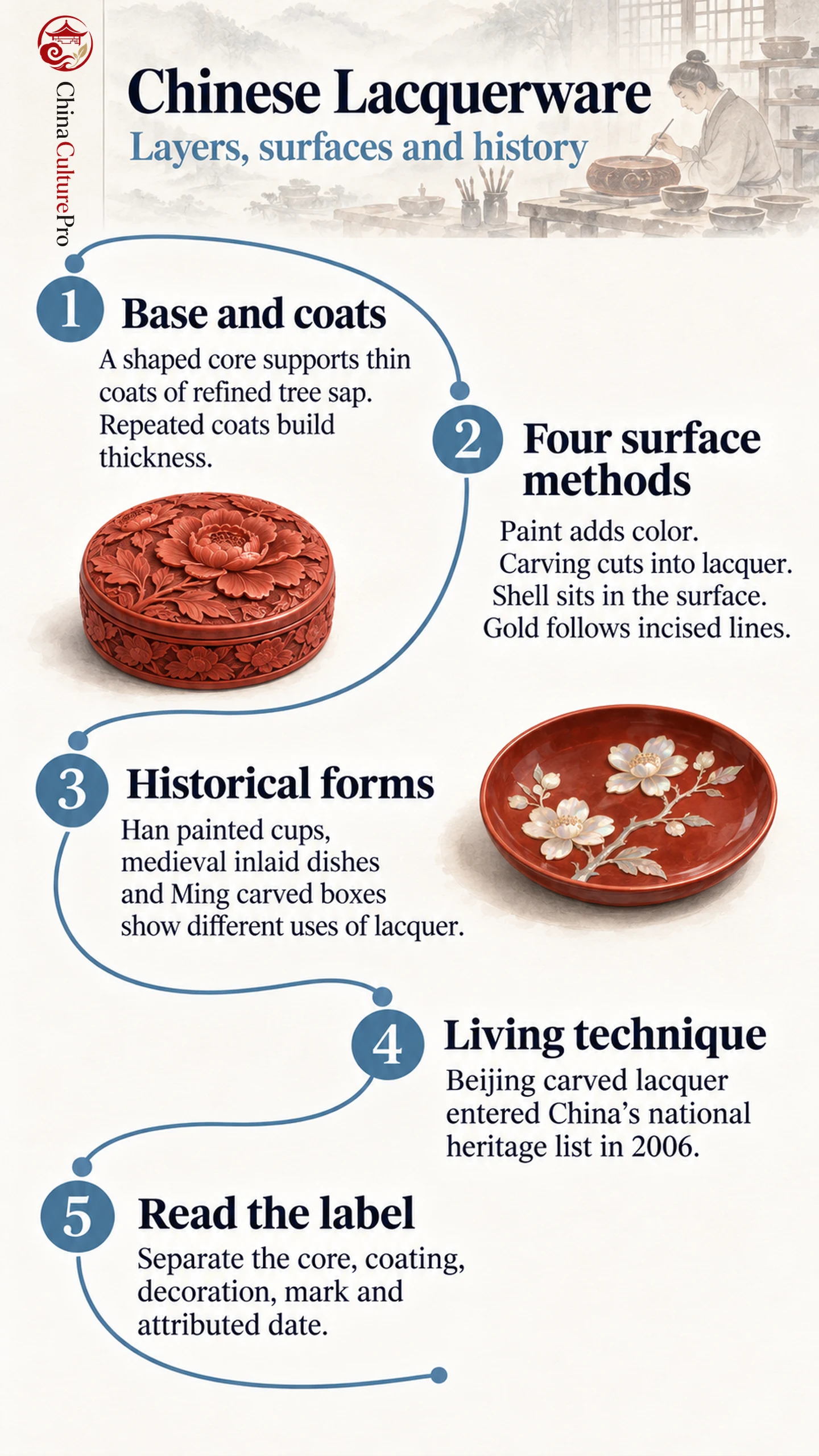
Light falls differently on a carved red box and a shell-inlaid dish. The carved relief casts shadows. The shell reflects color as the angle changes. Those details reveal how each surface was made.
From Tree Sap to a Finished Surface
Traditional East Asian lacquer comes from the sap of the lacquer tree. Makers refine the sap and apply it in thin coats. The coats cure in warm, humid conditions. Building a thicker surface takes repeated applications, with curing between coats.[1]
The support gives the object its form. Wood can supply the shape of a dish or box, while the lacquer changes its surface. The red lacquer on one inlaid dish covers a wood core, a useful distinction when the red surface hides the underlying material.[4]
Thickness matters because it affects what a maker can do to the surface. A series of coats may prepare a ground for painting or inlay. A substantial build-up can become a material for carving. This relationship between support and surface runs through many Chinese traditional crafts.
Painted, Carved, Inlaid and Engraved Lacquer
Compare the material carrying the pattern and its relationship to the surface.
| Technique | What carries the design |
|---|---|
| Painted lacquer | Color forms the design on a lacquered surface. The painted cloud design on a Western Han ear cup is one example.[3] |
| Carved lacquer (雕漆, diāoqī) | The design is cut into built-up coats of lacquer. Its relief is formed within the coating itself.[1][2] |
| Mother-of-pearl inlay (螺钿, luódiàn) | Pieces of shell form iridescent parts of the design set into the surface. A documented dish combines shell and traces of gilding.[4] |
| Engraved gold (戗金, qiàngjīn) | Gold is applied into fine incised lines. The grooves define the pattern.[1] |
A single object can combine methods. Read a label that mentions both inlay and incisions as a description of different areas or materials on the same piece.[4]
Three Objects Across the History of Lacquerware
A painted Western Han ear cup from Mawangdui (马王堆, Mǎwángduī) tomb 1 has a wooden core and cloud-pattern decoration. Excavated in 1972, it is 17.6 cm long. Its paired side grips and low oval profile show how lacquer was used on a vessel with a clear practical form. The tomb context belongs to the history of the Han dynasty.[3]
The medieval shell-inlaid dish with red lacquer offers a different surface. The collection record lists the thirteenth century in its period field. The longer label proposes the fourteenth century and leaves the earlier date possible. The material entry records shell and traces of gilding separately from that date discussion.[4]
An early fifteenth-century covered box with peonies is cut in red lacquer. The base bears a Yongle (永乐, Yǒnglè) reign mark. In this documented example, the record connects relief decoration and the Ming dynasty court context.[5]
Carving remains a transmitted practice. The Beijing carved lacquer technique was included in the first batch of China’s national intangible heritage list in 2006. The listing concerns the practice of building and carving lacquer layers. It is one example of intangible cultural heritage in China.[6]
How to Read a Lacquerware Label
Start with the core or support, then identify the coating and the added material. A label such as “red lacquer on wood core with mother-of-pearl inlay” describes several layers of the same object. Use the accession number in museum collection records to see whether the catalogue adds a date range, mark or conservation observation.
Compare a date field with its supporting notes. A reign mark is a feature of an object, and an excavation record provides a different kind of evidence. A label can report both the mark and a reasoned attribution. The same label may describe the surface confidently while leaving the period uncertain.
FAQs About Chinese Lacquerware
Is lacquerware made entirely of lacquer?
Many pieces have a base of wood or another material that provides the shape. The lacquer is a coating, and in carved work it can become thick enough to carry a design in relief.
Is Chinese lacquerware always red or black?
Red and black are familiar colors. Inlays, gilding and painted areas can add other colors and kinds of reflection.
How can carved lacquer be distinguished from painted lacquer?
On carved lacquer, the design is cut into a built-up coating. A painted design is carried by color on the surface. Some records document several treatments on one object.
Does a reign mark give the date of every lacquer object?
A mark is one field in the object record. Compare it with the attributed date, technique and other evidence for that specific piece.
Sources
[1] Department of Asian Art, The Metropolitan Museum of Art. Lacquerware of East Asia
[2] The Metropolitan Museum of Art. Red and Black: Chinese Lacquer, 13th–16th Century
[3] Hong Kong Antiquities and Monuments Office. Han Lacquer Ear Cups and Dishes
[4] National Museum of Asian Art, Smithsonian Institution. Lacquer with Inlay, S1987.369
[5] The Metropolitan Museum of Art. Covered Box with Peonies and Seasonal Flowers, 1974.269a, b
[6] China Intangible Cultural Heritage Digital Museum. Carved Lacquer Technique, VIII-50