


Quick Answer: What Is Changhua Chicken-Blood Stone Carving?
Changhua chicken-blood stone (昌化鸡血石, Chānghuà jīxuèshí) is a carving material associated with Changhua in western Hangzhou, Zhejiang. Its red marks come from cinnabar (辰砂, chénshā). Local carvers make seals and sculptures that work with the color already in the stone. [1][2][4]
- Color: Cinnabar gives the stone red patches or streaks.
- Design: The location of those patches can influence what a carver depicts.
- Use: A seal may have an engraved base and a body that displays the stone’s color. [2][4][5]
Changhua names a source and a regional carving tradition. Mineralogical accounts also record chicken-blood stone from Balin in Inner Mongolia. [1][2]
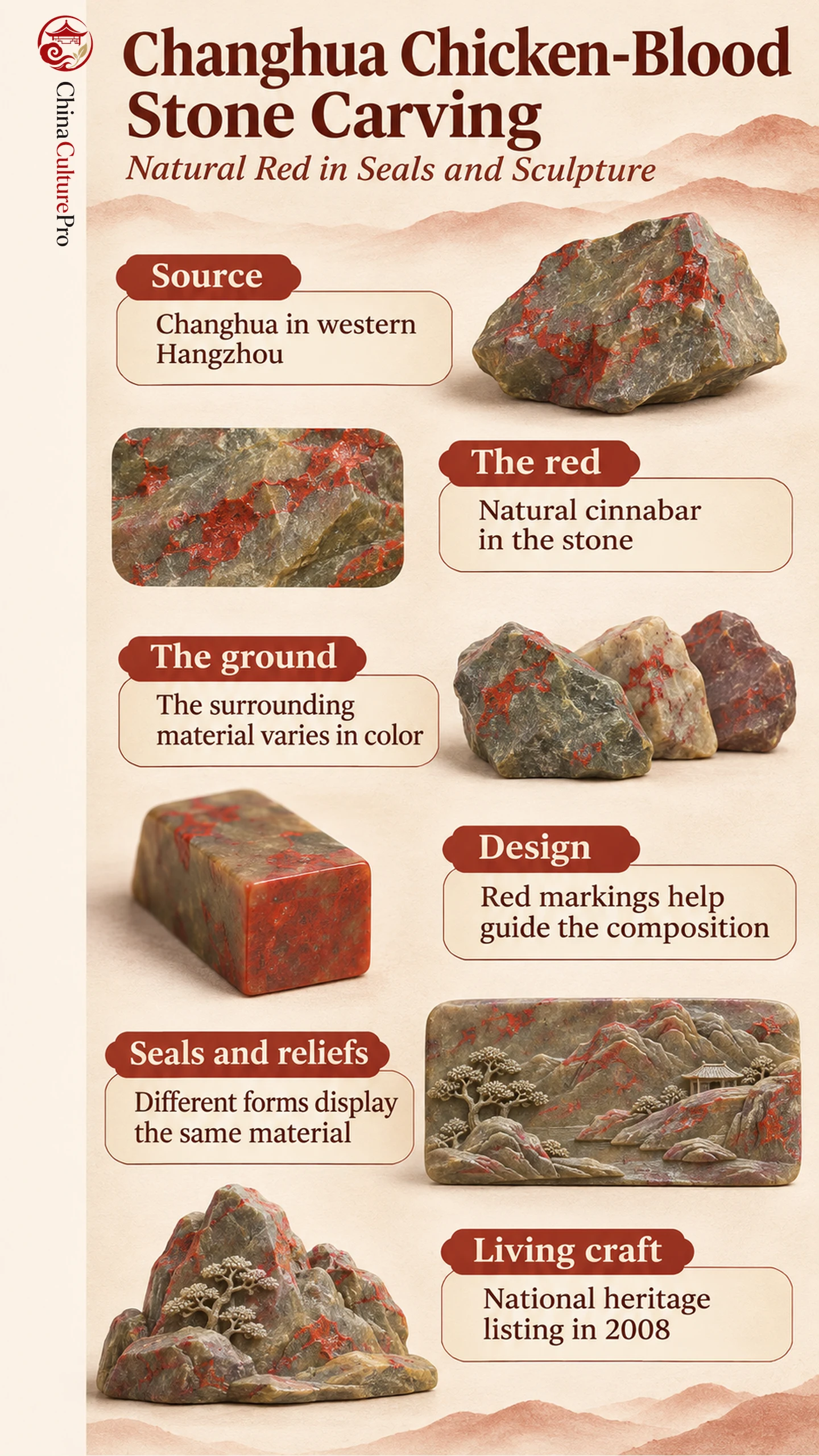
An engraved seal carries information on more than one surface. Its base supplies the impression. The sides may carry an inscription, as well as color that was already present in the stone.
Where the Red Comes From
In specimens studied by Wang Fuquan and Guo Jingfeng, red cinnabar occurs within a fine-grained mixture that includes clay minerals such as dickite and kaolinite, along with quartz. The red can form spots, streaks or larger patches. The base material around those marks also varies in color. A pale ground and a dark ground can frame the same shade of red very differently. [2]
The similar English name bloodstone can refer to heliotrope, usually a dark green chalcedony with red iron oxide inclusions. Changhua’s red comes from cinnabar, a mercury sulfide mineral. Museum conservation guidance treats the form of a mercury-bearing material as important. A finished object and loose mineral dust present different handling questions. [2][3][8][9]
How the Stone Guides the Design
A national heritage exhibition account describes design-led carving (巧雕, qiǎodiāo) as adapting the form to bring out the red. A carver may first consider how much red the piece has and where it meets the ground color. A red patch can act as a point of emphasis in a scene. If the color lies in a broad streak, the maker can leave part of the surface intact and arrange the carved design around it. [2][4]
Relief raises a design above the surrounding surface, while carving in the round gives a piece a form on every side. Shallow relief can leave more of a colored surface in view. The heritage account describes leaving some areas intact so the material helps carry the design. This is one approach within the wider practice of Chinese stone carving. [1][4]
What a Changhua Seal Can Show
The National Palace Museum in Taipei catalogs a Changhua seal inscribed for Tan Yankai. The seal is 6.1 centimeters high, and the museum describes its body as gray-green with small ocher and pale patches. Its face carries four characters in seal script. An inscription on the side records that Li Yinsang cut the seal at the request of Zu’an. The museum pairs it with a companion seal whose face bears that name. [5]
The seal makes the distinction between its parts visible. The face made an impression, the side inscription gives information about the commission, and the material forms the body that one sees and holds. A Qing seal in the National Museum of History belongs to a pair. The museum’s record cites a Zhejiang gazetteer compiled during the Qianlong reign that describes Changhua seal stone with red markings. Both objects put the material into the history of Chinese seal carving. [5][6]
How the Changhua Craft Is Passed On
China’s national register added chicken-blood stone carving in 2008 under stone carving, with the Changhua tradition represented by Lin’an in Zhejiang. The register names Qian Gaochao (钱高潮, Qián Gāocháo) as a representative practitioner. He learned from his father and later studied sculpture at the China Academy of Art. A national heritage profile records his return home and establishment of a stone-carving factory in 1985. [1][4][7]
The heritage exhibition profiles work he made in both seal and sculptural forms. The exhibition lists both pictorial works and seals among his pieces. A pictorial carving can make a red area part of the subject. On a seal, a colored area may remain visible in the body above the engraved face. [4][5][7]
FAQs About Changhua Chicken-Blood Stone Carving
Why is it called chicken-blood stone?
The name refers to the bright red appearance of some patches. Cinnabar is the mineral that gives Changhua chicken-blood stone this color. [1][2]
How does it differ from the gemstone bloodstone?
The red in Changhua chicken-blood stone comes from cinnabar. In heliotrope, the variety often called bloodstone in gemology, red flecks are associated with iron oxides in chalcedony. [2][3]
What can a seal’s inscription tell you?
An engraving on the base can name the owner or state a phrase to stamp. An inscription on the side can give additional information, such as who carved the seal for its owner. [5][6]
Sources
[1] China Intangible Cultural Heritage Digital Museum. Stone Carving: Chicken-Blood Stone Carving
[2] Wang Fuquan and Guo Jingfeng, Gems & Gemology. Chicken-Blood Stone from China
[3] Gemological Institute of America. March Birthstones: Bloodstone
[4] China Intangible Cultural Heritage Digital Museum. Master Craftsmanship: Chicken-Blood Stone Carving
[5] National Palace Museum, Taipei. Chicken-Blood Stone Seal with the Inscription Tan Yankai yin
[6] National Museum of History via Taiwan Cultural Memory Bank. Pair of Chicken-Blood Stone Seals
[7] China Intangible Cultural Heritage Digital Museum. Representative Practitioner: Qian Gaochao
[8] Museum Wales. Cinnabar Mineral Record
[9] Museum of Archaeology and Anthropology, University of Cambridge. Heavy Metals in Museum Collections